AI for Software Development Teams: The Complete Guide to Building More Productive Engineering Organizations

AI for Software Development Teams: The Complete Guide to Building More Productive Engineering Organizations

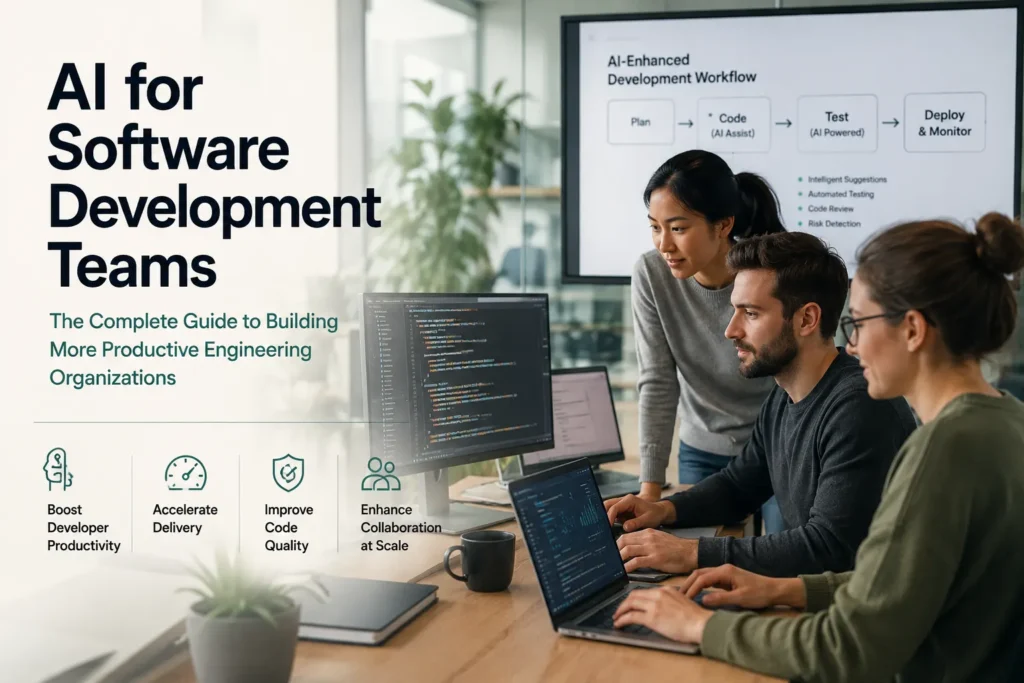
A team of software developers collaborates in a modern office using AI-assisted development tools, with code displayed on multiple screens to represent AI-powered software engineering workflows.
Discover how AI is transforming software development by improving productivity, accelerating delivery, and enhancing software quality. Learn the strategies, tools, and best practices engineering leaders need to successfully adopt AI across modern development teams.
Share the Post:

Artificial intelligence is no longer a future trend for software engineering. It has become an everyday productivity tool that is changing how engineering organizations write code, test applications, review pull requests, manage technical debt, and deliver software.

Today, organizations of every size are exploring how AI for software development teams can accelerate development without compromising quality. From startups looking to release products faster to enterprise engineering departments managing hundreds of developers, AI has become a strategic capability rather than an experimental technology.

The rapid adoption of AI coding assistants, intelligent testing platforms, automated documentation tools, and machine learning-powered DevOps solutions is reshaping the entire software development lifecycle. Engineering leaders are no longer asking whether artificial intelligence belongs in software development, they are determining where it creates the greatest business value.

However, successful adoption goes far beyond purchasing an AI tool. Organizations need clear implementation strategies, governance, security policies, developer enablement, and workflow integration to maximize engineering productivity while maintaining software quality.

In this comprehensive guide, you’ll learn how AI is transforming software development teams, where it delivers measurable business outcomes, which tools provide the greatest value, how companies implement AI in engineering teams, and the practical steps required to build an effective AI adoption strategy for software teams.

Whether you’re a CTO, VP of Engineering, Engineering Manager, Founder, or technology executive evaluating the next stage of your engineering organization, this guide will help you make informed decisions about integrating artificial intelligence into your development workflows.

What Is AI for Software Development Teams?

AI for software development teams refers to the use of artificial intelligence technologies to enhance every stage of software engineering, from planning and coding to testing, deployment, monitoring, and long-term maintenance.

Unlike traditional automation, which relies on predefined rules, AI systems analyze patterns, understand context, generate recommendations, and assist developers in making better technical decisions. Modern AI solutions are powered by large language models (LLMs), machine learning algorithms, and specialized engineering tools capable of understanding programming languages, software architecture, documentation, and business requirements.

Today’s engineering teams use AI to:

  • Generate production-ready code.
  • Explain unfamiliar codebases.
  • Review pull requests.
  • Detect security vulnerabilities.
  • Generate automated tests.
  • Improve technical documentation.
  • Accelerate debugging.
  • Optimize DevOps workflows.
  • Estimate development effort.
  • Reduce repetitive engineering work.

Rather than replacing software engineers, AI acts as an intelligent collaborator that allows developers to focus on higher-value activities such as architecture, product design, innovation, and solving complex business problems.

This shift represents one of the most significant changes in software engineering since the adoption of Agile development and cloud computing.

Why AI Is Reshaping Modern Engineering Organizations

Software development has always been constrained by three competing priorities:

  • Deliver software faster.
  • Maintain high quality.
  • Control engineering costs.

Historically, improving one area often required sacrificing another. Accelerating releases increased technical debt. Expanding engineering teams raised operational costs. Increasing testing slowed delivery.

Artificial intelligence is beginning to change this equation.

Instead of simply automating repetitive tasks, AI augments engineers throughout their daily work, enabling faster decision-making and reducing the time spent on low-value activities.

Industry studies consistently show that developers spend surprisingly little of their day writing new application code. Much of their time is dedicated to:

Engineering ActivityTypical Time Allocation
Reading existing codeHigh
Debugging issuesHigh
Writing documentationModerate
Code reviewsModerate
Meetings and collaborationModerate
Writing new featuresLower than many expect

By reducing friction in these supporting activities, AI engineering productivity improvements can significantly increase the overall output of software teams without requiring proportional increases in headcount.

For engineering leaders, this creates opportunities to:

  • Deliver products faster.
  • Reduce development bottlenecks.
  • Improve developer satisfaction.
  • Shorten onboarding for new engineers.
  • Improve software quality.
  • Increase engineering efficiency across distributed teams.

These improvements explain why AI has become a board-level discussion rather than simply another developer tool.

The Current State of AI Adoption in Software Development

Over the past two years, AI has evolved from isolated experimentation to widespread adoption across engineering organizations.

Instead of limiting AI to innovation teams, companies are embedding it directly into everyday software development workflows. Developers increasingly rely on AI coding assistants, while QA teams use AI-powered testing tools and DevOps engineers automate infrastructure management through intelligent platforms.

Several factors are driving this shift:

Increasing Developer Demand

Software engineers themselves are embracing AI because it removes repetitive work and accelerates common development tasks.

Many developers now use AI to:

  • Generate boilerplate code.
  • Refactor legacy applications.
  • Explain unfamiliar frameworks.
  • Produce unit tests.
  • Write SQL queries.
  • Create API documentation.
  • Troubleshoot runtime errors.

As AI becomes integrated into IDEs and development environments, using intelligent assistants is becoming as natural as using autocomplete or version control.

Rising Business Expectations

Business leaders expect engineering organizations to deliver software faster while managing budgets more efficiently.

This pressure has intensified due to:

  • Increasing competition.
  • Higher customer expectations.
  • Shorter product release cycles.
  • Limited availability of senior engineering talent.
  • Growing software complexity.

Artificial intelligence provides a practical way to improve engineering throughput without scaling headcount at the same pace.

For organizations already working with distributed or nearshore engineering teams, AI also helps standardize workflows, accelerate onboarding, and improve collaboration across multiple locations. This is especially important for companies evaluating how AI is impacting software outsourcing and distributed engineering models.

Maturing AI Ecosystems

The AI tooling landscape has expanded rapidly. Organizations can now choose specialized solutions tailored to nearly every stage of software development. To compare specific platforms, see our guide to the best AI tools for software engineering teams.

Examples include:

Engineering FunctionAI Applications
CodingIntelligent code generation and completion
TestingAutomated test creation and maintenance
DevOpsInfrastructure optimization and deployment assistance
DocumentationAutomatic technical documentation generation
SecurityVulnerability detection and code analysis
Project ManagementSprint planning and requirement summarization
MonitoringIncident analysis and root cause identification

Rather than replacing existing engineering platforms, these tools integrate with GitHub, GitLab, Jira, Azure DevOps, AWS, Google Cloud, and other widely adopted development ecosystems.

Benefits of AI in Software Engineering

Engineering leaders evaluating artificial intelligence often ask a simple question:

Where does the business value actually come from?

The answer extends far beyond faster code generation.

The benefits of AI in software engineering span productivity, quality, operational efficiency, collaboration, and long-term scalability.

Faster Software Delivery

One of the most visible outcomes of AI adoption is shorter development cycles.

Developers spend less time on repetitive implementation work and more time solving business problems.

AI accelerates:

  • Feature development.
  • Bug fixes.
  • Test creation.
  • Documentation.
  • Code reviews.
  • API integration.
  • Refactoring.

This enables engineering organizations to ship software more frequently without proportionally increasing engineering headcount.

Improved Code Quality

AI-powered development tools continuously analyze code for:

  • Bugs.
  • Security vulnerabilities.
  • Performance issues.
  • Maintainability concerns.
  • Coding standard violations.

Instead of identifying issues late in the development lifecycle, teams receive immediate feedback while code is still being written.

This reduces rework and improves overall software reliability.

Better Knowledge Sharing

One of the biggest challenges facing growing engineering organizations is knowledge concentration.

Senior developers often become bottlenecks because they possess critical institutional knowledge.

AI helps democratize expertise by:

  • Explaining legacy systems.
  • Summarizing architecture.
  • Answering technical questions.
  • Generating onboarding documentation.
  • Translating complex code into understandable language.

New developers become productive much faster, reducing onboarding time and improving collaboration across engineering teams.

Increased Engineering Efficiency

Engineering efficiency is no longer measured solely by lines of code or sprint velocity.

Modern organizations evaluate:

  • Cycle time.
  • Deployment frequency.
  • Change failure rate.
  • Lead time for changes.
  • Developer satisfaction.
  • Time spent on value-generating work.

AI contributes positively across each of these metrics by eliminating repetitive manual tasks and allowing engineers to focus on higher-impact initiatives.

For companies scaling distributed engineering organizations, these gains compound over time, creating measurable improvements in productivity without sacrificing software quality.

Where AI Fits Across the Software Development Lifecycle

Artificial intelligence is no longer confined to writing code. Today, organizations are embedding AI across the entire software development lifecycle (SDLC), creating measurable improvements in speed, quality, collaboration, and operational efficiency.

Engineering leaders who view AI as simply another coding assistant often miss its greatest opportunity: optimizing every phase of software delivery.

The table below illustrates how AI supports each stage of the SDLC.

SDLC PhaseHow AI HelpsBusiness Impact
Requirements GatheringSummarizes meetings, generates user stories, identifies missing requirementsBetter project alignment
Architecture & DesignSuggests system designs, diagrams, technology choicesFaster technical planning
DevelopmentGenerates code, explains APIs, refactors legacy codeHigher developer productivity
TestingCreates test cases, automates regression tests, analyzes failuresImproved software quality
Code ReviewDetects bugs, security issues, coding standard violationsFewer production defects
DeploymentAssists CI/CD pipelines and release validationFaster releases
MonitoringIdentifies anomalies and probable root causesReduced downtime
MaintenanceExplains legacy systems and recommends improvementsLower technical debt

Instead of treating AI as a standalone tool, high-performing engineering organizations integrate it into their existing workflows, enabling continuous assistance throughout the development process.

AI Coding Assistants and Developer Productivity

The rapid adoption of AI coding assistants represents one of the most significant changes in software engineering in decades.

Modern AI assistants do far more than autocomplete code. They understand project context, programming languages, architectural patterns, documentation, and even business requirements.

Popular capabilities include:

  • Generating new features.
  • Creating REST APIs.
  • Writing SQL queries.
  • Producing unit tests.
  • Refactoring legacy applications.
  • Explaining unfamiliar code.
  • Translating code between languages.
  • Creating documentation.
  • Detecting potential bugs before execution.

Rather than replacing developers, these assistants reduce repetitive work and allow engineers to focus on architecture, product decisions, and solving complex technical challenges.

Common AI Coding Assistants

Several AI platforms have emerged as leaders for software development teams.

ToolPrimary StrengthBest For
GitHub CopilotReal-time code completionGeneral software development
ChatGPTArchitecture discussions, debugging, documentationIndividual developers and teams
ClaudeLong-context code analysisLarge codebases
Amazon Q DeveloperAWS-native developmentCloud engineering
Gemini Code AssistGoogle Cloud ecosystemEnterprise development
CursorAI-first development environmentModern engineering teams

Each solution offers different strengths, and many engineering organizations combine multiple tools depending on project requirements.

The most successful implementations establish clear guidelines around:

  • Security.
  • Intellectual property.
  • Data privacy.
  • Code validation.
  • Human review.

AI-generated code should always undergo the same engineering standards applied to manually written software.

How AI Improves Software Testing and Quality Assurance

Software testing has traditionally required significant manual effort, making it an ideal candidate for AI-driven automation.

Today, artificial intelligence is transforming quality assurance by reducing repetitive testing activities while improving coverage and defect detection.

Instead of replacing QA engineers, AI enables them to focus on exploratory testing, risk analysis, and overall quality strategy. For a deeper look at this shift, read our guide: Will AI Replace QA Engineers?

AI-powered testing platforms can:

  • Generate test cases automatically.
  • Create regression suites.
  • Detect UI changes.
  • Recommend edge cases.
  • Analyze failed test executions.
  • Prioritize high-risk tests.
  • Predict defect-prone areas.
  • Generate test documentation.

AI Across Different Testing Types

Testing AreaAI Contribution
Functional TestingGenerates test scenarios from requirements
Regression TestingSelects the most relevant tests to execute
API TestingGenerates API requests and validations
UI TestingSelf-healing locators and visual comparison
Performance TestingPredicts bottlenecks using historical data
Security TestingDetects vulnerable code patterns
Accessibility TestingIdentifies WCAG compliance issues

Organizations that integrate AI into QA workflows often experience faster release cycles because testing becomes more adaptive and less dependent on manually maintained scripts. We explain this in more detail in our article on how AI is changing QA automation.

For companies scaling distributed QA teams, AI also helps standardize testing practices across multiple engineering groups and geographic locations.

AI in DevOps and Platform Engineering

Artificial intelligence is increasingly becoming a valuable capability within DevOps environments.

Traditional DevOps focuses on automation, while AI introduces intelligent decision-making into operational workflows.

Instead of executing predefined scripts, AI systems analyze telemetry, logs, metrics, and deployment histories to identify patterns humans might overlook.

Examples include:

  • Predicting deployment failures.
  • Detecting infrastructure anomalies.
  • Optimizing cloud resource utilization.
  • Recommending infrastructure changes.
  • Summarizing production incidents.
  • Accelerating root cause analysis.
  • Improving incident response.

This evolution enables platform engineering teams to spend less time reacting to operational issues and more time improving system reliability.

AI-Powered DevOps Use Cases

Modern engineering organizations increasingly leverage AI for:

  • CI/CD pipeline optimization.
  • Kubernetes troubleshooting.
  • Log analysis.
  • Infrastructure as Code validation.
  • Release risk assessment.
  • Capacity planning.
  • Cloud cost optimization.
  • Automated runbook generation.

Rather than replacing DevOps engineers, AI helps eliminate repetitive operational work while improving platform resilience.

AI for Engineering Managers and Technical Leaders

The impact of artificial intelligence extends well beyond individual developers.

Engineering managers, directors, and CTOs are using AI to make better decisions, improve visibility across projects, and optimize engineering performance.

Examples include:

  • Sprint planning assistance.
  • Engineering metrics analysis.
  • Risk identification.
  • Technical documentation summaries.
  • Meeting transcription.
  • Roadmap generation.
  • Hiring support.
  • Performance reporting.

Instead of manually consolidating information from Jira, GitHub, Slack, and project documentation, AI can aggregate insights into actionable recommendations.

This allows technical leaders to spend more time coaching teams, improving engineering culture, and aligning technology initiatives with business objectives.

Engineering Metrics AI Can Improve

MetricAI Contribution
Sprint PredictabilityBetter estimation support
Lead TimeFaster development workflows
Deployment FrequencyIncreased automation
Defect Escape RateEarlier issue detection
Mean Time to ResolutionFaster incident analysis
Documentation CoverageAutomated documentation generation
Developer OnboardingAI-assisted knowledge sharing

Organizations implementing AI successfully often find that the greatest productivity improvements occur at the team level rather than solely through individual developer gains.

How Companies Implement AI in Engineering Teams

One of the most common misconceptions is that AI adoption begins with selecting a tool.

In reality, successful organizations begin by identifying business problems rather than technologies. For companies that lack internal AI expertise, AI development team augmentation can help bring in specialized engineers faster.

The most effective AI adoption strategy for software teams typically follows a phased approach.

Phase 1: Identify High-Value Opportunities

Start by evaluating repetitive engineering activities.

Examples include:

  • Manual documentation.
  • Regression testing.
  • Code reviews.
  • Debugging repetitive issues.
  • Technical knowledge sharing.
  • Pull request summaries.

These activities often deliver quick productivity wins while requiring relatively little organizational change.

Phase 2: Establish Governance

Engineering organizations should define clear policies covering:

  • Acceptable AI usage.
  • Confidential data handling.
  • Intellectual property.
  • Security reviews.
  • Human approval requirements.
  • Compliance expectations.

Governance becomes increasingly important as AI usage expands across multiple engineering teams.

Phase 3: Pilot With Small Teams

Rather than deploying AI across the entire organization immediately, many companies begin with one or two engineering teams.

Pilot programs help evaluate:

  • Productivity improvements.
  • Developer satisfaction.
  • Workflow integration.
  • Security considerations.
  • ROI.

Lessons learned during these pilots inform broader implementation strategies.

Phase 4: Integrate AI Into Existing Workflows

Successful organizations avoid forcing developers to adopt entirely new processes.

Instead, they embed AI into familiar platforms such as:

  • IDEs.
  • GitHub.
  • GitLab.
  • Jira.
  • Azure DevOps.
  • Slack.
  • Confluence.

The goal is to make AI feel like a natural extension of existing development workflows rather than an additional task.

Phase 5: Measure Outcomes

AI initiatives should be evaluated using measurable engineering outcomes instead of anecdotal feedback.

Common KPIs include:

  • Cycle time.
  • Deployment frequency.
  • Developer satisfaction.
  • Defect rates.
  • Pull request turnaround.
  • Onboarding duration.
  • Engineering capacity.

Tracking these metrics helps leadership determine whether AI investments are delivering sustainable business value rather than short-term enthusiasm. Teams trying to scale efficiently can also explore how to build an AI engineering team without increasing costs.

This approach aligns with the latest Google Cloud DORA research, which recommends measuring AI adoption through engineering outcomes and organizational capabilities rather than usage alone.

Building an AI Adoption Strategy for Software Teams

While the technology behind AI evolves rapidly, successful adoption follows a consistent pattern. Organizations that achieve the greatest return on investment treat AI as a long-term engineering capability rather than a one-time software purchase.

An effective AI adoption strategy for software teams should balance innovation with governance, ensuring developers have the flexibility to experiment while maintaining security, quality, and compliance.

A practical framework includes the following steps:

  1. Define clear business objectives before selecting AI tools.
  2. Prioritize high-impact use cases that solve real engineering challenges.
  3. Establish governance policies for AI usage and data security.
  4. Train developers on effective prompt engineering and AI best practices.
  5. Integrate AI into existing workflows instead of creating parallel processes.
  6. Continuously measure productivity gains and adjust the strategy over time.

Organizations that approach AI strategically are more likely to see sustained improvements in engineering efficiency and software quality than those adopting tools without a clear roadmap.

Common Challenges and Risks of AI Adoption

Despite its advantages, implementing AI in engineering teams introduces new challenges that technical leaders must address proactively.

Security and Data Privacy

Many AI platforms process prompts in cloud environments. Without clear policies, developers may inadvertently expose proprietary code, customer data, or confidential business information.

Organizations should establish guidelines regarding:

  • Sensitive data handling.
  • Approved AI platforms.
  • Enterprise licensing.
  • Source code confidentiality.
  • Compliance requirements.
  • Access controls.

Code Quality

AI-generated code can accelerate development, but it is not inherently production-ready.

Generated code may:

  • Introduce security vulnerabilities.
  • Ignore architectural standards.
  • Duplicate existing functionality.
  • Increase technical debt.
  • Produce inefficient implementations.

Human review remains essential. AI should enhance engineering judgment, not replace it.

Overreliance on AI

One of the greatest risks is allowing developers to accept AI-generated solutions without understanding how they work.

Engineering excellence still depends on critical thinking, architecture knowledge, debugging skills, and software design principles.

Organizations should encourage developers to use AI as a collaborative assistant rather than an unquestioned authority.

Change Management

Technology adoption often succeeds or fails based on people rather than software.

Engineering leaders should communicate:

  • Why AI is being introduced.
  • How it benefits developers.
  • What expectations exist.
  • Which workflows will change.
  • How success will be measured.

Transparent communication helps reduce resistance and encourages responsible adoption across engineering teams.

Best Practices for Integrating AI into Development Workflows

Organizations looking to maximize the benefits of AI in software engineering should follow several proven best practices.

Start With Repetitive Tasks

The fastest wins typically come from automating repetitive activities such as:

  • Documentation.
  • Unit test generation.
  • Code reviews.
  • Bug analysis.
  • Meeting summaries.
  • Sprint planning support.

These tasks allow teams to experience measurable productivity improvements while building confidence in AI tools.

Maintain Human Oversight

Every AI-generated recommendation should be validated by experienced engineers before entering production.

Human review ensures:

  • Code quality.
  • Architectural consistency.
  • Security compliance.
  • Business alignment.
  • Maintainability.

The goal is augmented intelligence, not autonomous software development.

Invest in Developer Education

AI literacy is becoming a core engineering skill.

Training should cover:

  • Prompt engineering.
  • AI limitations.
  • Responsible usage.
  • Security practices.
  • Tool selection.
  • Workflow integration.

Organizations that invest in education typically achieve higher adoption rates and better engineering outcomes.

Measure What Matters

Rather than tracking AI usage alone, focus on business outcomes.

Recommended metrics include:

KPIDesired Outcome
Cycle TimeReduced
Deployment FrequencyIncreased
Production DefectsReduced
Developer SatisfactionIncreased
Lead Time for ChangesReduced
Code Review DurationReduced
Onboarding TimeReduced

These metrics provide a clearer picture of whether AI is delivering meaningful value.

AI Is Most Effective When Combined With Strong Engineering Practices

Artificial intelligence can significantly improve software development workflows, but it cannot compensate for weak engineering fundamentals.

Organizations with mature development processes often see the greatest benefits because AI amplifies existing best practices rather than replacing them.

Successful engineering teams continue to rely on:

  • Agile planning.
  • Well-defined coding standards.
  • Automated testing.
  • CI/CD pipelines.
  • Effective code reviews.
  • Strong documentation.
  • Continuous learning.

AI becomes another layer of acceleration within an already healthy engineering culture. This is why leaders should understand the difference between AI vs traditional software development before changing their delivery model. Recent findings from Microsoft Research also suggest that organizations see the greatest value from AI when adoption is supported by strong engineering practices, team culture, and developer enablement rather than tools alone.

For companies building distributed or nearshore teams, combining experienced software engineers with modern AI capabilities creates an opportunity to increase delivery speed while maintaining high standards of quality, collaboration, and scalability.

Whether organizations are expanding internal engineering departments or augmenting existing teams with external talent, AI works best when integrated into disciplined software development practices.

Conclusion

Artificial intelligence is fundamentally changing how modern software is designed, built, tested, and maintained.

The conversation has shifted from whether AI belongs in software engineering to how organizations can implement it responsibly and effectively.

Companies that embrace AI for software development teams are improving engineering productivity, accelerating delivery, enhancing software quality, and enabling developers to focus on solving higher-value business problems rather than repetitive technical tasks.

However, long-term success depends on more than selecting the latest AI tool. It requires a thoughtful adoption strategy, clear governance, developer education, and continuous measurement of engineering outcomes.

Organizations that combine experienced engineering talent with intelligent AI workflows are positioning themselves to innovate faster while maintaining the quality and reliability that customers expect.

As AI capabilities continue to evolve, engineering leaders who invest in responsible adoption today will be better prepared to build scalable, high-performing software teams for the future.

If your organization is exploring how to scale engineering capacity, modernize development woOrganizations with mature development processesrkflows, or strengthen distributed software teams, partnering with experienced nearshore engineering professionals can help accelerate AI adoption while maintaining engineering excellence. Contact TechAID to learn how our experienced software engineers can support your technology initiatives.
Key Takeaways
  • AI boosts developer productivity by automating repetitive tasks like coding, testing, documentation, and code reviews, allowing engineers to focus on higher-value work.

  • Successful AI adoption requires strategy, including governance, security, developer training, and seamless integration into existing engineering workflows.

  • AI enhances, not replaces, software engineers, helping organizations deliver higher-quality software faster while improving collaboration and scalability.

  • Artificial intelligence is no longer a future trend for software engineering. It has become an everyday productivity tool that is changing how engineering organizations write code, test applications, review pull requests, manage technical debt, and deliver software.

    Today, organizations of every size are exploring how AI for software development teams can accelerate development without compromising quality. From startups looking to release products faster to enterprise engineering departments managing hundreds of developers, AI has become a strategic capability rather than an experimental technology.

    The rapid adoption of AI coding assistants, intelligent testing platforms, automated documentation tools, and machine learning-powered DevOps solutions is reshaping the entire software development lifecycle. Engineering leaders are no longer asking whether artificial intelligence belongs in software development, they are determining where it creates the greatest business value.

    However, successful adoption goes far beyond purchasing an AI tool. Organizations need clear implementation strategies, governance, security policies, developer enablement, and workflow integration to maximize engineering productivity while maintaining software quality.

    In this comprehensive guide, you’ll learn how AI is transforming software development teams, where it delivers measurable business outcomes, which tools provide the greatest value, how companies implement AI in engineering teams, and the practical steps required to build an effective AI adoption strategy for software teams.

    Whether you’re a CTO, VP of Engineering, Engineering Manager, Founder, or technology executive evaluating the next stage of your engineering organization, this guide will help you make informed decisions about integrating artificial intelligence into your development workflows.

    What Is AI for Software Development Teams?

    AI for software development teams refers to the use of artificial intelligence technologies to enhance every stage of software engineering, from planning and coding to testing, deployment, monitoring, and long-term maintenance.

    Unlike traditional automation, which relies on predefined rules, AI systems analyze patterns, understand context, generate recommendations, and assist developers in making better technical decisions. Modern AI solutions are powered by large language models (LLMs), machine learning algorithms, and specialized engineering tools capable of understanding programming languages, software architecture, documentation, and business requirements.

    Today’s engineering teams use AI to:

    • Generate production-ready code.
    • Explain unfamiliar codebases.
    • Review pull requests.
    • Detect security vulnerabilities.
    • Generate automated tests.
    • Improve technical documentation.
    • Accelerate debugging.
    • Optimize DevOps workflows.
    • Estimate development effort.
    • Reduce repetitive engineering work.

    Rather than replacing software engineers, AI acts as an intelligent collaborator that allows developers to focus on higher-value activities such as architecture, product design, innovation, and solving complex business problems.

    This shift represents one of the most significant changes in software engineering since the adoption of Agile development and cloud computing.

    Why AI Is Reshaping Modern Engineering Organizations

    Software development has always been constrained by three competing priorities:

    • Deliver software faster.
    • Maintain high quality.
    • Control engineering costs.

    Historically, improving one area often required sacrificing another. Accelerating releases increased technical debt. Expanding engineering teams raised operational costs. Increasing testing slowed delivery.

    Artificial intelligence is beginning to change this equation.

    Instead of simply automating repetitive tasks, AI augments engineers throughout their daily work, enabling faster decision-making and reducing the time spent on low-value activities.

    Industry studies consistently show that developers spend surprisingly little of their day writing new application code. Much of their time is dedicated to:

    Engineering ActivityTypical Time Allocation
    Reading existing codeHigh
    Debugging issuesHigh
    Writing documentationModerate
    Code reviewsModerate
    Meetings and collaborationModerate
    Writing new featuresLower than many expect

    By reducing friction in these supporting activities, AI engineering productivity improvements can significantly increase the overall output of software teams without requiring proportional increases in headcount.

    For engineering leaders, this creates opportunities to:

    • Deliver products faster.
    • Reduce development bottlenecks.
    • Improve developer satisfaction.
    • Shorten onboarding for new engineers.
    • Improve software quality.
    • Increase engineering efficiency across distributed teams.

    These improvements explain why AI has become a board-level discussion rather than simply another developer tool.

    The Current State of AI Adoption in Software Development

    Over the past two years, AI has evolved from isolated experimentation to widespread adoption across engineering organizations.

    Instead of limiting AI to innovation teams, companies are embedding it directly into everyday software development workflows. Developers increasingly rely on AI coding assistants, while QA teams use AI-powered testing tools and DevOps engineers automate infrastructure management through intelligent platforms.

    Several factors are driving this shift:

    Increasing Developer Demand

    Software engineers themselves are embracing AI because it removes repetitive work and accelerates common development tasks.

    Many developers now use AI to:

    • Generate boilerplate code.
    • Refactor legacy applications.
    • Explain unfamiliar frameworks.
    • Produce unit tests.
    • Write SQL queries.
    • Create API documentation.
    • Troubleshoot runtime errors.

    As AI becomes integrated into IDEs and development environments, using intelligent assistants is becoming as natural as using autocomplete or version control.

    Rising Business Expectations

    Business leaders expect engineering organizations to deliver software faster while managing budgets more efficiently.

    This pressure has intensified due to:

    • Increasing competition.
    • Higher customer expectations.
    • Shorter product release cycles.
    • Limited availability of senior engineering talent.
    • Growing software complexity.

    Artificial intelligence provides a practical way to improve engineering throughput without scaling headcount at the same pace.

    For organizations already working with distributed or nearshore engineering teams, AI also helps standardize workflows, accelerate onboarding, and improve collaboration across multiple locations. This is especially important for companies evaluating how AI is impacting software outsourcing and distributed engineering models.

    Maturing AI Ecosystems

    The AI tooling landscape has expanded rapidly. Organizations can now choose specialized solutions tailored to nearly every stage of software development. To compare specific platforms, see our guide to the best AI tools for software engineering teams.

    Examples include:

    Engineering FunctionAI Applications
    CodingIntelligent code generation and completion
    TestingAutomated test creation and maintenance
    DevOpsInfrastructure optimization and deployment assistance
    DocumentationAutomatic technical documentation generation
    SecurityVulnerability detection and code analysis
    Project ManagementSprint planning and requirement summarization
    MonitoringIncident analysis and root cause identification

    Rather than replacing existing engineering platforms, these tools integrate with GitHub, GitLab, Jira, Azure DevOps, AWS, Google Cloud, and other widely adopted development ecosystems.

    Benefits of AI in Software Engineering

    Engineering leaders evaluating artificial intelligence often ask a simple question:

    Where does the business value actually come from?

    The answer extends far beyond faster code generation.

    The benefits of AI in software engineering span productivity, quality, operational efficiency, collaboration, and long-term scalability.

    Faster Software Delivery

    One of the most visible outcomes of AI adoption is shorter development cycles.

    Developers spend less time on repetitive implementation work and more time solving business problems.

    AI accelerates:

    • Feature development.
    • Bug fixes.
    • Test creation.
    • Documentation.
    • Code reviews.
    • API integration.
    • Refactoring.

    This enables engineering organizations to ship software more frequently without proportionally increasing engineering headcount.

    Improved Code Quality

    AI-powered development tools continuously analyze code for:

    • Bugs.
    • Security vulnerabilities.
    • Performance issues.
    • Maintainability concerns.
    • Coding standard violations.

    Instead of identifying issues late in the development lifecycle, teams receive immediate feedback while code is still being written.

    This reduces rework and improves overall software reliability.

    Better Knowledge Sharing

    One of the biggest challenges facing growing engineering organizations is knowledge concentration.

    Senior developers often become bottlenecks because they possess critical institutional knowledge.

    AI helps democratize expertise by:

    • Explaining legacy systems.
    • Summarizing architecture.
    • Answering technical questions.
    • Generating onboarding documentation.
    • Translating complex code into understandable language.

    New developers become productive much faster, reducing onboarding time and improving collaboration across engineering teams.

    Increased Engineering Efficiency

    Engineering efficiency is no longer measured solely by lines of code or sprint velocity.

    Modern organizations evaluate:

    • Cycle time.
    • Deployment frequency.
    • Change failure rate.
    • Lead time for changes.
    • Developer satisfaction.
    • Time spent on value-generating work.

    AI contributes positively across each of these metrics by eliminating repetitive manual tasks and allowing engineers to focus on higher-impact initiatives.

    For companies scaling distributed engineering organizations, these gains compound over time, creating measurable improvements in productivity without sacrificing software quality.

    Where AI Fits Across the Software Development Lifecycle

    Artificial intelligence is no longer confined to writing code. Today, organizations are embedding AI across the entire software development lifecycle (SDLC), creating measurable improvements in speed, quality, collaboration, and operational efficiency.

    Engineering leaders who view AI as simply another coding assistant often miss its greatest opportunity: optimizing every phase of software delivery.

    The table below illustrates how AI supports each stage of the SDLC.

    SDLC PhaseHow AI HelpsBusiness Impact
    Requirements GatheringSummarizes meetings, generates user stories, identifies missing requirementsBetter project alignment
    Architecture & DesignSuggests system designs, diagrams, technology choicesFaster technical planning
    DevelopmentGenerates code, explains APIs, refactors legacy codeHigher developer productivity
    TestingCreates test cases, automates regression tests, analyzes failuresImproved software quality
    Code ReviewDetects bugs, security issues, coding standard violationsFewer production defects
    DeploymentAssists CI/CD pipelines and release validationFaster releases
    MonitoringIdentifies anomalies and probable root causesReduced downtime
    MaintenanceExplains legacy systems and recommends improvementsLower technical debt

    Instead of treating AI as a standalone tool, high-performing engineering organizations integrate it into their existing workflows, enabling continuous assistance throughout the development process.

    AI Coding Assistants and Developer Productivity

    The rapid adoption of AI coding assistants represents one of the most significant changes in software engineering in decades.

    Modern AI assistants do far more than autocomplete code. They understand project context, programming languages, architectural patterns, documentation, and even business requirements.

    Popular capabilities include:

    • Generating new features.
    • Creating REST APIs.
    • Writing SQL queries.
    • Producing unit tests.
    • Refactoring legacy applications.
    • Explaining unfamiliar code.
    • Translating code between languages.
    • Creating documentation.
    • Detecting potential bugs before execution.

    Rather than replacing developers, these assistants reduce repetitive work and allow engineers to focus on architecture, product decisions, and solving complex technical challenges.

    Common AI Coding Assistants

    Several AI platforms have emerged as leaders for software development teams.

    ToolPrimary StrengthBest For
    GitHub CopilotReal-time code completionGeneral software development
    ChatGPTArchitecture discussions, debugging, documentationIndividual developers and teams
    ClaudeLong-context code analysisLarge codebases
    Amazon Q DeveloperAWS-native developmentCloud engineering
    Gemini Code AssistGoogle Cloud ecosystemEnterprise development
    CursorAI-first development environmentModern engineering teams

    Each solution offers different strengths, and many engineering organizations combine multiple tools depending on project requirements.

    The most successful implementations establish clear guidelines around:

    • Security.
    • Intellectual property.
    • Data privacy.
    • Code validation.
    • Human review.

    AI-generated code should always undergo the same engineering standards applied to manually written software.

    How AI Improves Software Testing and Quality Assurance

    Software testing has traditionally required significant manual effort, making it an ideal candidate for AI-driven automation.

    Today, artificial intelligence is transforming quality assurance by reducing repetitive testing activities while improving coverage and defect detection.

    Instead of replacing QA engineers, AI enables them to focus on exploratory testing, risk analysis, and overall quality strategy. For a deeper look at this shift, read our guide: Will AI Replace QA Engineers?

    AI-powered testing platforms can:

    • Generate test cases automatically.
    • Create regression suites.
    • Detect UI changes.
    • Recommend edge cases.
    • Analyze failed test executions.
    • Prioritize high-risk tests.
    • Predict defect-prone areas.
    • Generate test documentation.

    AI Across Different Testing Types

    Testing AreaAI Contribution
    Functional TestingGenerates test scenarios from requirements
    Regression TestingSelects the most relevant tests to execute
    API TestingGenerates API requests and validations
    UI TestingSelf-healing locators and visual comparison
    Performance TestingPredicts bottlenecks using historical data
    Security TestingDetects vulnerable code patterns
    Accessibility TestingIdentifies WCAG compliance issues

    Organizations that integrate AI into QA workflows often experience faster release cycles because testing becomes more adaptive and less dependent on manually maintained scripts. We explain this in more detail in our article on how AI is changing QA automation.

    For companies scaling distributed QA teams, AI also helps standardize testing practices across multiple engineering groups and geographic locations.

    AI in DevOps and Platform Engineering

    Artificial intelligence is increasingly becoming a valuable capability within DevOps environments.

    Traditional DevOps focuses on automation, while AI introduces intelligent decision-making into operational workflows.

    Instead of executing predefined scripts, AI systems analyze telemetry, logs, metrics, and deployment histories to identify patterns humans might overlook.

    Examples include:

    • Predicting deployment failures.
    • Detecting infrastructure anomalies.
    • Optimizing cloud resource utilization.
    • Recommending infrastructure changes.
    • Summarizing production incidents.
    • Accelerating root cause analysis.
    • Improving incident response.

    This evolution enables platform engineering teams to spend less time reacting to operational issues and more time improving system reliability.

    AI-Powered DevOps Use Cases

    Modern engineering organizations increasingly leverage AI for:

    • CI/CD pipeline optimization.
    • Kubernetes troubleshooting.
    • Log analysis.
    • Infrastructure as Code validation.
    • Release risk assessment.
    • Capacity planning.
    • Cloud cost optimization.
    • Automated runbook generation.

    Rather than replacing DevOps engineers, AI helps eliminate repetitive operational work while improving platform resilience.

    AI for Engineering Managers and Technical Leaders

    The impact of artificial intelligence extends well beyond individual developers.

    Engineering managers, directors, and CTOs are using AI to make better decisions, improve visibility across projects, and optimize engineering performance.

    Examples include:

    • Sprint planning assistance.
    • Engineering metrics analysis.
    • Risk identification.
    • Technical documentation summaries.
    • Meeting transcription.
    • Roadmap generation.
    • Hiring support.
    • Performance reporting.

    Instead of manually consolidating information from Jira, GitHub, Slack, and project documentation, AI can aggregate insights into actionable recommendations.

    This allows technical leaders to spend more time coaching teams, improving engineering culture, and aligning technology initiatives with business objectives.

    Engineering Metrics AI Can Improve

    MetricAI Contribution
    Sprint PredictabilityBetter estimation support
    Lead TimeFaster development workflows
    Deployment FrequencyIncreased automation
    Defect Escape RateEarlier issue detection
    Mean Time to ResolutionFaster incident analysis
    Documentation CoverageAutomated documentation generation
    Developer OnboardingAI-assisted knowledge sharing

    Organizations implementing AI successfully often find that the greatest productivity improvements occur at the team level rather than solely through individual developer gains.

    How Companies Implement AI in Engineering Teams

    One of the most common misconceptions is that AI adoption begins with selecting a tool.

    In reality, successful organizations begin by identifying business problems rather than technologies. For companies that lack internal AI expertise, AI development team augmentation can help bring in specialized engineers faster.

    The most effective AI adoption strategy for software teams typically follows a phased approach.

    Phase 1: Identify High-Value Opportunities

    Start by evaluating repetitive engineering activities.

    Examples include:

    • Manual documentation.
    • Regression testing.
    • Code reviews.
    • Debugging repetitive issues.
    • Technical knowledge sharing.
    • Pull request summaries.

    These activities often deliver quick productivity wins while requiring relatively little organizational change.

    Phase 2: Establish Governance

    Engineering organizations should define clear policies covering:

    • Acceptable AI usage.
    • Confidential data handling.
    • Intellectual property.
    • Security reviews.
    • Human approval requirements.
    • Compliance expectations.

    Governance becomes increasingly important as AI usage expands across multiple engineering teams.

    Phase 3: Pilot With Small Teams

    Rather than deploying AI across the entire organization immediately, many companies begin with one or two engineering teams.

    Pilot programs help evaluate:

    • Productivity improvements.
    • Developer satisfaction.
    • Workflow integration.
    • Security considerations.
    • ROI.

    Lessons learned during these pilots inform broader implementation strategies.

    Phase 4: Integrate AI Into Existing Workflows

    Successful organizations avoid forcing developers to adopt entirely new processes.

    Instead, they embed AI into familiar platforms such as:

    • IDEs.
    • GitHub.
    • GitLab.
    • Jira.
    • Azure DevOps.
    • Slack.
    • Confluence.

    The goal is to make AI feel like a natural extension of existing development workflows rather than an additional task.

    Phase 5: Measure Outcomes

    AI initiatives should be evaluated using measurable engineering outcomes instead of anecdotal feedback.

    Common KPIs include:

    • Cycle time.
    • Deployment frequency.
    • Developer satisfaction.
    • Defect rates.
    • Pull request turnaround.
    • Onboarding duration.
    • Engineering capacity.

    Tracking these metrics helps leadership determine whether AI investments are delivering sustainable business value rather than short-term enthusiasm. Teams trying to scale efficiently can also explore how to build an AI engineering team without increasing costs.

    This approach aligns with the latest Google Cloud DORA research, which recommends measuring AI adoption through engineering outcomes and organizational capabilities rather than usage alone.

    Building an AI Adoption Strategy for Software Teams

    While the technology behind AI evolves rapidly, successful adoption follows a consistent pattern. Organizations that achieve the greatest return on investment treat AI as a long-term engineering capability rather than a one-time software purchase.

    An effective AI adoption strategy for software teams should balance innovation with governance, ensuring developers have the flexibility to experiment while maintaining security, quality, and compliance.

    A practical framework includes the following steps:

    1. Define clear business objectives before selecting AI tools.
    2. Prioritize high-impact use cases that solve real engineering challenges.
    3. Establish governance policies for AI usage and data security.
    4. Train developers on effective prompt engineering and AI best practices.
    5. Integrate AI into existing workflows instead of creating parallel processes.
    6. Continuously measure productivity gains and adjust the strategy over time.

    Organizations that approach AI strategically are more likely to see sustained improvements in engineering efficiency and software quality than those adopting tools without a clear roadmap.

    Common Challenges and Risks of AI Adoption

    Despite its advantages, implementing AI in engineering teams introduces new challenges that technical leaders must address proactively.

    Security and Data Privacy

    Many AI platforms process prompts in cloud environments. Without clear policies, developers may inadvertently expose proprietary code, customer data, or confidential business information.

    Organizations should establish guidelines regarding:

    • Sensitive data handling.
    • Approved AI platforms.
    • Enterprise licensing.
    • Source code confidentiality.
    • Compliance requirements.
    • Access controls.

    Code Quality

    AI-generated code can accelerate development, but it is not inherently production-ready.

    Generated code may:

    • Introduce security vulnerabilities.
    • Ignore architectural standards.
    • Duplicate existing functionality.
    • Increase technical debt.
    • Produce inefficient implementations.

    Human review remains essential. AI should enhance engineering judgment, not replace it.

    Overreliance on AI

    One of the greatest risks is allowing developers to accept AI-generated solutions without understanding how they work.

    Engineering excellence still depends on critical thinking, architecture knowledge, debugging skills, and software design principles.

    Organizations should encourage developers to use AI as a collaborative assistant rather than an unquestioned authority.

    Change Management

    Technology adoption often succeeds or fails based on people rather than software.

    Engineering leaders should communicate:

    • Why AI is being introduced.
    • How it benefits developers.
    • What expectations exist.
    • Which workflows will change.
    • How success will be measured.

    Transparent communication helps reduce resistance and encourages responsible adoption across engineering teams.

    Best Practices for Integrating AI into Development Workflows

    Organizations looking to maximize the benefits of AI in software engineering should follow several proven best practices.

    Start With Repetitive Tasks

    The fastest wins typically come from automating repetitive activities such as:

    • Documentation.
    • Unit test generation.
    • Code reviews.
    • Bug analysis.
    • Meeting summaries.
    • Sprint planning support.

    These tasks allow teams to experience measurable productivity improvements while building confidence in AI tools.

    Maintain Human Oversight

    Every AI-generated recommendation should be validated by experienced engineers before entering production.

    Human review ensures:

    • Code quality.
    • Architectural consistency.
    • Security compliance.
    • Business alignment.
    • Maintainability.

    The goal is augmented intelligence, not autonomous software development.

    Invest in Developer Education

    AI literacy is becoming a core engineering skill.

    Training should cover:

    • Prompt engineering.
    • AI limitations.
    • Responsible usage.
    • Security practices.
    • Tool selection.
    • Workflow integration.

    Organizations that invest in education typically achieve higher adoption rates and better engineering outcomes.

    Measure What Matters

    Rather than tracking AI usage alone, focus on business outcomes.

    Recommended metrics include:

    KPIDesired Outcome
    Cycle TimeReduced
    Deployment FrequencyIncreased
    Production DefectsReduced
    Developer SatisfactionIncreased
    Lead Time for ChangesReduced
    Code Review DurationReduced
    Onboarding TimeReduced

    These metrics provide a clearer picture of whether AI is delivering meaningful value.

    AI Is Most Effective When Combined With Strong Engineering Practices

    Artificial intelligence can significantly improve software development workflows, but it cannot compensate for weak engineering fundamentals.

    Organizations with mature development processes often see the greatest benefits because AI amplifies existing best practices rather than replacing them.

    Successful engineering teams continue to rely on:

    • Agile planning.
    • Well-defined coding standards.
    • Automated testing.
    • CI/CD pipelines.
    • Effective code reviews.
    • Strong documentation.
    • Continuous learning.

    AI becomes another layer of acceleration within an already healthy engineering culture. This is why leaders should understand the difference between AI vs traditional software development before changing their delivery model. Recent findings from Microsoft Research also suggest that organizations see the greatest value from AI when adoption is supported by strong engineering practices, team culture, and developer enablement rather than tools alone.

    For companies building distributed or nearshore teams, combining experienced software engineers with modern AI capabilities creates an opportunity to increase delivery speed while maintaining high standards of quality, collaboration, and scalability.

    Whether organizations are expanding internal engineering departments or augmenting existing teams with external talent, AI works best when integrated into disciplined software development practices.

    Conclusion

    Artificial intelligence is fundamentally changing how modern software is designed, built, tested, and maintained.

    The conversation has shifted from whether AI belongs in software engineering to how organizations can implement it responsibly and effectively.

    Companies that embrace AI for software development teams are improving engineering productivity, accelerating delivery, enhancing software quality, and enabling developers to focus on solving higher-value business problems rather than repetitive technical tasks.

    However, long-term success depends on more than selecting the latest AI tool. It requires a thoughtful adoption strategy, clear governance, developer education, and continuous measurement of engineering outcomes.

    Organizations that combine experienced engineering talent with intelligent AI workflows are positioning themselves to innovate faster while maintaining the quality and reliability that customers expect.

    As AI capabilities continue to evolve, engineering leaders who invest in responsible adoption today will be better prepared to build scalable, high-performing software teams for the future.

    If your organization is exploring how to scale engineering capacity, modernize development woOrganizations with mature development processesrkflows, or strengthen distributed software teams, partnering with experienced nearshore engineering professionals can help accelerate AI adoption while maintaining engineering excellence. Contact TechAID to learn how our experienced software engineers can support your technology initiatives.
    Related Posts