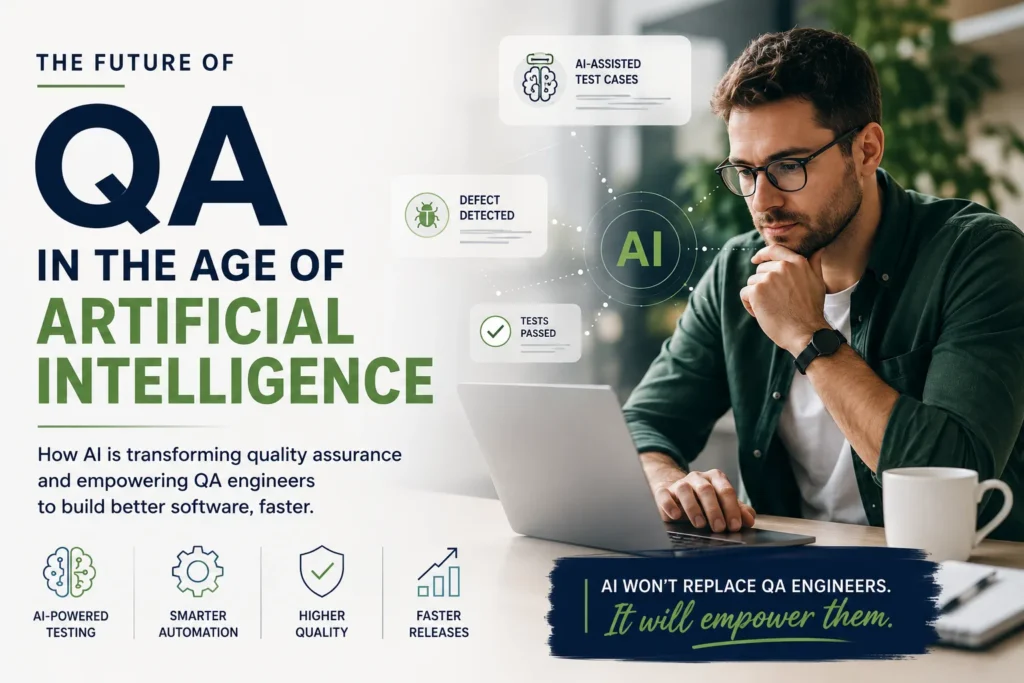
The Future of QA in the Age of Artificial Intelligence
The question will AI replace QA engineers has become one of the most debated topics in modern software development. As artificial intelligence continues transforming engineering workflows, companies are questioning whether AI-powered testing tools will eliminate the need for quality assurance professionals or redefine their responsibilities.
AI is already changing how teams approach software testing automation, from generating test cases to identifying potential defects and improving release cycles. However, the future of QA is not simply about humans versus machines. The biggest shift is toward collaboration between AI systems and skilled QA engineers.
For CTOs, Engineering Managers, and technology leaders scaling software teams, understanding the impact of AI on QA engineering careers is essential. Companies that adopt AI strategically can improve product quality, accelerate delivery, and create stronger engineering processes.
Why Everyone Is Asking If AI Will Replace QA Engineers
Artificial intelligence has moved from experimental technology to a practical tool used across software engineering teams. AI coding assistants, automated testing platforms, and machine learning-based quality solutions are helping organizations build and release software faster than ever.
This rapid adoption has created uncertainty among QA professionals.
Many teams are asking:
- Is AI replacing software testers?
- Can AI replace manual testing jobs?
- Will automation reduce the demand for QA engineers?
- What does the future of QA automation with AI look like?
The answer depends on how we define the QA engineer role.
If QA is viewed only as manually executing repetitive test cases, then AI and automation will continue replacing many of those tasks.
But quality assurance has always involved much more than running tests. QA engineers analyze requirements, understand user expectations, identify risks, validate business logic, and help teams prevent problems before software reaches customers.
AI can accelerate these activities, but it does not eliminate the need for human expertise.
The Evolution of Software Testing: From Manual QA to AI-Assisted Quality Engineering
Software testing has continuously evolved alongside development methodologies and technology trends.
The Manual Testing Era
Traditional QA processes depended heavily on manual execution.
Testers would:
- Review requirements
- Create test scenarios
- Execute test cases manually
- Document defects
- Verify fixes
- Support release decisions
This approach was effective but limited by time constraints and human capacity.
As applications became more complex, companies needed faster and more scalable approaches.
The Rise of Software Testing Automation
Software testing automation transformed how engineering teams approached quality.
Automation allowed organizations to:
- Run thousands of tests consistently
- Reduce repetitive work
- Improve regression testing
- Increase release frequency
- Support agile development cycles
Frameworks and tools helped QA teams move from manual execution toward automation engineering.
However, traditional automation also created challenges.
Automated tests often required constant maintenance. Small application changes could break large test suites, creating additional workload for QA teams.
The AI-Powered Testing Era
AI introduces a new stage of evolution.
Modern AI systems can help teams:
- Generate test cases
- Analyze application behavior
- Detect unusual patterns
- Predict possible defects
- Improve test coverage
- Recommend testing strategies
This has changed the conversation from “will AI replace QA engineers” to a more practical question:
“How can QA engineers use AI to become more effective?”
AI and QA Engineers: Replacement or Collaboration?
The debate around automation vs QA engineers future often assumes that AI and humans compete for the same role.
In reality, they solve different parts of the quality challenge.
AI is highly effective at repetitive, data-heavy activities.
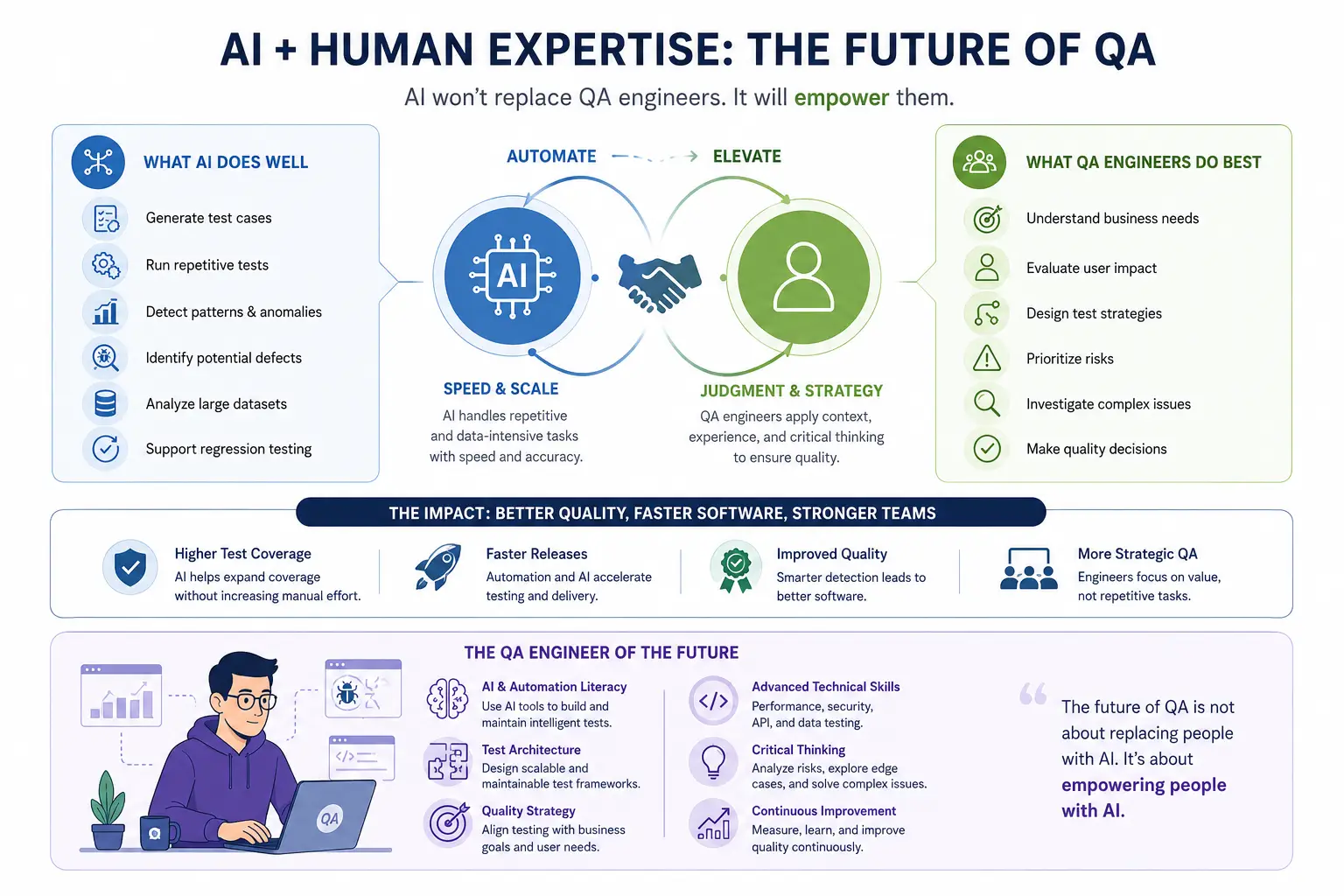
What AI Does Well
AI tools can assist with:
- Generating basic test scenarios
- Running automated checks
- Finding patterns in large datasets
- Identifying potential bugs
- Analyzing test results
- Supporting regression testing
These capabilities help teams reduce manual effort and increase speed.
What QA Engineers Still Provide
Human QA engineers remain essential for:
- Understanding business requirements
- Evaluating user impact
- Designing testing strategies
- Prioritizing risks
- Making quality decisions
- Investigating unexpected issues
A test failure does not always mean the same thing.
A QA engineer needs to determine:
- Is this a critical production risk?
- Does it impact customers?
- Should a release be delayed?
- Is the issue technical or related to business logic?
These decisions require context and experience.
The Impact of AI on QA Engineering Careers
The impact of AI on QA engineering careers is not that QA professionals disappear. Instead, the role is becoming more technical, strategic, and focused on engineering quality.
The QA engineer of the future will spend less time performing repetitive checks and more time building intelligent quality systems.
Emerging responsibilities include:
- AI-assisted automation
- Test architecture design
- Quality engineering strategy
- Performance testing
- Security validation
- Continuous improvement
This shift means QA professionals need to expand their skills.
The most valuable QA engineers will be those who understand both traditional testing principles and modern AI capabilities.
For companies building distributed engineering teams, this evolution creates new opportunities. Organizations can combine automation expertise, software engineering knowledge, and AI-driven testing approaches to create stronger development processes.
The future of QA is not about fewer engineers.
It is about engineers using better tools.
How AI Is Changing Testing Automation Strategies
AI is influencing several areas of modern testing automation strategies.
AI-Generated Test Cases
One of the most significant changes is AI-assisted test creation.
Instead of manually writing every possible scenario, AI tools can analyze:
- Application workflows
- User interactions
- Existing requirements
- Historical defects
and suggest potential test cases.
Benefits include:
- Faster test preparation
- Increased test coverage
- Discovery of overlooked scenarios
- Reduced repetitive work
However, human validation remains necessary.
Generated tests still need QA engineers to confirm they represent meaningful risks and real user behavior.
AI vs QA Engineers: What Can Actually Be Automated?
Understanding will ai replace qa engineers requires breaking down what parts of QA are truly automatable and which ones still depend on human judgment. The reality behind is ai replacing software testers is that automation is expanding, but not fully replacing QA responsibilities.
When it comes to automation frameworks, Selenium has long been one of the most widely adopted tools for browser-based testing. However, modern AI-powered testing platforms are beginning to complement and, in some cases, extend traditional automation approaches. You can review Selenium’s core capabilities and documentation here: https://www.selenium.dev/documentation/
What AI Can Automate Today
AI is already capable of handling several key QA functions within software testing automation workflows:
- Regression testing at scale
- UI test generation and execution
- Log analysis and anomaly detection
- Defect clustering and prioritization
- Visual testing comparisons
- Self-healing test scripts
These improvements are especially visible in modern automated testing tools AI platforms, which reduce maintenance overhead and increase testing speed.
AI is particularly strong in environments where patterns are predictable and requirements are well-defined.
What AI Cannot Replace
Despite progress in automation, AI still struggles with critical QA responsibilities:
- Understanding ambiguous product requirements
- Interpreting business context and user intent
- Exploratory testing based on intuition
- Evaluating user experience quality
- Making release decisions under uncertainty
This is where the long-tail concern can ai replace manual testing jobs becomes important. While manual execution is decreasing, strategic QA thinking is becoming more valuable.
AI lacks the ability to fully understand:
- Why a feature matters to a user
- How edge cases impact business outcomes
- Whether a “bug” is actually a design decision
The Future of QA Automation With AI
The future of qa automation with ai is shifting toward intelligent, adaptive systems rather than static test scripts.
From Script-Based Testing to AI-Driven Testing
Traditional automation relies on predefined rules:
- Click this button
- Validate this output
- Compare expected vs actual results
AI-based systems evolve beyond this by:
- Learning application behavior over time
- Identifying dynamic UI changes
- Adjusting test flows automatically
- Predicting failure points before execution
This evolution reduces reliance on brittle test frameworks like older selenium alternatives ai solutions are starting to replace or complement.
Self-Healing Test Systems
One of the most important innovations is self-healing automation.
When UI elements change, AI can:
- Detect structural changes
- Update selectors automatically
- Re-run impacted tests
- Reduce false failures
This significantly improves stability in CI/CD pipelines.
Predictive Quality Engineering
Instead of only detecting bugs, AI is starting to predict them.
By analyzing:
- Historical defect data
- Code changes
- Deployment patterns
AI can flag high-risk areas before release.
This shifts QA from reactive testing to proactive quality engineering.
Can AI Replace Manual Testing Jobs?
The question can ai replace manual testing jobs is often misunderstood.
What Is Actually Happening
Manual testing as repetitive execution is declining. However, manual testing as a cognitive activity is evolving.
Tasks being reduced:
- Repetitive UI checks
- Basic regression testing
- Repeated validation scenarios
Tasks becoming more important:
- Exploratory testing
- User journey validation
- Real-world edge case discovery
- Usability and UX validation
The Real Shift in QA Roles
Instead of replacing QA engineers, AI is reshaping the role into:
- QA Automation Engineer
- Quality Engineering Specialist
- AI-assisted Testing Strategist
- Software Quality Analyst
The qa engineer future jobs landscape is becoming more technical and hybrid.
How QA Engineers Can Adapt to AI
To stay relevant in an AI-driven environment, QA professionals must evolve their skill sets.
1. Learn Automation Beyond UI Testing
Modern QA engineers must understand:
- API testing
- Backend validation
- Integration testing
- CI/CD pipelines
2. Work With AI Testing Tools
Familiarity with automated testing tools AI platforms is becoming essential, including:
- AI-based test generation tools
- Visual testing systems
- Intelligent debugging platforms
3. Strengthen Analytical Thinking
AI handles execution, but humans handle decisions.
Strong QA engineers focus on:
- Risk analysis
- Test strategy design
- Root cause investigation
4. Understand System Architecture
QA is becoming closer to engineering.
Understanding microservices, cloud systems, and distributed architectures is now critical.
The Future Role of QA Engineers in Software Teams
The role of QA is shifting from execution to engineering ownership.
QA as Quality Engineers
Future QA professionals will:
- Design quality frameworks
- Define testing strategies
- Integrate AI into testing pipelines
- Monitor system reliability in production
QA Inside Engineering Teams
QA is no longer a separate phase. It is embedded across:
- Development
- Deployment
- Monitoring
This aligns with modern DevOps and continuous delivery practices.
To better understand how modern engineering teams integrate quality into every stage of delivery, DevOps principles play a critical role in unifying development and operations workflows. Microsoft provides a detailed overview of this approach and how it supports continuous integration, continuous testing, and faster release cycles: Learn Microsoft
Automation vs QA Engineers Future Reality
The real outcome is not replacement, but convergence.
AI + QA engineers together create:
- Faster release cycles
- Higher test coverage
- Reduced production failures
- More stable software systems
For companies scaling engineering teams, this hybrid model is becoming the standard.
TechAID works with organizations that are transitioning toward this structure, helping them balance automation capabilities with human engineering expertise to improve delivery speed and software reliability.
Transition Insight
Teams that treat AI as a replacement often struggle with quality gaps.
Teams that treat AI as an augmentation layer achieve:
- Better engineering velocity
- Stronger QA processes
- More resilient product releases
The difference is strategic adoption, not technology alone.
How Engineering Leaders Should Prepare for AI-Driven QA
For CTOs, VP Engineering, and Founders, the question will ai replace qa engineers is less about job elimination and more about restructuring how quality is built into software systems.
Shift From QA Teams to Quality Engineering Systems
Modern engineering organizations are moving away from isolated QA departments toward integrated quality engineering models.
This means:
- QA becomes embedded in development teams
- Testing is shared across engineers and QA specialists
- AI is used as a continuous validation layer
- Quality is measured across the entire SDLC
This structure improves speed while reducing bottlenecks.
Invest in AI-Augmented Testing Infrastructure
Leaders should prioritize tools and systems that support:
- AI-powered test generation
- Continuous testing pipelines
- Intelligent failure detection
- Automated reporting and analytics
This is where software testing automation evolves into intelligent automation ecosystems.
Redefine QA Hiring Strategy
Instead of hiring only manual testers, companies should focus on:
- QA automation engineers
- Software engineers with testing expertise
- AI-savvy quality specialists
- DevOps-integrated QA roles
This aligns directly with qa career future trends.
Top Risks of Relying Too Heavily on AI in QA
While AI improves efficiency, over-reliance can create risks.
1. False Confidence in Test Coverage
AI-generated tests may appear complete but miss critical edge cases.
2. Lack of Business Context
AI cannot fully understand:
- Customer expectations
- Market requirements
- Strategic product decisions
3. Over-Automation of Low-Value Tests
Not every test should be automated. Some scenarios require human validation.
4. Debugging Complexity
AI may identify issues but not always explain root causes clearly.
Best Practices for AI-Driven QA Transformation
Emerging roles include AI QA Engineer, Test Infrastructure Engineer, Quality Data Analyst, DevSecQA Engineer. If companies want to stay competitive in this shift, they should proactively Hire QA Engineers with experience in automation and AI-driven testing systems.
1. Start With Hybrid Testing Models
Combine:
- Manual exploratory testing
- Automated regression suites
- AI-assisted test generation
2. Prioritize High-Impact Automation
Focus on:
- Critical user flows
- Revenue-generating features
- High-risk system areas
3. Build Feedback Loops
Ensure AI systems learn from:
- Production incidents
- Bug reports
- User behavior analytics
4. Train QA Teams on AI Tools
Upskilling is essential. Teams must understand how to use:
- AI testing platforms
- Predictive analytics tools
- Self-healing test frameworks
The Future of QA Careers in an AI World
The impact of ai on qa engineering careers is best described as transformation rather than elimination.
QA Is Becoming a Strategic Engineering Role
Instead of focusing on execution, QA engineers will:
- Influence architecture decisions
- Define quality standards
- Lead automation strategy
- Monitor system reliability at scale
Demand Will Shift, Not Disappear
While low-skill manual testing roles may decrease, demand for:
- Senior QA engineers
- Automation specialists
- QA architects
- Quality engineers with AI expertise
will increase significantly.
New Opportunities in QA Engineering
Emerging roles include:
- AI QA Engineer
- Test Infrastructure Engineer
- Quality Data Analyst
- DevSecQA Engineer
These roles combine software engineering, testing, and AI capabilities.
Final Answer: Will AI Replace QA Engineers?
The clear answer is: no, but it will redefine them significantly.
AI will continue to automate repetitive testing tasks, reduce manual workload, and improve speed. However, QA engineers remain essential for:
- Strategic thinking
- Risk assessment
- User experience validation
- Business logic verification
The future of QA is not replacement, but collaboration between human expertise and AI systems.
Organizations that embrace this hybrid model will:
- Release faster
- Improve product quality
- Reduce production failures
- Build stronger engineering cultures
TechAID helps companies implement these modern QA and engineering structures by building nearshore teams that combine automation expertise with senior engineering leadership, ensuring scalable and reliable software delivery.
TechAID helps companies implement modern QA and engineering structures by building nearshore teams that combine automation expertise with senior engineering leadership. If you’re ready to scale your QA and engineering capabilities, you can Build Your Nearshore QA and Engineering Team with TechAID