Hiring LATAM software engineers has become one of the most effective strategies for U.S. companies looking to scale engineering teams without sacrificing quality. As competition for technical talent continues to increase, organizations are turning to Latin America to access experienced developers who offer strong technical skills, time zone alignment, and long-term scalability.
As a result, hiring LATAM software engineers has evolved from an alternative hiring strategy into a mainstream approach adopted by startups, scale-ups, and enterprise organizations alike. Latin America offers access to highly skilled engineers, strong English proficiency, overlapping time zones with North America, and significantly lower hiring costs compared to domestic recruiting.
However, successful hiring goes beyond choosing the right country or finding developers with impressive technical skills. Companies must evaluate engagement models, communication practices, cultural compatibility, legal considerations, and long-term scalability to build distributed engineering teams that consistently deliver results.
This guide explains everything decision-makers need to know about hiring software engineers in Latin America in 2026. Whether you’re expanding an existing development team, accelerating product delivery, or looking for a long-term nearshore partner, you’ll find practical recommendations to make informed hiring decisions.
Why Hiring LATAM Software Engineers Has Become a Strategic Advantage
The global competition for engineering talent continues to intensify. Organizations across virtually every industry are investing in digital products, cloud infrastructure, artificial intelligence, cybersecurity, and automation initiatives, increasing demand for experienced software engineers faster than local labor markets can supply them.
For many U.S. companies, traditional hiring has become increasingly expensive and unpredictable. Positions often remain open for months, salary expectations continue to rise, and competition from major technology companies makes attracting senior talent even more challenging.
Hiring software engineers in Latin America addresses many of these challenges while allowing organizations to maintain quality, collaboration, and delivery speed.
Some of the primary business drivers include:
- Faster access to experienced engineering talent
- Lower recruitment and employment costs
- Time zone alignment with North American teams
- Strong technical education across the region
- High English proficiency among experienced developers
- Cultural compatibility with U.S. organizations
- Greater flexibility when scaling engineering teams
Rather than replacing domestic employees, many organizations use LATAM engineers to complement existing teams, accelerate roadmap execution, and reduce hiring bottlenecks.
The Shift from Cost Savings to Strategic Talent Acquisition
A decade ago, many companies viewed nearshore hiring primarily as a cost-reduction strategy. While financial efficiency remains an important benefit, today’s technology leaders increasingly prioritize access to specialized talent.
Engineering managers are looking for developers with expertise in modern frameworks, cloud-native architectures, DevOps, AI integration, mobile development, cybersecurity, and data engineering. In many cases, access to these skills has become more valuable than labor arbitrage alone.
This shift explains why nearshore hiring has become a strategic workforce decision rather than simply an outsourcing initiative.
TechAID Perspective
Organizations that achieve the greatest success with LATAM teams typically focus on long-term integration instead of short-term staffing. The most productive distributed teams share engineering processes, participate in sprint planning, collaborate during code reviews, and communicate as one unified organization rather than operating as separate internal and external teams.
What Makes LATAM an Attractive Talent Market
Latin America has established itself as one of the world’s fastest-growing software development hubs. Countries throughout the region continue investing in STEM education, technology ecosystems, startup communities, and engineering programs that produce thousands of skilled professionals every year.
For U.S. companies, this creates an ideal combination of technical capability and operational convenience.
Some of the advantages include:
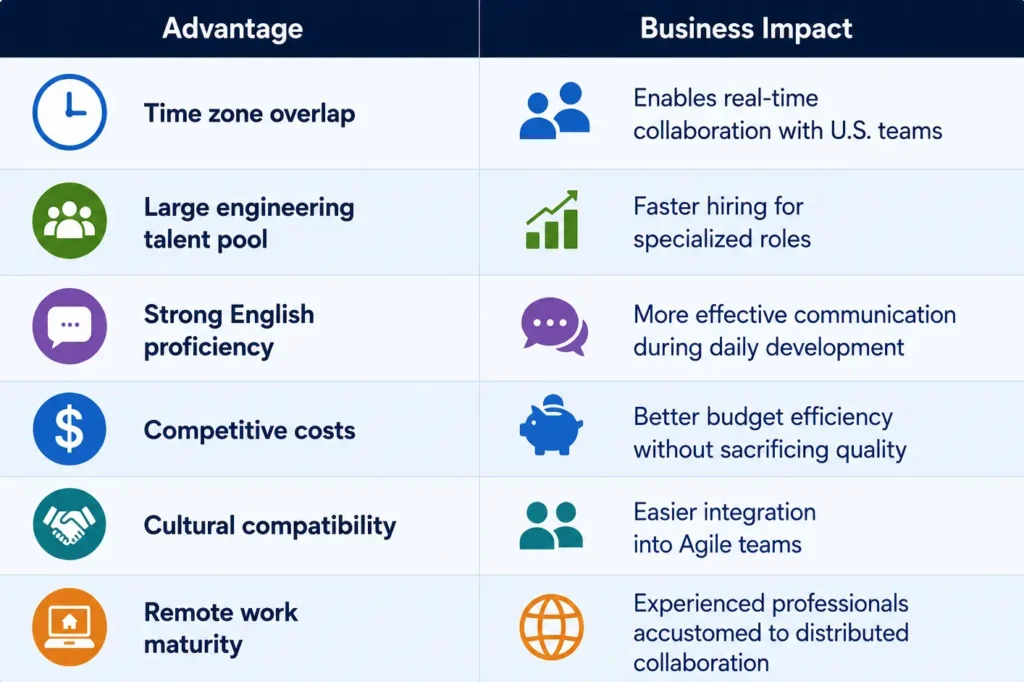
Unlike offshore regions with significant time differences, LATAM engineers can actively participate in standups, sprint planning, architecture discussions, pair programming, and production incident response during the same business hours as their U.S. counterparts.
Time Zone Alignment Is More Valuable Than Many Companies Realize
Real-time collaboration often becomes one of the biggest productivity advantages of nearshore development.
When developers, product managers, QA engineers, designers, and stakeholders share overlapping working hours, organizations benefit from:
- Faster decision-making
- Shorter feedback loops
- More productive Agile ceremonies
- Reduced project delays
- Improved knowledge sharing
- Stronger team cohesion
These operational improvements frequently generate greater business value than hourly rate differences alone.
For organizations comparing global hiring strategies, understanding the operational differences between nearshore and offshore development models is essential before making long-term hiring decisions.
How to Hire Software Engineers in LATAM Step by Step
Hiring software engineers in Latin America isn’t simply about finding developers with the right programming languages on their resume. The companies that consistently build successful distributed engineering teams follow a structured hiring process that evaluates technical expertise, communication, cultural compatibility, and long-term team integration.
Instead of rushing into recruitment, it’s worth approaching hiring as a business decision rather than a staffing exercise. Every new engineer should solve a specific business problem, whether that’s accelerating product development, improving software quality, reducing technical debt, or expanding engineering capacity.
A proven hiring process generally follows these stages:
- Define the business objectives.
- Identify the engineering roles you need.
- Choose the right engagement model.
- Evaluate technical and communication skills.
- Validate cultural and team fit.
- Build a structured onboarding process.
Skipping any of these steps often leads to longer ramp-up periods, communication issues, or expensive hiring mistakes.
Start With Business Needs, Not Job Titles
Many organizations begin by writing a job description before clearly defining the problem they’re trying to solve. While this seems logical, it often results in hiring engineers whose skills don’t fully align with the company’s priorities.
For example, a company struggling with slow release cycles may assume it needs more developers, when the real bottleneck lies in QA automation or DevOps. Likewise, hiring senior backend engineers won’t necessarily improve product delivery if unclear requirements or inefficient workflows are the underlying issue.
Before opening any position, ask questions such as:
- What business objective are we trying to achieve?
- Which engineering skills are currently missing?
- Is this a short-term capacity issue or a long-term hiring need?
- Will the engineer own features, architecture, maintenance, or product innovation?
Answering these questions makes it significantly easier to identify the right type of talent.
Identify the Roles That Will Deliver the Greatest Impact
Latin America’s software engineering ecosystem has matured considerably over the past decade, giving companies access to professionals across virtually every modern technology stack.
Depending on your objectives, you may need:
- Frontend Developers
- Backend Developers
- Full-Stack Engineers
- Mobile Developers
- QA Engineers
- QA Automation Engineers
- DevOps Engineers
- Cloud Engineers
- Data Engineers
- AI Engineers
- Technical Leads
- Engineering Managers
Rather than trying to hire every role at once, many successful companies begin with a small group of high-impact engineers and expand gradually as their product roadmap evolves.
Choosing the Right Hiring Model
One of the biggest decisions you’ll make isn’t where to hire, it’s how to hire. Before hiring LATAM software engineers, organizations should determine which engagement model best supports their long-term business objectives.
The engagement model you choose will influence recruiting speed, operational complexity, team integration, flexibility, and long-term scalability. There is no universally “best” model; the right choice depends on your company’s stage, internal resources, and engineering goals.
The most common approaches include direct hiring, staff augmentation, dedicated development teams, and software outsourcing.
Direct Hiring
Direct hiring gives organizations complete ownership over the recruitment process and the long-term development of their engineering team. Companies recruit, interview, contract, and manage developers internally, creating a team that becomes fully integrated into the business.
This model works well for organizations with established recruiting operations, HR resources, and experience managing international talent.
The primary advantage is control. Companies define every aspect of the hiring process, career progression, and engineering culture. However, that control also comes with greater administrative responsibility, including compliance, payroll, legal considerations, and talent retention.
Staff Augmentation
Staff augmentation allows companies to expand their engineering capacity without building an international recruiting operation from scratch.
Instead of outsourcing an entire project, engineers join the client’s existing development team, participate in daily standups, sprint planning, code reviews, and collaborate just like internal employees.
For engineering organizations that already have technical leadership but need additional capacity, staff augmentation often provides the fastest path to scaling development.
Unlike traditional outsourcing, engineering priorities remain entirely under the client’s control.
Dedicated Development Teams
Dedicated teams extend the staff augmentation concept by providing an entire engineering unit instead of individual contributors.
Rather than hiring developers one by one, companies gain access to multidisciplinary teams that may include software engineers, QA specialists, DevOps engineers, designers, and technical leads working together toward shared product goals.
This approach is particularly valuable for organizations building new products or maintaining multiple development streams simultaneously.
Software Outsourcing
Software outsourcing shifts responsibility for project execution to an external vendor.
Instead of managing individual engineers, companies define project objectives, timelines, and deliverables while the vendor oversees day-to-day development.
This model can work well for projects with clearly defined requirements, but it provides less visibility into daily engineering decisions than embedded hiring models such as staff augmentation.
Organizations seeking close collaboration with their internal product and engineering teams often prefer nearshore staff augmentation over traditional project outsourcing.
Comparing the Most Common Hiring Models
| Model | Best For | Level of Control | Speed to Scale |
|---|---|---|---|
| Direct Hiring | Building an internal engineering organization | High | Moderate |
| Staff Augmentation | Expanding existing teams | High | High |
| Dedicated Teams | Long-term product development | Medium-High | High |
| Software Outsourcing | Clearly defined projects | Medium | High |
The best model depends on your internal capabilities. Companies with experienced engineering leadership often benefit from staff augmentation because it combines rapid hiring with direct management, while organizations lacking internal technical oversight may prefer a more managed delivery model.
Choosing the Best Country to Hire Software Engineers
One of the most common misconceptions about hiring in Latin America is treating the region as a single talent market.
In reality, every country offers different strengths, technology ecosystems, salary expectations, English proficiency levels, and developer communities.
Rather than asking “Which country is the best?”, companies should ask “Which country best fits our hiring priorities?”
Some organizations prioritize the largest talent pool, while others focus on communication skills, time zone alignment, technical specialization, or long-term retention.
When evaluating potential hiring markets, consider factors such as:
- Availability of experienced engineers
- English proficiency
- Time zone overlap with your team
- Technical education and university ecosystem
- Remote work experience
- Salary expectations
- Cultural compatibility
- Market maturity
Argentina, Brazil, Colombia, Mexico, Costa Rica, Chile, Peru, and Uruguay all have thriving technology communities, but each market offers a different combination of these characteristics.
Instead of selecting a country first, define the type of engineer you need and evaluate which market is most likely to provide that talent.
For organizations evaluating the region as a whole, our Best Countries to Hire Developers in LATAM guide provides a detailed comparison of the leading markets.
Argentina, for example, continues to be one of the strongest markets for hiring senior software engineers thanks to its mature technology ecosystem, experienced remote workforce, and strong English proficiency among experienced developers.
If you’re specifically considering Argentine talent, we’ve also prepared a dedicated guide covering salaries, hiring practices, advantages, and market insights.
Companies hiring LATAM software engineers should evaluate countries based on technical expertise, English proficiency, time zone overlap, and long-term talent availability rather than salary alone.
Evaluating Technical and Soft Skills
Finding experienced software engineers is only part of the hiring process. The real challenge is identifying professionals who can contribute effectively within your engineering organization from day one. Successfully hiring LATAM software engineers requires evaluating both technical expertise and communication skills.
Technical expertise certainly matters, but successful remote teams are built on a combination of technical ability, communication, accountability, and collaboration. Companies that evaluate only coding skills often overlook the qualities that determine long-term performance.
A comprehensive evaluation should include both technical and interpersonal competencies.
Assess Technical Skills in Real-World Scenarios
Traditional algorithm tests and brainteasers have become less relevant for many software engineering roles. While they may assess problem-solving ability, they rarely reflect the work developers perform every day.
Instead, consider assessments that simulate real business challenges, such as:
- Reviewing an existing codebase and suggesting improvements.
- Building or extending a small application.
- Designing a REST or GraphQL API.
- Debugging a production issue.
- Explaining architectural decisions.
- Completing a collaborative pair-programming exercise.
These exercises provide a much clearer picture of how candidates think, communicate, and approach software development.
The technical interview should also reflect the technologies your team uses. A frontend developer should be evaluated differently from a DevOps engineer or a machine learning specialist.
Evaluate Communication as Carefully as Technical Ability
Distributed engineering teams rely heavily on communication. Engineers spend a significant portion of their day discussing requirements, participating in Agile ceremonies, reviewing pull requests, documenting solutions, and collaborating with product managers and designers.
Strong communication reduces misunderstandings, accelerates decision-making, and improves delivery quality.
During interviews, pay attention to whether candidates can:
- Explain technical concepts clearly.
- Ask thoughtful follow-up questions.
- Communicate trade-offs.
- Discuss previous projects confidently.
- Describe challenges and how they resolved them.
- Adapt technical explanations to different audiences.
These skills become increasingly important as engineers grow into senior or leadership positions.
Don’t Overlook English Proficiency
For U.S. companies, English proficiency is often one of the biggest contributors to successful collaboration.
This doesn’t mean every engineer needs perfect grammar or a native accent. Instead, candidates should be able to communicate comfortably in day-to-day engineering activities, including:
- Daily standups
- Sprint planning
- Technical discussions
- Code reviews
- Documentation
- Client meetings when required
The expected level of English should align with the role. Senior engineers, technical leads, architects, and engineering managers typically require stronger communication skills because they interact more frequently with stakeholders.
Look for Ownership, Not Just Execution
One characteristic consistently shared by high-performing software engineers is ownership.
Rather than waiting for instructions, they proactively identify risks, suggest improvements, and take responsibility for delivering outcomes.
Interview questions that explore ownership often reveal more than purely technical exercises.
For example:
- Tell me about a time you disagreed with a technical decision.
- Describe a production issue you helped resolve.
- How do you handle unclear requirements?
- What would you improve about your last team’s development process?
- Describe a feature you owned from planning to deployment.
The answers help determine whether a candidate thinks like an engineer or simply completes assigned tasks.
Cost Considerations When Hiring LATAM Software Engineers
When hiring LATAM software engineers, reducing costs is often one of the initial motivations. However, successful companies evaluate total business value rather than hourly rates alone. The total cost of hiring LATAM software engineers extends beyond salaries and should include recruitment, onboarding, and long-term retention.
The true cost of hiring extends far beyond compensation.
A complete cost analysis should consider:
- Recruitment expenses
- Time-to-hire
- Onboarding and ramp-up time
- Engineering management effort
- Productivity during the first months
- Employee retention
- Administrative overhead
- Compliance and legal costs
- Collaboration efficiency
When evaluated from this broader perspective, nearshore hiring often delivers value not simply because salaries are lower, but because organizations can scale faster while maintaining engineering quality.
Think in Terms of Total Cost of Ownership
An engineer with a lower hourly rate may ultimately cost more if communication challenges, poor collaboration, or high turnover reduce delivery velocity.
Conversely, an experienced nearshore engineer who integrates quickly into your team can accelerate releases, improve software quality, and reduce hiring delays—all of which contribute to a lower total cost of ownership.
This is why experienced engineering leaders increasingly evaluate hiring strategies based on long-term business outcomes rather than hourly pricing alone.
For a detailed comparison of salary trends, operational costs, and hiring economics, explore our guide to IT Staffing Costs: U.S. vs. LATAM.
Common Challenges When Hiring in LATAM
While hiring LATAM software engineers offers many advantages, organizations should also understand the operational challenges that can affect distributed teams.
Most issues are operational rather than geographic, and they can be minimized through thoughtful hiring and effective management practices.
Hiring Too Quickly
One of the biggest mistakes organizations make is prioritizing speed over quality.
Pressure to fill open roles often leads to rushed interviews or inconsistent evaluation processes. Although hiring quickly may solve an immediate staffing problem, it can create larger performance issues later.
A structured hiring process almost always produces better long-term results.
Prioritizing Cost Over Capability
Lower costs should never be the primary hiring criterion.
The most successful engineering organizations focus on business impact rather than hourly rates. Hiring the right engineer who contributes consistently is almost always more valuable than hiring the least expensive candidate available.
Ignoring Cultural Fit
Technical skills alone do not guarantee success.
Engineers who communicate effectively, embrace feedback, collaborate well, and align with your company’s working style typically become productive much faster than equally skilled candidates who struggle to integrate into the team.
Cultural fit should never be confused with hiring people who think alike. Instead, it means finding professionals who share similar expectations around communication, accountability, ownership, and teamwork.
Lack of a Structured Onboarding Process
Even exceptional engineers need time to become productive.
Organizations that invest in onboarding generally experience:
- Faster ramp-up times.
- Better collaboration.
- Fewer communication issues.
- Higher employee engagement.
- Improved retention.
A strong onboarding process should include technical documentation, access to development tools, introductions to key stakeholders, coding standards, engineering workflows, and clear expectations for the first 30, 60, and 90 days.
Best Practices for Building High-Performing Nearshore Teams
Hiring LATAM software engineers successfully requires more than finding talented developers. Long-term success depends on strong onboarding, communication, documentation, and team integration.
Organizations that consistently build successful nearshore engineering teams tend to follow a few common principles.
Treat Nearshore Engineers as Part of Your Core Team
The highest-performing distributed teams don’t distinguish between “internal” and “external” engineers.
Everyone participates in planning sessions, sprint reviews, retrospectives, architecture discussions, and product conversations.
This sense of inclusion strengthens collaboration, improves accountability, and increases long-term retention.
Invest in Documentation
Clear documentation reduces dependency on individual team members and helps new engineers become productive more quickly.
Engineering documentation should cover:
- System architecture
- Development standards
- Deployment processes
- Coding conventions
- Product requirements
- Incident response procedures
Well-documented teams scale more efficiently and experience fewer communication bottlenecks.
Measure Outcomes Instead of Hours
Modern engineering organizations increasingly evaluate success through business outcomes rather than time spent online.
Instead of monitoring activity, focus on metrics such as:
- Sprint predictability
- Release frequency
- Lead time for changes
- Defect rates
- Customer impact
- Product delivery milestones
Outcome-based management creates greater trust while encouraging engineers to focus on delivering value instead of simply completing tasks.
TechAID Perspective: Successful Nearshore Hiring Is About Building Teams, Not Filling Roles
Companies that achieve the greatest return from nearshore hiring approach it as a long-term engineering strategy rather than a short-term staffing solution.
The strongest distributed teams share the same engineering culture, development practices, communication standards, and product ownership regardless of where individual team members are located.
When nearshore engineers are fully integrated into planning, collaboration, and decision-making, geographic distance quickly becomes far less important than shared goals and effective teamwork.
Conclusion
Hiring LATAM software engineers is no longer simply a way to reduce development costs—it’s a strategic approach to building stronger, more scalable engineering organizations.
With access to highly skilled professionals, overlapping U.S. time zones, strong technical education, and growing expertise across modern technologies, Latin America has become one of the world’s most attractive regions for software talent.
However, successful hiring depends on much more than selecting the right country or offering a competitive salary. Organizations that consistently build high-performing distributed teams invest in structured hiring processes, evaluate both technical and communication skills, choose engagement models that fit their business goals, and integrate nearshore engineers as true members of their engineering organization.
Whether you’re hiring your first remote developer or scaling an established product team, taking a strategic approach to nearshore hiring can help you accelerate delivery, improve software quality, and create sustainable engineering growth.
If you’re evaluating how to expand your engineering team with experienced LATAM talent, working with a trusted nearshore partner can significantly reduce hiring time while helping you find professionals who fit both your technical requirements and your company culture.
Ready to build your engineering team with top LATAM software engineers? Contact TechAID to discuss your hiring goals and discover how our nearshore staffing solutions can help you scale faster.