
Outsourcing software development has become a strategic way for businesses to accelerate product delivery, access specialized talent, and scale engineering teams without the lengthy hiring process. However, choosing the right outsourcing model is just as important as choosing the right technology stack or development methodology.
When comparing nearshore vs offshore development, many companies initially focus on hourly rates. While cost is certainly an important factor, it is only one piece of the decision. Time zone compatibility, communication, cultural alignment, project visibility, and collaboration often have a greater impact on the success of a software project than labor costs alone.
For startups, growing SaaS companies, and enterprise organizations alike, selecting the right development model can influence product quality, release velocity, and long-term business outcomes. Understanding the differences between nearshore and offshore development allows technology leaders to make informed decisions based on their business goals rather than assumptions.
In this guide, we’ll explore the key differences between nearshore vs offshore development, examine the benefits of nearshore development, compare costs beyond hourly rates, and help you determine which outsourcing model is best suited for your organization.
What Is Nearshore Development?
Nearshore development is an outsourcing model where businesses partner with software engineers or dedicated development teams located in nearby countries that share similar time zones.
For companies in the United States, nearshore software development typically means working with engineering professionals across Latin America, including countries such as:
- Argentina
- Colombia
- Mexico
- Costa Rica
- Uruguay
- Brazil
- Chile
Unlike traditional outsourcing models that prioritize cost reduction above everything else, nearshore development focuses on improving collaboration while still providing significant cost savings compared to hiring domestically.
If you’re new to this delivery model, our comprehensive guide to nearshore software development explains how it works, when to use it, and why many U.S. companies are choosing LATAM engineering teams to accelerate software delivery.
Because teams operate during overlapping business hours, they can participate in daily standups, sprint planning sessions, code reviews, design discussions, and production incident responses without waiting until the next business day for answers.
Some of the most important nearshore outsourcing benefits include:
- Real-time collaboration
- Faster communication
- Stronger cultural compatibility
- Better Agile execution
- Easier project management
- Improved team integration
- Reduced delivery risk
Rather than functioning as an external vendor, nearshore engineers often become a seamless extension of an organization’s internal development team.
What Is Offshore Development?
Offshore development involves outsourcing software engineering work to countries located in distant geographic regions, often with substantial time zone differences.
Popular offshore destinations include:
- India
- Philippines
- Vietnam
- Pakistan
- Bangladesh
For many years, offshore outsourcing has been associated with one primary advantage: lower labor costs. These regions offer large engineering talent pools capable of supporting projects ranging from startup MVPs to enterprise-scale digital transformation initiatives.
Offshore providers can supply expertise across numerous technical disciplines, including:
- Software development
- Quality assurance
- DevOps
- Cloud engineering
- Mobile development
- Data engineering
- Technical support
While offshore outsourcing can provide considerable cost savings, organizations should also consider operational factors that influence project success.
Common challenges include:
- Limited working-hour overlap
- Longer communication cycles
- Slower decision-making
- Increased dependency on documentation
- Delayed feedback during Agile development
- More complex project coordination
These challenges do not make offshore development a poor choice. Many organizations successfully manage offshore teams by establishing mature processes, detailed documentation, and experienced technical leadership. However, businesses that rely on rapid iteration, continuous collaboration, and frequent customer feedback may find these communication barriers difficult to overcome.
Nearshore vs Offshore Development: Key Differences at a Glance
Although both outsourcing models provide access to skilled software engineers, the day-to-day experience can be very different.
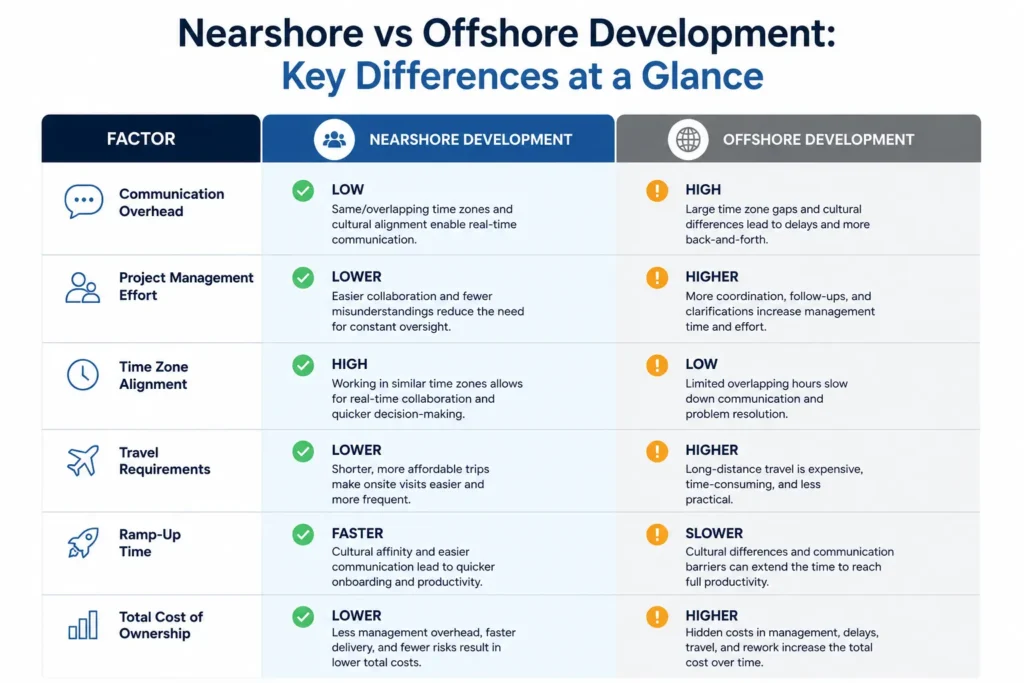
The comparison highlights why many organizations evaluate outsourcing based on overall business value rather than hourly pricing alone. While offshore development may offer lower rates, communication delays, management overhead, and slower feedback cycles can increase the total cost of a project over time.
This is one reason why the benefits of nearshore development have become increasingly attractive for companies that prioritize speed, collaboration, and software quality alongside cost efficiency.
Cost Comparison Beyond Hourly Rates
One of the biggest misconceptions when evaluating nearshore vs offshore development is that the provider with the lowest hourly rate is automatically the most cost-effective choice.
In reality, the true cost of software development extends far beyond what you pay per developer. Productivity, communication efficiency, project management, and delivery speed all contribute to your total cost of ownership. Organizations evaluating outsourcing partners should also consider the total cost of ownership rather than hourly rates alone, an approach consistently recommended by Gartner in its research on IT sourcing and vendor management.
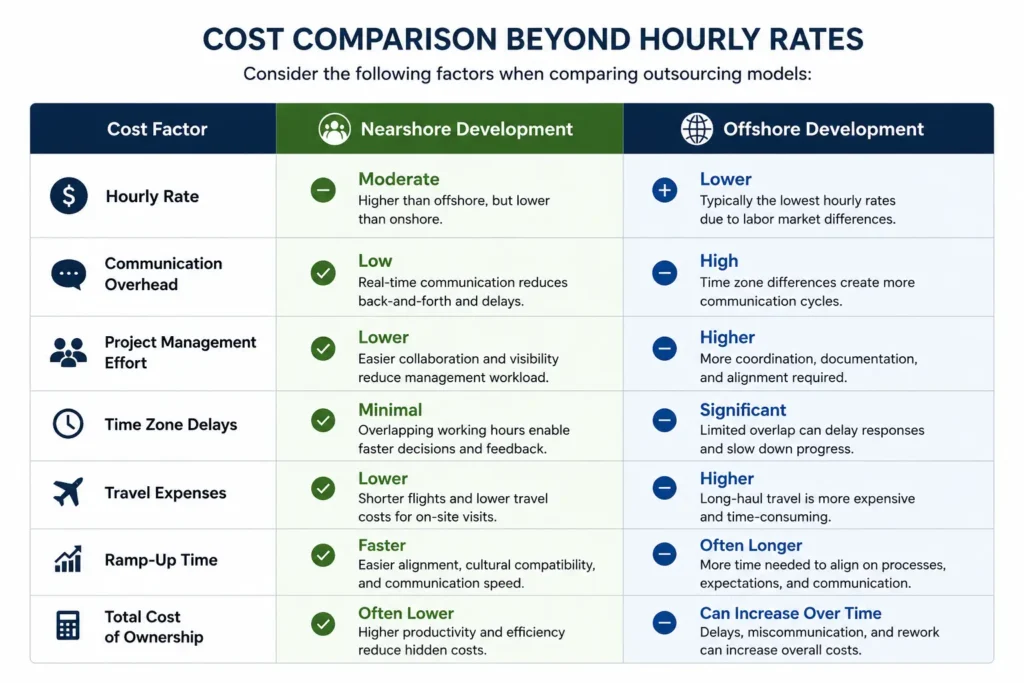
For example, if an engineering team loses several hours each week waiting for answers due to time zone differences, those delays can accumulate over the course of a project. Missed feedback windows may lead to longer development cycles, additional revisions, and postponed releases.
When evaluating outsourcing partners, consider the overall value they bring rather than focusing exclusively on hourly pricing.
Communication and Time Zone Collaboration
Software development is highly collaborative. Engineers regularly discuss architecture, clarify requirements, review pull requests, troubleshoot production issues, and participate in Agile ceremonies.
When teams work within similar business hours, these interactions happen naturally.
Nearshore development allows organizations to:
- Hold daily standups in real time
- Conduct pair programming sessions
- Resolve blockers immediately
- Review code faster
- Make decisions without waiting until the next day
- Collaborate closely with product managers and designers
In contrast, offshore teams often operate eight to twelve hours ahead of U.S. business hours. While asynchronous communication can be effective for certain workflows, it may slow projects that require frequent collaboration.
For businesses following Agile methodologies, real-time communication often translates into:
- Faster sprint execution
- Quicker issue resolution
- Shorter feedback loops
- Greater visibility into project progress
- Improved stakeholder alignment
Teams following Agile practices often benefit from continuous collaboration and rapid feedback cycles, principles outlined in the Atlassian Agile Coach resources.
These operational advantages are among the primary nearshore software development advantages that continue to drive adoption among U.S. companies.
Team Integration and Company Culture
Successful software projects depend on more than technical skills. Collaboration, trust, and shared understanding play an equally important role.
Nearshore teams often integrate more naturally into existing engineering organizations because they typically share:
- Similar working hours
- Comparable business practices
- Familiarity with Agile methodologies
- Strong English proficiency
- Cultural similarities with North American companies
As a result, nearshore engineers frequently participate as full members of internal teams rather than functioning solely as external contractors.
This level of integration makes it easier to:
- Build long-term engineering teams
- Maintain consistent development practices
- Share institutional knowledge
- Improve accountability
- Increase developer engagement
Organizations looking to create lasting partnerships rather than transactional outsourcing relationships often find this collaborative approach particularly valuable.
Software Quality and Productivity
Choosing between nearshore vs offshore development is not simply about where developers are located—it’s about how effectively teams can deliver high-quality software.
Several factors influence engineering productivity, including:
- Requirement clarity
- Communication speed
- Technical leadership
- Development processes
- Team stability
- Collaboration between stakeholders
When communication happens quickly and decisions are made in real time, teams spend less time waiting and more time building.
Research from industry organizations consistently shows that high-performing engineering teams emphasize collaboration, rapid feedback, and continuous improvement. These principles become easier to maintain when distributed teams operate within overlapping business hours.
The result is often:
- Faster feature delivery
- Fewer misunderstandings
- Reduced rework
- Improved code quality
- More predictable sprint planning
- Better customer outcomes
Of course, success ultimately depends on choosing the right outsourcing partner. Both nearshore and offshore providers can deliver exceptional results when supported by experienced leadership, mature development practices, and effective communication.
Nearshore vs Offshore Development for Startups
For startups, speed is often more valuable than minimizing hourly development costs.
Founders typically need to:
- Launch an MVP quickly
- Validate product-market fit
- Respond rapidly to customer feedback
- Iterate based on user behavior
- Scale engineering capacity as the business grows
These priorities make collaboration especially important.
Nearshore development enables startup teams to work closely with external engineers throughout the product lifecycle. Product discussions, roadmap planning, sprint reviews, and technical decisions can all happen during the same workday.
This flexibility becomes particularly valuable when requirements evolve frequently, as they often do during the early stages of a company.
Offshore development can still be a strong option for startups with clearly defined technical requirements or limited budgets. However, businesses should carefully evaluate whether lower hourly costs outweigh the potential impact of communication delays during periods of rapid product iteration.
For many early-stage companies, the benefits of nearshore development include faster execution, stronger collaboration, and the ability to adapt quickly as business priorities change.
How to Choose the Right Outsourcing Model
The right outsourcing strategy depends on your business objectives, team structure, budget, and project complexity. Rather than asking which model is universally better, ask which model best supports your organization’s goals.
Use the following framework to guide your decision.
Choose Nearshore Development If You:
- Need real-time collaboration with your engineering team.
- Follow Agile or Scrum methodologies.
- Are building or scaling a SaaS product.
- Expect requirements to evolve throughout the project.
- Want an extension of your in-house engineering team.
- Value faster communication and quicker decision-making.
- Need developers who can easily participate in client meetings.
Choose Offshore Development If You:
- Have a well-defined project scope with stable requirements.
- Prioritize minimizing hourly development costs.
- Have experienced project managers overseeing distributed teams.
- Can rely primarily on asynchronous communication.
- Are building a project with less frequent stakeholder interaction.
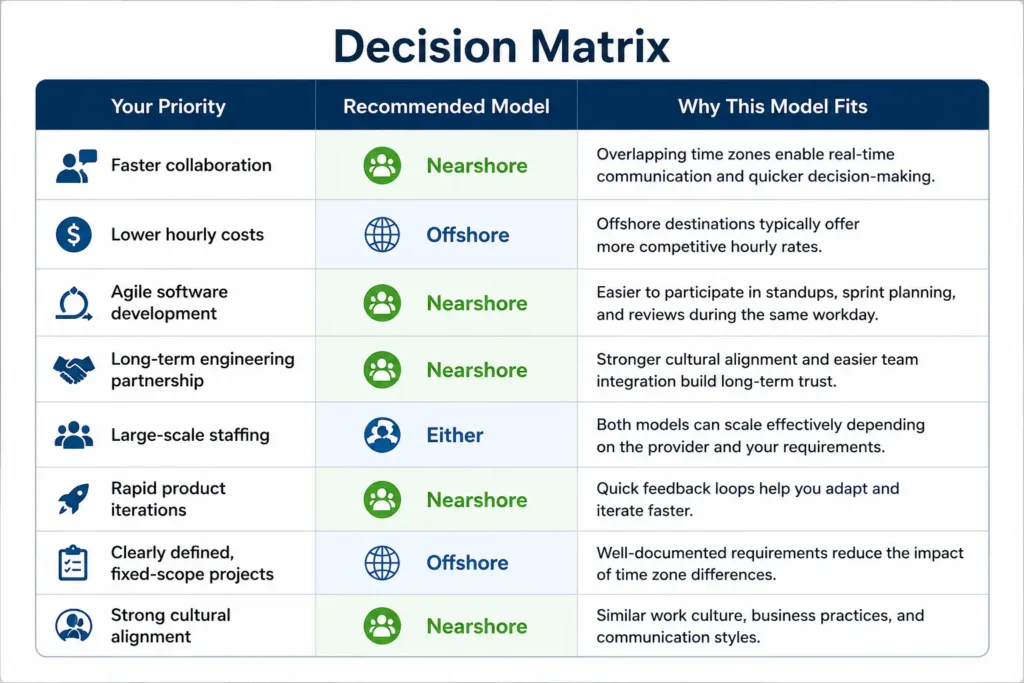
Ultimately, the success of your software project depends less on geography and more on selecting a partner with proven technical expertise, transparent communication, and a collaborative mindset.
Final Thoughts
The debate around nearshore vs offshore development isn’t about identifying a single “best” outsourcing model, it’s about choosing the approach that aligns with your business priorities.
Offshore development can be an effective option for organizations focused primarily on reducing development costs and managing projects with well-defined requirements. Nearshore development, on the other hand, offers advantages that are increasingly valuable for companies building modern software products: real-time collaboration, stronger cultural alignment, faster communication, and seamless integration with internal teams.
As businesses continue adopting Agile practices and accelerating digital transformation initiatives, many technology leaders are discovering that productivity, collaboration, and speed often deliver greater long-term value than the lowest possible hourly rate.
If your organization is looking to scale engineering capacity while maintaining close collaboration and high software quality, nearshore development can provide the flexibility and responsiveness needed to support sustainable growth.
Whether you’re hiring a single software engineer or building an entire dedicated development team, choosing the right outsourcing partner is one of the most important decisions you’ll make. Evaluate providers based not only on cost but also on their technical expertise, communication practices, engineering culture, and ability to become a true extension of your team.
If you’re exploring nearshore software development for your next project, TechAID helps U.S. companies build high-performing engineering teams across Latin America. Our collaborative approach allows businesses to scale faster, improve delivery, and work with experienced professionals who integrate seamlessly into existing teams.
Ready to build a high-performing engineering team without sacrificing collaboration? Explore our staff augmentation services or contact our team to discuss your hiring goals and discover how nearshore talent can accelerate your next project.