Software Discovery Phase: 6 Decisions Before You Fund Delivery

Software Discovery Phase: 6 Decisions Before You Fund Delivery

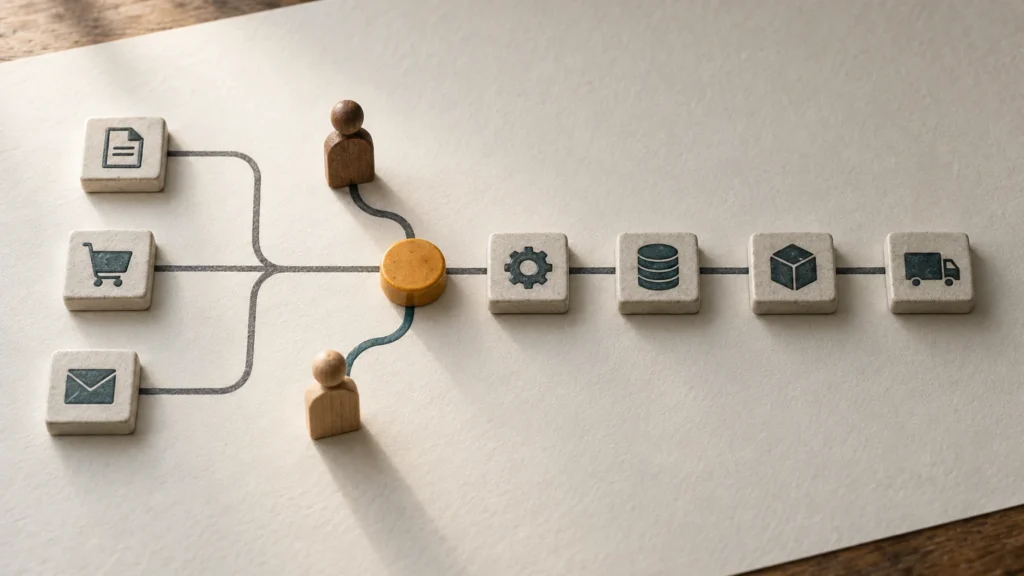
Team reviewing workflow assumptions during a software discovery phase.
Before funding an outsourced build, establish what discovery must prove. Six buyer decisions connect evidence, scope, ownership, spending limits, and a usable handoff to a defensible next step—including the option not to build.
Share the Post:

You have a proposal, a target launch date, and three departments describing different versions of the same product. The supplier wants a delivery commitment. Your engineers still cannot explain which system owns the data, and the operations team has not agreed who will handle exceptions.

A software discovery phase is useful here only if it changes the decision you can responsibly make. A polished requirements deck is not enough. You need evidence that separates a worthwhile, bounded project from an attractive idea whose dependencies are still unknown.

For CTOs, product leaders, and founders considering project outsourcing, the practical question is not simply whether discovery is worth paying for. It is what the work must establish before you authorize the next commitment. Use the six decisions below to define that standard, compare proposals, and retain the option to narrow or stop the initiative.

What a software discovery phase should buy

A software discovery phase is a bounded investigation into a problem, its users, constraints, and viable next steps. Its output is a supported investment decision—not a promise that every requirement is known or that delivery will have no surprises.

The UK Government Service Manual distinguishes discovery from building the service: discovery establishes whether further exploration is worthwhile. That is a useful boundary for commercial buyers too. A sales qualification call, a paid investigation, and a production build are different commitments, even when a supplier uses “discovery” for all three.

Terminology also differs between organizations. Some include prototypes or technical experiments in discovery; others place them in a separate phase. Resolve that difference in the brief. State whether you are buying interviews and analysis, a disposable experiment, or production-quality implementation. Do not accept an ambiguous label as the scope.

Keep the software discovery phase proportionate. A small change in a well-understood system may need only a short review of assumptions, dependencies, and acceptance criteria. A cross-system initiative with uncertain user needs or unavailable data needs more investigation. Repeating research that your team already possesses adds cost without necessarily improving the decision.

1. Is there a problem worth funding?

Start with the consequence of the current situation, not the requested application. “Build a customer portal” is a proposed solution. “Customers cannot see whether a submitted request is complete, so support repeatedly checks it manually” is a problem that can be investigated.

Ask the team to establish who experiences the problem, how often it occurs, what happens when it remains unresolved, and what evidence supports that account. Include people doing the operational work, not only the executive sponsor. Separate observed behavior from stakeholder expectations and from assumptions that have not yet been checked.

The useful deliverable is a short problem statement with an evidence trail and a proposed measure of improvement. For example, record the current time spent resolving incomplete requests and the proportion requiring manual follow-up. If the baseline is unavailable, make collecting it a named task rather than inventing a return-on-investment estimate.

During the software discovery phase, challenge whether software is the necessary intervention. Could clearer instructions, a process change, configuration of an existing product, or a narrower integration address the same problem? Comparing these options prevents the build proposal from becoming the only possible answer before the investigation starts.

A practical approval test: can the sponsor explain whose situation should improve and how the organization would recognize that improvement? If the answer remains “we need a modern platform,” the problem definition is not yet specific enough to support a delivery commitment.

2. Which unknowns could change the decision?

A list of risks is less useful than a list of decisions each risk could overturn. Identify the assumptions that would change the project’s scope, feasibility, operating cost, or usefulness if they proved false. Investigate those first, instead of giving every open question equal attention.

For each significant assumption, record five things:

  • The claim being relied on, stated so someone can challenge it.
  • The evidence available now, including its source, date, and limitations.
  • The consequence if the claim is wrong.
  • The next investigation or experiment, with an owner and access dependency.
  • The decision that can be made after the evidence arrives.

Consider an integration described as “the vendor has an API.” That statement does not establish access to the required objects, a suitable permission model, usable rate limits, test-environment availability, or permission to reuse the data. Request the relevant documentation and involve the system owner before estimating implementation as routine plumbing.

Keep uncertainty visible in software discovery phase deliverables. Label a constraint confirmed, assumed, disputed, or unresolved. A diagram with an unverified connection should not look identical to one backed by inspected documentation and a responsible owner.

Where a technical experiment is needed, specify its question and limits. The Service Manual’s alpha guidance emphasizes focused prototypes that test risky assumptions. Apply that discipline to a separately agreed experiment: define what it would demonstrate, what it would not demonstrate, and whether the result is disposable. A sandbox success is not proof of production capacity or security.

Do not require certainty about everything. Require enough evidence for the next decision, and make the remaining uncertainty an explicit condition of that decision. If essential access cannot be obtained, report a blocked feasibility question rather than silently treating it as resolved.

3. What is the smallest useful delivery boundary?

The software discovery phase should make the first delivery boundary easier to explain. Define a complete user outcome that can be accepted, not an arbitrary list of screens or a percentage of the eventual platform. A small release still needs a workable path through its exceptions.

Describe the starting event, the user or system involved, the successful outcome, and the conditions that count as failure. Then list what is deliberately outside the boundary. Exclusions matter most when stakeholders could reasonably assume they were included: historical data cleanup, multilingual support, unusual account types, third-party license changes, or support after launch.

For a request-status portal, a bounded first release might let existing customers see the status of one request type using the current identity system. It might exclude new customer registration and changes to the underlying fulfillment process. That is useful only if the existing status data is accurate enough to answer the customer’s question.

Include the less visible work in software project scoping. Identify environment setup, data preparation, accessibility, security review, deployment, operational monitoring, training, and handoff responsibilities where relevant. These are not automatically separate projects merely because they are absent from a wireframe.

Write representative acceptance examples before seeking a firm delivery proposal. What should happen when a customer has two accounts, a record is missing, or an upstream system is unavailable? This is not an attempt to specify every future detail. It reveals whether the proposed boundary is coherent enough to estimate and govern.

TechAID’s third-party software acceptance checklist can help carry these expectations into delivery. At this stage, choose which evidence will eventually be required; do not pretend a discovery report has already passed production acceptance.

4. Who must participate—and who will own delivery?

An external team cannot discover facts that your organization cannot make available. Before the software discovery phase starts, name the business decision-maker, technical reviewer, operational representative, and owners of critical systems or data. Identify who can approve access and resolve conflicting requirements.

Ask each participant for a specific contribution and response window. The finance lead may validate a cost assumption; a support lead may provide anonymized examples; a security specialist may assess a proposed data flow. “Stakeholders will be available” is not an operational plan.

Keep an access-and-decisions log alongside the research. If a supplier is waiting for a system account, user interview, or business decision, record the effect on the investigation. Agree what can continue in parallel and when the work should pause. Otherwise, a calendar deadline can arrive with most of the important questions untouched.

Choose the engagement model after clarifying responsibility

Project outsourcing fits a bounded outcome for which a partner manages execution. Your organization still supplies strategic direction, decisions, and final approval. A partner can lead the investigation or subsequent implementation within an agreed scope; that does not transfer your authority to decide what the business needs.

Nearshore staff augmentation fits when your managers will direct the work and need embedded specialists. Adding an engineer does not automatically create a product owner, resolve competing priorities, or provide a managed project. Be explicit about the management capacity you retain.

Direct hiring fits enduring ownership that should remain inside the organization. If the discovery reveals a permanent platform responsibility rather than a temporary delivery gap, a long-term hire may be the more appropriate next step. Avoid forcing an ongoing organizational need into a short project solely because project funding is easier to obtain.

The project discovery phase should therefore inform both the scope and the operating model. A technically feasible plan can still be unsuitable if nobody is available to make decisions, accept delivery, or run the result.

5. What exactly are you authorizing and paying for?

Separate approval of the software discovery phase from approval of the full build. The investigation should have a defined objective, activities, outputs, review points, spending limit, and completion decision. A statement that the team will “understand the requirements” is too open-ended to compare with another proposal.

Compare software discovery phase proposals by asking suppliers to explain the work behind their estimate: which people participate, the expected effort, client contributions, external costs, and assumptions about access. Compare those inputs and outputs, not only the total fee. A cheaper proposal may omit a difficult dependency; a more expensive one may investigate questions that cannot affect your decision.

There is no universal percentage of implementation cost that makes discovery appropriate. Budget from the questions that need answering and the consequences of getting them wrong. Include your own employees’ participation and review time. Treat any broad market price range as context, not a substitute for a scoped proposal.

The U.S. Digital Services Playbook recommends budgeting for research and prototyping and structuring contracts around frequent deliverables and evolving priorities. For a private business, the practical application is to agree short evidence reviews and clear authorization boundaries with procurement and legal advisers—not to copy government contract terms.

Use a timebox with a decision rule

A timebox limits the investment; it does not guarantee that every question will be answered. At each review, ask what changed, which assumptions remain consequential, and whether another increment of investigation could change the decision. Extending the work needs a specific question, expected evidence, and newly approved limit.

One public procurement illustrates the separation. A UK Department of Health and Social Care discovery brief, with an application closing date of October 6, 2026, specified capped time-and-materials work and stated that later-phase funding would be sought after discovery, based on its recommendations and evidence. That is a documented buying arrangement, not a universal pricing model or a TechAID price benchmark.

For your own engagement, agree how blocked work, substitutions, scope changes, and additional investigation are approved. Clarify whether payment is tied to completion of agreed work, acceptance of specified outputs, or another defined basis. The contract should not make a favorable build recommendation the condition for successful discovery.

6. Can you make an independent next-step decision?

At the end of the software discovery phase, ask for a recommendation that distinguishes evidence from preference. It should explain the proposed next commitment, alternatives considered, unresolved risks, estimated effort with assumptions, and conditions that would make the recommendation invalid.

Use four possible outcomes:

  • Proceed with a bounded next stage because its objective, dependencies, ownership, and acceptance approach are sufficiently understood.
  • Investigate a specific unresolved question before authorizing implementation.
  • Narrow or change the approach because a smaller intervention better addresses the problem.
  • Stop because the expected benefit, feasibility, or organizational readiness does not justify further spending.

Stopping is not a defective deliverable when it follows the evidence. In an August 20, 2025 account, Home Office Digital describes how user-centred teams have recommended not continuing beyond discovery or alpha. Its lesson for buyers is straightforward: reward a defensible decision, including an inconvenient one, rather than treating continuation as proof that discovery succeeded.

Review the findings with someone who can challenge them and who is not responsible for selling the implementation. That might be your CTO, an internal architect, or another appropriately qualified reviewer. Independence does not require adding a large committee; it requires someone able to question the evidence and the proposed commitment.

Make the outputs usable without the original presenter. Agree access to editable documents, research findings at an appropriate privacy level, decision records, diagrams, and any experiment code. Clarify usage rights and third-party restrictions with your advisers. A PDF that references inaccessible supplier workspaces is a weak handoff.

Discovery phase deliverables should not lock you into the same delivery supplier by accident. Another qualified team should be able to understand the problem, inspect the reasoning, and identify what still needs validation. That does not mean a replacement team will accept every estimate or avoid all onboarding effort.

A worked example: a portal proposal becomes an integration decision

Consider a hypothetical B2B distributor asked to replace status-update emails with a new customer portal. The sponsor expects fewer support contacts. Sales wants account registration and analytics. Operations believes the existing order system already contains everything required. None of these statements has been validated.

A bounded software discovery phase reviews anonymized support requests, observes how staff answer them, and maps where status information originates. It finds two different problems: some customers cannot access information that already exists; other requests remain unresolved because internal teams do not update the source record consistently.

Those findings change the decision. A new interface could address the first problem but would display unreliable information for the second. The recommendation separates a process correction from a limited read-only integration. Registration and analytics remain outside the initial boundary because they do not resolve the observed status problem.

An unresolved permission question prevents an immediate fixed-scope build commitment. The next approved step is a limited technical experiment with non-production data, not construction of the whole portal. Its result must show whether the intended customer can see only the records they are authorized to access, and identify what remains unproven.

If access can be implemented safely, the team can refine the delivery proposal. If it cannot, the business can reconsider the approach before funding a larger implementation. The value lies in changing the sequence and size of commitments—not in claiming discovery eliminates uncertainty.

This is an illustrative decision path, not a TechAID client result or a promised delivery schedule. Your investigation may produce a different answer, including confirmation that an existing plan is already sufficiently supported.

Bring the decision brief to the delivery conversation

A useful software discovery phase ends with a clearer choice and a smaller set of explicit unknowns. Before asking a partner for a delivery commitment, assemble the problem statement, evidence, first-release boundary, dependency owners, acceptance expectations, and unresolved assumptions.

TechAID’s project outsourcing model provides managed execution for defined initiatives, with capabilities including custom software development, project management, QA, and DevOps. The appropriate scope must be agreed for your situation; a generic discovery label is not a substitute for that agreement.

Bring your current brief and the three assumptions most likely to change it to a project-outsourcing conversation with TechAID. Ask which questions need resolving before a delivery proposal is credible, what your team must contribute, and how the next stage would be accepted. Authorize the work that earns the next decision—not the entire project merely because the presentation is persuasive.


Key Takeaways
  • Define discovery as a bounded investigation that supports an investment decision, including the option not to build.

  • Establish the problem and its evidence before treating a proposed software solution as necessary.

  • Prioritize assumptions that could change feasibility, scope, cost, or usefulness, and make unresolved uncertainty visible.

  • Set a smallest useful delivery boundary with explicit exclusions and representative acceptance examples.

  • Name internal decision-makers, system owners, and access responsibilities so discovery can produce a usable delivery handoff.

  • You have a proposal, a target launch date, and three departments describing different versions of the same product. The supplier wants a delivery commitment. Your engineers still cannot explain which system owns the data, and the operations team has not agreed who will handle exceptions.

    A software discovery phase is useful here only if it changes the decision you can responsibly make. A polished requirements deck is not enough. You need evidence that separates a worthwhile, bounded project from an attractive idea whose dependencies are still unknown.

    For CTOs, product leaders, and founders considering project outsourcing, the practical question is not simply whether discovery is worth paying for. It is what the work must establish before you authorize the next commitment. Use the six decisions below to define that standard, compare proposals, and retain the option to narrow or stop the initiative.

    What a software discovery phase should buy

    A software discovery phase is a bounded investigation into a problem, its users, constraints, and viable next steps. Its output is a supported investment decision—not a promise that every requirement is known or that delivery will have no surprises.

    The UK Government Service Manual distinguishes discovery from building the service: discovery establishes whether further exploration is worthwhile. That is a useful boundary for commercial buyers too. A sales qualification call, a paid investigation, and a production build are different commitments, even when a supplier uses “discovery” for all three.

    Terminology also differs between organizations. Some include prototypes or technical experiments in discovery; others place them in a separate phase. Resolve that difference in the brief. State whether you are buying interviews and analysis, a disposable experiment, or production-quality implementation. Do not accept an ambiguous label as the scope.

    Keep the software discovery phase proportionate. A small change in a well-understood system may need only a short review of assumptions, dependencies, and acceptance criteria. A cross-system initiative with uncertain user needs or unavailable data needs more investigation. Repeating research that your team already possesses adds cost without necessarily improving the decision.

    1. Is there a problem worth funding?

    Start with the consequence of the current situation, not the requested application. “Build a customer portal” is a proposed solution. “Customers cannot see whether a submitted request is complete, so support repeatedly checks it manually” is a problem that can be investigated.

    Ask the team to establish who experiences the problem, how often it occurs, what happens when it remains unresolved, and what evidence supports that account. Include people doing the operational work, not only the executive sponsor. Separate observed behavior from stakeholder expectations and from assumptions that have not yet been checked.

    The useful deliverable is a short problem statement with an evidence trail and a proposed measure of improvement. For example, record the current time spent resolving incomplete requests and the proportion requiring manual follow-up. If the baseline is unavailable, make collecting it a named task rather than inventing a return-on-investment estimate.

    During the software discovery phase, challenge whether software is the necessary intervention. Could clearer instructions, a process change, configuration of an existing product, or a narrower integration address the same problem? Comparing these options prevents the build proposal from becoming the only possible answer before the investigation starts.

    A practical approval test: can the sponsor explain whose situation should improve and how the organization would recognize that improvement? If the answer remains “we need a modern platform,” the problem definition is not yet specific enough to support a delivery commitment.

    2. Which unknowns could change the decision?

    A list of risks is less useful than a list of decisions each risk could overturn. Identify the assumptions that would change the project’s scope, feasibility, operating cost, or usefulness if they proved false. Investigate those first, instead of giving every open question equal attention.

    For each significant assumption, record five things:

    • The claim being relied on, stated so someone can challenge it.
    • The evidence available now, including its source, date, and limitations.
    • The consequence if the claim is wrong.
    • The next investigation or experiment, with an owner and access dependency.
    • The decision that can be made after the evidence arrives.

    Consider an integration described as “the vendor has an API.” That statement does not establish access to the required objects, a suitable permission model, usable rate limits, test-environment availability, or permission to reuse the data. Request the relevant documentation and involve the system owner before estimating implementation as routine plumbing.

    Keep uncertainty visible in software discovery phase deliverables. Label a constraint confirmed, assumed, disputed, or unresolved. A diagram with an unverified connection should not look identical to one backed by inspected documentation and a responsible owner.

    Where a technical experiment is needed, specify its question and limits. The Service Manual’s alpha guidance emphasizes focused prototypes that test risky assumptions. Apply that discipline to a separately agreed experiment: define what it would demonstrate, what it would not demonstrate, and whether the result is disposable. A sandbox success is not proof of production capacity or security.

    Do not require certainty about everything. Require enough evidence for the next decision, and make the remaining uncertainty an explicit condition of that decision. If essential access cannot be obtained, report a blocked feasibility question rather than silently treating it as resolved.

    3. What is the smallest useful delivery boundary?

    The software discovery phase should make the first delivery boundary easier to explain. Define a complete user outcome that can be accepted, not an arbitrary list of screens or a percentage of the eventual platform. A small release still needs a workable path through its exceptions.

    Describe the starting event, the user or system involved, the successful outcome, and the conditions that count as failure. Then list what is deliberately outside the boundary. Exclusions matter most when stakeholders could reasonably assume they were included: historical data cleanup, multilingual support, unusual account types, third-party license changes, or support after launch.

    For a request-status portal, a bounded first release might let existing customers see the status of one request type using the current identity system. It might exclude new customer registration and changes to the underlying fulfillment process. That is useful only if the existing status data is accurate enough to answer the customer’s question.

    Include the less visible work in software project scoping. Identify environment setup, data preparation, accessibility, security review, deployment, operational monitoring, training, and handoff responsibilities where relevant. These are not automatically separate projects merely because they are absent from a wireframe.

    Write representative acceptance examples before seeking a firm delivery proposal. What should happen when a customer has two accounts, a record is missing, or an upstream system is unavailable? This is not an attempt to specify every future detail. It reveals whether the proposed boundary is coherent enough to estimate and govern.

    TechAID’s third-party software acceptance checklist can help carry these expectations into delivery. At this stage, choose which evidence will eventually be required; do not pretend a discovery report has already passed production acceptance.

    4. Who must participate—and who will own delivery?

    An external team cannot discover facts that your organization cannot make available. Before the software discovery phase starts, name the business decision-maker, technical reviewer, operational representative, and owners of critical systems or data. Identify who can approve access and resolve conflicting requirements.

    Ask each participant for a specific contribution and response window. The finance lead may validate a cost assumption; a support lead may provide anonymized examples; a security specialist may assess a proposed data flow. “Stakeholders will be available” is not an operational plan.

    Keep an access-and-decisions log alongside the research. If a supplier is waiting for a system account, user interview, or business decision, record the effect on the investigation. Agree what can continue in parallel and when the work should pause. Otherwise, a calendar deadline can arrive with most of the important questions untouched.

    Choose the engagement model after clarifying responsibility

    Project outsourcing fits a bounded outcome for which a partner manages execution. Your organization still supplies strategic direction, decisions, and final approval. A partner can lead the investigation or subsequent implementation within an agreed scope; that does not transfer your authority to decide what the business needs.

    Nearshore staff augmentation fits when your managers will direct the work and need embedded specialists. Adding an engineer does not automatically create a product owner, resolve competing priorities, or provide a managed project. Be explicit about the management capacity you retain.

    Direct hiring fits enduring ownership that should remain inside the organization. If the discovery reveals a permanent platform responsibility rather than a temporary delivery gap, a long-term hire may be the more appropriate next step. Avoid forcing an ongoing organizational need into a short project solely because project funding is easier to obtain.

    The project discovery phase should therefore inform both the scope and the operating model. A technically feasible plan can still be unsuitable if nobody is available to make decisions, accept delivery, or run the result.

    5. What exactly are you authorizing and paying for?

    Separate approval of the software discovery phase from approval of the full build. The investigation should have a defined objective, activities, outputs, review points, spending limit, and completion decision. A statement that the team will “understand the requirements” is too open-ended to compare with another proposal.

    Compare software discovery phase proposals by asking suppliers to explain the work behind their estimate: which people participate, the expected effort, client contributions, external costs, and assumptions about access. Compare those inputs and outputs, not only the total fee. A cheaper proposal may omit a difficult dependency; a more expensive one may investigate questions that cannot affect your decision.

    There is no universal percentage of implementation cost that makes discovery appropriate. Budget from the questions that need answering and the consequences of getting them wrong. Include your own employees’ participation and review time. Treat any broad market price range as context, not a substitute for a scoped proposal.

    The U.S. Digital Services Playbook recommends budgeting for research and prototyping and structuring contracts around frequent deliverables and evolving priorities. For a private business, the practical application is to agree short evidence reviews and clear authorization boundaries with procurement and legal advisers—not to copy government contract terms.

    Use a timebox with a decision rule

    A timebox limits the investment; it does not guarantee that every question will be answered. At each review, ask what changed, which assumptions remain consequential, and whether another increment of investigation could change the decision. Extending the work needs a specific question, expected evidence, and newly approved limit.

    One public procurement illustrates the separation. A UK Department of Health and Social Care discovery brief, with an application closing date of October 6, 2026, specified capped time-and-materials work and stated that later-phase funding would be sought after discovery, based on its recommendations and evidence. That is a documented buying arrangement, not a universal pricing model or a TechAID price benchmark.

    For your own engagement, agree how blocked work, substitutions, scope changes, and additional investigation are approved. Clarify whether payment is tied to completion of agreed work, acceptance of specified outputs, or another defined basis. The contract should not make a favorable build recommendation the condition for successful discovery.

    6. Can you make an independent next-step decision?

    At the end of the software discovery phase, ask for a recommendation that distinguishes evidence from preference. It should explain the proposed next commitment, alternatives considered, unresolved risks, estimated effort with assumptions, and conditions that would make the recommendation invalid.

    Use four possible outcomes:

    • Proceed with a bounded next stage because its objective, dependencies, ownership, and acceptance approach are sufficiently understood.
    • Investigate a specific unresolved question before authorizing implementation.
    • Narrow or change the approach because a smaller intervention better addresses the problem.
    • Stop because the expected benefit, feasibility, or organizational readiness does not justify further spending.

    Stopping is not a defective deliverable when it follows the evidence. In an August 20, 2025 account, Home Office Digital describes how user-centred teams have recommended not continuing beyond discovery or alpha. Its lesson for buyers is straightforward: reward a defensible decision, including an inconvenient one, rather than treating continuation as proof that discovery succeeded.

    Review the findings with someone who can challenge them and who is not responsible for selling the implementation. That might be your CTO, an internal architect, or another appropriately qualified reviewer. Independence does not require adding a large committee; it requires someone able to question the evidence and the proposed commitment.

    Make the outputs usable without the original presenter. Agree access to editable documents, research findings at an appropriate privacy level, decision records, diagrams, and any experiment code. Clarify usage rights and third-party restrictions with your advisers. A PDF that references inaccessible supplier workspaces is a weak handoff.

    Discovery phase deliverables should not lock you into the same delivery supplier by accident. Another qualified team should be able to understand the problem, inspect the reasoning, and identify what still needs validation. That does not mean a replacement team will accept every estimate or avoid all onboarding effort.

    A worked example: a portal proposal becomes an integration decision

    Consider a hypothetical B2B distributor asked to replace status-update emails with a new customer portal. The sponsor expects fewer support contacts. Sales wants account registration and analytics. Operations believes the existing order system already contains everything required. None of these statements has been validated.

    A bounded software discovery phase reviews anonymized support requests, observes how staff answer them, and maps where status information originates. It finds two different problems: some customers cannot access information that already exists; other requests remain unresolved because internal teams do not update the source record consistently.

    Those findings change the decision. A new interface could address the first problem but would display unreliable information for the second. The recommendation separates a process correction from a limited read-only integration. Registration and analytics remain outside the initial boundary because they do not resolve the observed status problem.

    An unresolved permission question prevents an immediate fixed-scope build commitment. The next approved step is a limited technical experiment with non-production data, not construction of the whole portal. Its result must show whether the intended customer can see only the records they are authorized to access, and identify what remains unproven.

    If access can be implemented safely, the team can refine the delivery proposal. If it cannot, the business can reconsider the approach before funding a larger implementation. The value lies in changing the sequence and size of commitments—not in claiming discovery eliminates uncertainty.

    This is an illustrative decision path, not a TechAID client result or a promised delivery schedule. Your investigation may produce a different answer, including confirmation that an existing plan is already sufficiently supported.

    Bring the decision brief to the delivery conversation

    A useful software discovery phase ends with a clearer choice and a smaller set of explicit unknowns. Before asking a partner for a delivery commitment, assemble the problem statement, evidence, first-release boundary, dependency owners, acceptance expectations, and unresolved assumptions.

    TechAID’s project outsourcing model provides managed execution for defined initiatives, with capabilities including custom software development, project management, QA, and DevOps. The appropriate scope must be agreed for your situation; a generic discovery label is not a substitute for that agreement.

    Bring your current brief and the three assumptions most likely to change it to a project-outsourcing conversation with TechAID. Ask which questions need resolving before a delivery proposal is credible, what your team must contribute, and how the next stage would be accepted. Authorize the work that earns the next decision—not the entire project merely because the presentation is persuasive.

    Related Posts