
IT Staff Augmentation Cost Calculator
Compare fully loaded U.S. in-house software engineering and IT salaries against agile LATAM nearshore and offshore staff augmentation models. Factoring in overhead, talent acquisition fees, and hidden geographic friction to calculate true enterprise delivery costs.
| Staffing Cost Component | In-House U.S. Full-Time Employee | LATAM Nearshore Dedicated Partner | Offshore Outsourcing (Asia) | Financial & Operational Context |
|---|---|---|---|---|
| Raw Salary / Baseline Rate | -- | -- | -- | Baseline market pay vs. vendor contract hourly limits. |
| Benefits, Taxes & HR (30%) | -- | Vendor Absorbed | Vendor Absorbed | Mandatory healthcare, FICA, compliance, and local benefits. |
| Sourcing & Infrastructure | -- | Zero Overhead | Zero Overhead | 22% recruiter fee + $7.5k standard hardware/software seat cost. |
| Time Zone Async Drag Tax | $0 | $0 Sync | -- | +20% Tax: Budget lost to developmental bottlenecks caused by 10hr+ timezone lag. |
| Communication Rework Loss | $0 | $0 Sync | -- | +15% Tax: Overhead consumed by architectural fixes due to misaligned specs. |
| Delivery Failure Premium | Standard Baseline | $0 Low Risk | -- | +25% Tax: Risk capital allocated against the statistically 35% higher offshore project failure rate. |
| True Cost Per Technical Resource | -- | -- | -- | The actual localized burden mapped to a single headcount. |
| Total Annual Engineering Spend | -- | -- | -- | Aggregated financial liability scaled by target team size. |
Our IT Staff Augmentation
Cost Calculator Methodology
When calculating the financial impact of expanding your engineering footprint, looking purely at an engineer’s base salary creates an optimization blind spot. Our calculator utilizes total cost of employment (TCOE) modeling to compare traditional local hiring with flexible nearshore staff augmentation.
Granular Cost Categories of Internal Headcount
The 30% Tax & Benefits Burden: Local U.S. full-time employees require significant capital allocation beyond base pay. This includes mandatory FICA taxes, health insurance premiums, 401(k) matching, workers’ compensation, and state payroll processing taxes.
Talent Acquisition & Sourcing Fees: Technical recruiting is highly competitive. Utilizing external agencies incurs standard placement fees averaging 22% of the engineer’s first-year base salary.
The Operational Tooling Ecosystem: Every internal engineer requires hardware provisioning, specialized IDE licenses, cloud environment seats, and collaborative tool allocations averaging $7,500 annually.
Visualizing the TCOE (Total Cost of Engineering Placement)
A data-driven breakdown contrasting raw developer compensation with hidden geographic friction taxes.
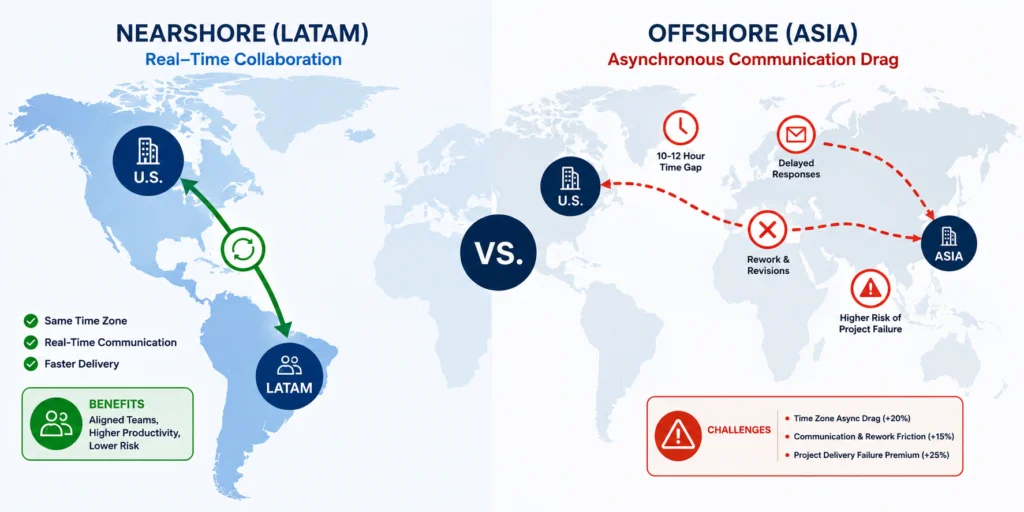
Many engineering leaders consider traditional offshore outsourcing (e.g., to Asia) because of low hourly rates. However, global B2B delivery benchmarks show that extreme time differentials actively destroy those savings through two distinct hidden variables:
Time Zone Async Drag Tax (+20%): A 10-to-12-hour time gap eliminates synchronous collaboration. Teams stall waiting a full business day for simple code reviews, forcing organizations to absorb a heavy management and project management overhead tax.
Communication & Rework Friction (+15%): Cultural alignment gaps and broken feedback loops result in misaligned sprint requirements. This introduces ongoing code correction drag, extending project timelines.
Project Delivery Failure Premium (+25%): According to industry studies by McKinsey and the Standish Group, highly asynchronous offshore delivery pipelines face a 35% higher partial or total project failure rate, requiring risk capital allocation to buffer against missed roadmap deadlines.
Quantifying the Hidden "Offshore Friction Taxes"
FAQs
What is the focus of an IT staff augmentation cost calculator?
An IT staff augmentation cost calculator maps out all visible and invisible expenses of localized tech hiring — such as benefits, taxes, and agency sourcing fees — and contrasts them with the all-inclusive flat contract rates of nearshore or offshore talent models.
How does nearshore staff augmentation eliminate recruiting overhead?
When utilizing a nearshore dedicated partner, the vendor completely absorbs the costs of talent acquisition, background screening, HR compliance, and local payroll taxes. Your business pays a single, predictable contract fee per resource without upfront placement layout penalties.
Why is LATAM nearshoring lower risk than offshore outsourcing?
LATAM nearshore developers operate in absolute time zone alignment with U.S. markets (EST/CST/PST). Real-time communication enables synchronized daily standups, pair programming, and immediate CI/CD feedback, completely removing the heavy asynchronous drag that’s common with offshore teams.
How does the calculator quantify the hidden costs of offshore outsourcing?
The calculator goes beyond raw hourly contract rates by modeling data from landmark global operations and project management studies. It automatically applies a 20% Time Zone Async Drag Tax derived from temporal distance data published in the Harvard Business School Working Paper Ecosystem, which establishes that time zone differences drastically slice synchronous communication lines and create heavy coordination friction. It also factors in a 15% Communication & Rework Loss using engineering benchmarks from the Project Management Institute (PMI) Thought Leadership Reports, which document that nearly half of challenged tech projects fail due to inaccurate requirements and communication drag. Finally, the model calculates a 25% Project Delivery Failure Premium to buffer against the high volatility metrics tracked globally in the Standish Group CHAOS Studies and joint software delivery research by McKinsey & Company, which proves that distant, asynchronous software pipelines face significantly higher rates of budget overruns, unmet targets, or outright cancellations.