AI Developer Augmentation: 7 Smart Strategies to Scale AI Teams

AI Developer Augmentation: 7 Smart Strategies to Scale AI Teams

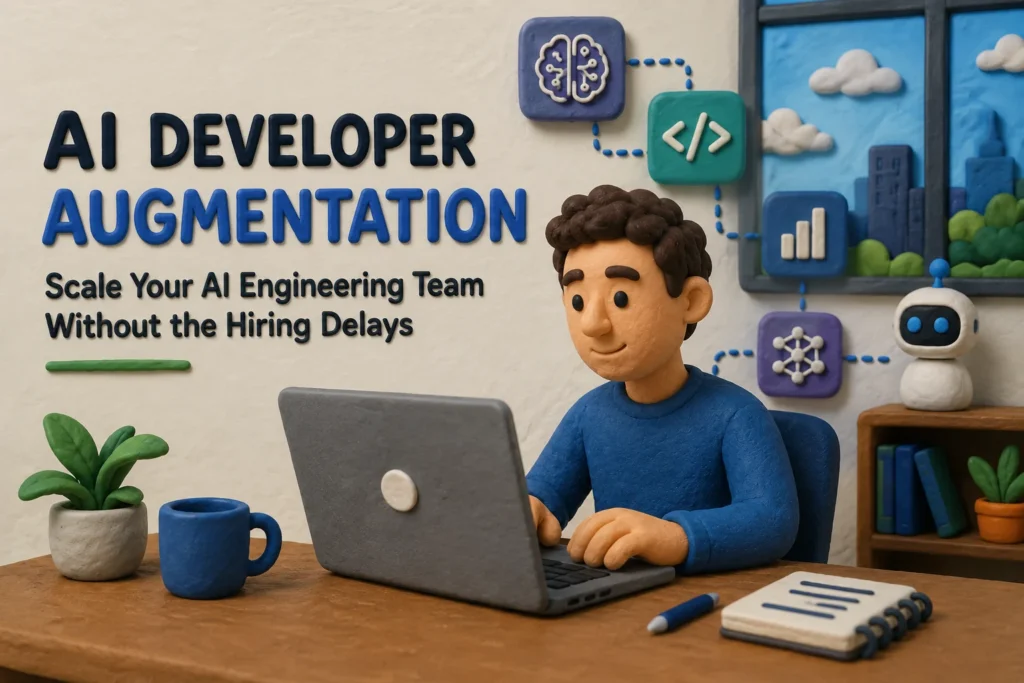
Claymation-style illustration of an AI developer working on a laptop, representing AI developer augmentation and the growth of modern engineering teams.
Discover how AI developer augmentation helps companies quickly access specialized AI talent without the delays of traditional hiring. Learn when to use staff augmentation, how to scale AI engineering teams, and why nearshore AI developers are becoming the preferred choice for U.S. businesses.
Share the Post:

AI is transforming every industry, but building an internal AI team has become one of the biggest hiring challenges for technology leaders. Companies are racing to integrate generative AI, machine learning, automation, and intelligent applications into their products, yet the demand for experienced AI engineers far exceeds the available talent.

Many organizations discover that recruiting senior AI specialists can take months, delaying product roadmaps and increasing development costs. At the same time, committing to permanent hires isn’t always the right business decision—especially for startups, growing SaaS companies, or organizations exploring AI initiatives before making long-term investments.

This is where ai developer augmentation has become a strategic solution. Instead of waiting months to recruit specialized professionals, businesses can quickly extend their existing engineering teams with experienced AI developers who integrate into current workflows, collaborate with internal teams, and accelerate AI initiatives without the overhead of traditional hiring.

Whether you’re building AI-powered SaaS products, implementing large language models (LLMs), developing recommendation engines, or modernizing internal processes with machine learning, augmenting your engineering team provides the flexibility needed to move faster while reducing hiring risks.

In this guide, you’ll learn when AI staff augmentation makes the most sense, how it compares to traditional hiring, what skills to prioritize, and how companies can successfully scale AI engineering teams with nearshore talent.

Why AI Developer Augmentation Is Growing So Quickly

Artificial intelligence has shifted from being an experimental technology to becoming a business priority. Organizations across industries are investing heavily in AI initiatives to improve customer experiences, automate workflows, optimize operations, and develop innovative digital products.

However, AI adoption has introduced a new challenge: finding experienced professionals capable of designing, building, deploying, and maintaining AI systems.

Several factors contribute to today’s AI talent shortage:

  • Rapid enterprise adoption of generative AI.
  • Increasing demand for machine learning engineers.
  • Limited supply of senior AI specialists.
  • Growing competition from large technology companies.
  • Rising compensation expectations for AI professionals.

According to industry research, AI-related job postings continue to grow significantly year over year, while experienced engineers remain among the most difficult technical roles to recruit. Companies often compete globally for the same small pool of highly specialized professionals.

As a result, many CTOs are reconsidering traditional hiring strategies and adopting engineering staff augmentation to maintain delivery speed without overextending internal recruiting teams.

Instead of delaying innovation projects while searching for permanent employees, organizations can add experienced specialists only when they are needed.

What Is AI Developer Augmentation?

AI developer augmentation is a staffing model that allows organizations to temporarily expand their engineering teams by adding experienced AI professionals who work alongside internal developers.

Unlike project outsourcing, augmented engineers become integrated members of your existing team. They participate in daily standups, sprint planning, architecture discussions, code reviews, and product planning while following your development processes and engineering standards.

This approach gives organizations access to highly specialized expertise without assuming the long-term costs and risks associated with permanent hiring.

Typical engagement models include:

Engagement ModelBest For
Full-time AI engineersLong-term AI initiatives
Part-time specialistsAdvisory or architecture support
Project-based augmentationProduct launches or MVPs
Specialized AI consultantsShort-term expertise for complex implementations

Because AI technologies evolve rapidly, companies often need different skill sets at different stages of a project. Staff augmentation provides the flexibility to adjust team composition as priorities change.

For example, an organization may initially require a machine learning engineer to develop predictive models, later bring in an MLOps specialist for deployment automation, and eventually add an AI infrastructure engineer to optimize cloud performance.

Rather than maintaining all these roles internally, businesses can scale resources according to actual project needs.

This flexibility explains why ai engineer staff augmentation services have become increasingly attractive for companies building AI-powered products.

Why Traditional AI Hiring Is Becoming More Difficult

Hiring AI professionals today differs significantly from recruiting traditional software engineers. The rapid adoption of generative AI has significantly increased demand for engineers with experience in LLMs, AI infrastructure, and machine learning. As NVIDIA explains in its guide to generative AI, advances in foundation models have accelerated enterprise adoption across industries, increasing the need for specialized AI engineering talent.

Modern AI projects require expertise across multiple disciplines, including software engineering, data science, cloud infrastructure, machine learning, and increasingly, generative AI technologies.

Organizations frequently compete for professionals with experience in:

  • Large Language Models (LLMs)
  • Retrieval-Augmented Generation (RAG)
  • Prompt engineering
  • Machine learning pipelines
  • Deep learning frameworks
  • AI infrastructure
  • MLOps
  • Vector databases
  • AI model deployment
  • Cloud-native AI platforms

These skills are relatively new, making experienced candidates scarce.

The hiring process itself presents additional challenges:

  • Longer recruitment cycles.
  • High salary expectations.
  • Multiple competing offers.
  • Limited regional talent pools.
  • Significant onboarding time.
  • High opportunity costs caused by delayed product releases.

For many businesses, waiting four to six months to fill an AI position simply isn’t practical.

Instead, they choose to hire AI developers for your team through augmentation partners that already maintain vetted talent networks across multiple specialties.

This approach enables engineering leaders to continue delivering products while reducing recruitment bottlenecks.

When Should You Hire AI Engineers for Your Team?

Not every AI initiative requires permanent employees.

In many situations, augmenting your engineering team offers a more efficient and lower-risk solution.

Some common scenarios include:

Launching a New AI Product

A SaaS company wants to introduce AI-powered features but lacks internal machine learning expertise.

Rather than building an entirely new department, they add experienced AI specialists who help design, develop, and deploy the solution while transferring knowledge to the existing engineering team.

Accelerating Product Roadmaps

Many organizations already have talented software engineers but lack bandwidth.

Adding remote AI engineers allows existing teams to continue core product development while dedicated AI specialists focus on new intelligent features.

Filling Specialized Skill Gaps

AI projects often require niche expertise that isn’t needed permanently.

Examples include:

  • LLM integration
  • Computer vision
  • NLP
  • Recommendation engines
  • Reinforcement learning
  • AI infrastructure optimization

Instead of recruiting full-time experts for temporary needs, companies can add AI talent without hiring full time and scale resources based on project demands.

Supporting Existing Engineering Teams

Sometimes the objective isn’t replacing internal developers.

It’s enabling them.

Experienced AI engineers can mentor software teams, establish AI best practices, review architectures, and accelerate implementation without disrupting existing development processes.

Organizations looking to scale AI engineering teams often find that augmentation provides the ideal balance between flexibility, speed, and technical expertise while preserving complete ownership of their products and intellectual property.

Common AI Roles Companies Augment

One of the biggest advantages of ai developer augmentation is the ability to bring in highly specialized professionals only when their expertise is required. Instead of hiring multiple full-time AI specialists, organizations can assemble the right combination of skills for each stage of an AI initiative.

As AI systems move into production, many organizations also require MLOps engineers to automate model deployment, monitoring, and lifecycle management. According to AWS’s guide to MLOps best practices, establishing automated deployment, monitoring, and governance processes is essential for scaling machine learning applications reliably.

Some of the most commonly augmented AI roles include:

AI RolePrimary Responsibilities
Machine Learning EngineerDevelops predictive models and machine learning algorithms.
AI Software EngineerBuilds AI-powered applications and integrates AI services into products.
Data EngineerDesigns and manages data pipelines that feed AI models.
MLOps EngineerAutomates model deployment, monitoring, and lifecycle management.
Prompt EngineerOptimizes prompts for large language models and generative AI applications.
NLP EngineerDevelops language-based AI features such as chatbots and document processing.
Computer Vision EngineerCreates image recognition and visual AI systems.
AI Solutions ArchitectDefines AI architecture, scalability, and cloud infrastructure.

Depending on the maturity of an AI project, companies may need only one specialist or an entire cross-functional AI squad.

For example, a startup launching its first AI-powered feature may initially require a Machine Learning Engineer and an AI Software Engineer. As adoption grows, additional specialists such as MLOps engineers or AI architects can join the team without requiring major organizational restructuring.

This flexibility allows businesses to adapt as AI initiatives evolve.

AI Developer Augmentation vs Traditional Hiring

For engineering leaders, choosing between permanent hiring and augmentation isn’t simply about cost—it’s about balancing speed, flexibility, expertise, and long-term business objectives.

The following comparison highlights the key differences.

FactorAI Developer AugmentationTraditional Hiring
Time to onboardDays or weeksSeveral months
Access to specialized skillsImmediateLimited by local talent market
Team scalabilityHighly flexibleSlower and more rigid
Long-term employment commitmentNoYes
Recruiting effortMinimalHigh
Operational flexibilityHighMedium
Ability to adjust team sizeEasyDifficult

Traditional hiring remains an excellent option when organizations have predictable long-term staffing needs and sufficient recruiting capacity.

However, many AI initiatives begin as innovation projects where business priorities may change rapidly.

In these situations, ai engineer staff augmentation services reduce risk by allowing companies to increase or decrease engineering capacity without disrupting existing teams.

This approach is particularly valuable for organizations exploring emerging AI technologies that may require different skill sets over time.

Why Nearshore AI Developers Offer a Competitive Advantage

Many companies automatically think of offshore outsourcing when expanding engineering teams.

However, nearshore AI developers have become an increasingly attractive alternative, particularly for organizations in the United States. If you’re still evaluating delivery models, our guide on Nearshore vs. Offshore Development explains the key differences in cost, collaboration, and scalability.

Nearshore development combines the cost advantages of international hiring with many of the collaboration benefits traditionally associated with local teams.

Key advantages include:

Real-Time Collaboration

Working across similar time zones enables AI engineers to participate in daily standups, sprint planning, design sessions, and architecture reviews without scheduling challenges.

This becomes especially important for AI initiatives where rapid experimentation and continuous feedback drive project success.

Strong Technical Talent

Latin America has become one of the fastest-growing regions for software engineering talent.

Universities throughout the region continue producing highly qualified software engineers with expertise in:

  • Artificial Intelligence
  • Machine Learning
  • Cloud Computing
  • Python
  • Data Engineering
  • DevOps
  • MLOps
  • Large Language Models

Many professionals also have extensive experience working with North American companies and distributed Agile teams.

Better Communication

Effective AI development requires constant collaboration between product managers, engineering leaders, data scientists, and software developers.

Nearshore teams typically provide:

  • High English proficiency
  • Strong communication skills
  • Familiarity with Agile methodologies
  • Cultural compatibility with U.S. organizations

These factors reduce misunderstandings and accelerate delivery.

Greater Scalability

As AI initiatives grow, engineering leaders often need additional specialists quickly.

Nearshore staffing models make it easier to expand teams without restarting lengthy recruitment processes each time new expertise is required.

How to Successfully Integrate Remote AI Engineers

Adding experienced AI professionals is only part of the equation.

Successful engineering leaders also establish processes that help augmented engineers become productive quickly.

The following best practices consistently produce better outcomes.

Define Clear Technical Objectives

Before onboarding AI specialists, clearly identify:

  • Business goals
  • Technical deliverables
  • Success metrics
  • Expected timelines
  • Ownership boundaries

Clear expectations reduce onboarding time and improve collaboration.

Integrate Engineers Into Existing Teams

Augmented engineers should participate in:

  • Daily standups
  • Sprint planning
  • Code reviews
  • Design discussions
  • Retrospectives
  • Product planning sessions

Treating external engineers as part of the internal team creates stronger collaboration and improves long-term knowledge sharing.

Standardize Documentation

AI systems often involve multiple technologies and rapidly changing requirements.

Comprehensive documentation should include:

  • Model architecture
  • API documentation
  • Infrastructure diagrams
  • Data pipelines
  • Deployment processes
  • Monitoring strategies

Good documentation enables both internal and augmented engineers to work more efficiently.

Prioritize Security

AI applications frequently process sensitive business or customer data.

Organizations should establish clear guidelines regarding:

  • Access permissions
  • Data governance
  • Secure development practices
  • Compliance requirements
  • Intellectual property protection

Strong security practices allow companies to outsource AI engineers confidently while maintaining full control over proprietary information.

Building an AI Team That Can Scale

One of the biggest mistakes organizations make is assuming they need to hire every AI specialist before launching an initiative.

Successful companies often build AI capabilities incrementally.

A typical growth path looks like this:

Growth StageRecommended AI Team
AI ExplorationAI Consultant + Machine Learning Engineer
MVP DevelopmentAI Software Engineer + ML Engineer + Data Engineer
Product LaunchAdd MLOps Engineer and QA support
Growth PhaseExpand with AI Architects, NLP Specialists, and additional Software Engineers
Enterprise ScaleDedicated cross-functional AI engineering teams

This staged approach minimizes hiring risks while allowing organizations to validate business outcomes before making significant long-term investments.

Rather than committing to large permanent teams immediately, businesses can scale AI engineering teams according to customer demand, product adoption, and strategic priorities.

For many CTOs, this flexible model provides the best balance between innovation, operational efficiency, and financial sustainability.

How TechAID Helps Companies Scale AI Engineering Teams

Building AI capabilities requires more than simply finding engineers with machine learning experience. Successful AI initiatives depend on assembling the right combination of technical expertise, communication skills, and collaboration practices that allow new team members to contribute immediately.

TechAID helps U.S. companies extend their engineering organizations with experienced nearshore AI developers who integrate seamlessly into existing Agile teams. Whether you need to accelerate a proof of concept, launch AI-powered features, or expand an existing machine learning initiative, our staff augmentation model gives you access to specialized talent without the delays of traditional recruiting.

Our engineers have experience across modern AI technologies, including:

  • Large Language Models (LLMs)
  • Retrieval-Augmented Generation (RAG)
  • Machine Learning
  • Natural Language Processing
  • Computer Vision
  • Python AI ecosystems
  • MLOps
  • Cloud-native AI development
  • API integrations
  • AI-enabled SaaS applications

Rather than replacing your internal team, our specialists become an extension of your engineering organization, participating in daily standups, sprint planning, architecture discussions, and code reviews.

This collaborative approach enables companies to maintain full ownership of their products while accelerating delivery with experienced AI professionals.

Whether your goal is to hire AI developers for your team, strengthen an existing engineering department, or outsource AI engineers for a strategic initiative, staff augmentation provides the flexibility needed to move quickly while minimizing hiring risk.

Conclusion

Artificial intelligence is rapidly becoming a competitive necessity, but recruiting experienced AI professionals has never been more challenging. Long hiring cycles, increasing salary expectations, and an ongoing AI talent shortage make it difficult for organizations to execute ambitious product roadmaps using traditional hiring alone.

AI developer augmentation offers a practical alternative.

By extending existing engineering teams with experienced specialists, companies can accelerate AI initiatives, access highly specialized expertise, and adapt team capacity as business priorities evolve.

Rather than committing to permanent hires before project requirements are fully understood, organizations gain the flexibility to build AI capabilities incrementally while maintaining complete control over product development.

For technology leaders seeking to innovate faster, reduce recruitment bottlenecks, and deliver AI-powered products with confidence, engineering staff augmentation has become one of the most effective strategies available.

If your organization is planning its next AI initiative, contact TechAID to learn how our AI developer augmentation services can help you scale your engineering team faster with experienced nearshore AI engineers.

Key Takeaways
  • AI developer augmentation enables companies to access specialized AI talent faster than traditional hiring.

  • Nearshore AI engineers help organizations scale AI initiatives with greater flexibility, collaboration, and cost efficiency.

  • Staff augmentation allows businesses to build and grow AI engineering teams without the long-term commitment of full-time hiring.

  • AI is transforming every industry, but building an internal AI team has become one of the biggest hiring challenges for technology leaders. Companies are racing to integrate generative AI, machine learning, automation, and intelligent applications into their products, yet the demand for experienced AI engineers far exceeds the available talent.

    Many organizations discover that recruiting senior AI specialists can take months, delaying product roadmaps and increasing development costs. At the same time, committing to permanent hires isn’t always the right business decision—especially for startups, growing SaaS companies, or organizations exploring AI initiatives before making long-term investments.

    This is where ai developer augmentation has become a strategic solution. Instead of waiting months to recruit specialized professionals, businesses can quickly extend their existing engineering teams with experienced AI developers who integrate into current workflows, collaborate with internal teams, and accelerate AI initiatives without the overhead of traditional hiring.

    Whether you’re building AI-powered SaaS products, implementing large language models (LLMs), developing recommendation engines, or modernizing internal processes with machine learning, augmenting your engineering team provides the flexibility needed to move faster while reducing hiring risks.

    In this guide, you’ll learn when AI staff augmentation makes the most sense, how it compares to traditional hiring, what skills to prioritize, and how companies can successfully scale AI engineering teams with nearshore talent.

    Why AI Developer Augmentation Is Growing So Quickly

    Artificial intelligence has shifted from being an experimental technology to becoming a business priority. Organizations across industries are investing heavily in AI initiatives to improve customer experiences, automate workflows, optimize operations, and develop innovative digital products.

    However, AI adoption has introduced a new challenge: finding experienced professionals capable of designing, building, deploying, and maintaining AI systems.

    Several factors contribute to today’s AI talent shortage:

    • Rapid enterprise adoption of generative AI.
    • Increasing demand for machine learning engineers.
    • Limited supply of senior AI specialists.
    • Growing competition from large technology companies.
    • Rising compensation expectations for AI professionals.

    According to industry research, AI-related job postings continue to grow significantly year over year, while experienced engineers remain among the most difficult technical roles to recruit. Companies often compete globally for the same small pool of highly specialized professionals.

    As a result, many CTOs are reconsidering traditional hiring strategies and adopting engineering staff augmentation to maintain delivery speed without overextending internal recruiting teams.

    Instead of delaying innovation projects while searching for permanent employees, organizations can add experienced specialists only when they are needed.

    What Is AI Developer Augmentation?

    AI developer augmentation is a staffing model that allows organizations to temporarily expand their engineering teams by adding experienced AI professionals who work alongside internal developers.

    Unlike project outsourcing, augmented engineers become integrated members of your existing team. They participate in daily standups, sprint planning, architecture discussions, code reviews, and product planning while following your development processes and engineering standards.

    This approach gives organizations access to highly specialized expertise without assuming the long-term costs and risks associated with permanent hiring.

    Typical engagement models include:

    Engagement ModelBest For
    Full-time AI engineersLong-term AI initiatives
    Part-time specialistsAdvisory or architecture support
    Project-based augmentationProduct launches or MVPs
    Specialized AI consultantsShort-term expertise for complex implementations

    Because AI technologies evolve rapidly, companies often need different skill sets at different stages of a project. Staff augmentation provides the flexibility to adjust team composition as priorities change.

    For example, an organization may initially require a machine learning engineer to develop predictive models, later bring in an MLOps specialist for deployment automation, and eventually add an AI infrastructure engineer to optimize cloud performance.

    Rather than maintaining all these roles internally, businesses can scale resources according to actual project needs.

    This flexibility explains why ai engineer staff augmentation services have become increasingly attractive for companies building AI-powered products.

    Why Traditional AI Hiring Is Becoming More Difficult

    Hiring AI professionals today differs significantly from recruiting traditional software engineers. The rapid adoption of generative AI has significantly increased demand for engineers with experience in LLMs, AI infrastructure, and machine learning. As NVIDIA explains in its guide to generative AI, advances in foundation models have accelerated enterprise adoption across industries, increasing the need for specialized AI engineering talent.

    Modern AI projects require expertise across multiple disciplines, including software engineering, data science, cloud infrastructure, machine learning, and increasingly, generative AI technologies.

    Organizations frequently compete for professionals with experience in:

    • Large Language Models (LLMs)
    • Retrieval-Augmented Generation (RAG)
    • Prompt engineering
    • Machine learning pipelines
    • Deep learning frameworks
    • AI infrastructure
    • MLOps
    • Vector databases
    • AI model deployment
    • Cloud-native AI platforms

    These skills are relatively new, making experienced candidates scarce.

    The hiring process itself presents additional challenges:

    • Longer recruitment cycles.
    • High salary expectations.
    • Multiple competing offers.
    • Limited regional talent pools.
    • Significant onboarding time.
    • High opportunity costs caused by delayed product releases.

    For many businesses, waiting four to six months to fill an AI position simply isn’t practical.

    Instead, they choose to hire AI developers for your team through augmentation partners that already maintain vetted talent networks across multiple specialties.

    This approach enables engineering leaders to continue delivering products while reducing recruitment bottlenecks.

    When Should You Hire AI Engineers for Your Team?

    Not every AI initiative requires permanent employees.

    In many situations, augmenting your engineering team offers a more efficient and lower-risk solution.

    Some common scenarios include:

    Launching a New AI Product

    A SaaS company wants to introduce AI-powered features but lacks internal machine learning expertise.

    Rather than building an entirely new department, they add experienced AI specialists who help design, develop, and deploy the solution while transferring knowledge to the existing engineering team.

    Accelerating Product Roadmaps

    Many organizations already have talented software engineers but lack bandwidth.

    Adding remote AI engineers allows existing teams to continue core product development while dedicated AI specialists focus on new intelligent features.

    Filling Specialized Skill Gaps

    AI projects often require niche expertise that isn’t needed permanently.

    Examples include:

    • LLM integration
    • Computer vision
    • NLP
    • Recommendation engines
    • Reinforcement learning
    • AI infrastructure optimization

    Instead of recruiting full-time experts for temporary needs, companies can add AI talent without hiring full time and scale resources based on project demands.

    Supporting Existing Engineering Teams

    Sometimes the objective isn’t replacing internal developers.

    It’s enabling them.

    Experienced AI engineers can mentor software teams, establish AI best practices, review architectures, and accelerate implementation without disrupting existing development processes.

    Organizations looking to scale AI engineering teams often find that augmentation provides the ideal balance between flexibility, speed, and technical expertise while preserving complete ownership of their products and intellectual property.

    Common AI Roles Companies Augment

    One of the biggest advantages of ai developer augmentation is the ability to bring in highly specialized professionals only when their expertise is required. Instead of hiring multiple full-time AI specialists, organizations can assemble the right combination of skills for each stage of an AI initiative.

    As AI systems move into production, many organizations also require MLOps engineers to automate model deployment, monitoring, and lifecycle management. According to AWS’s guide to MLOps best practices, establishing automated deployment, monitoring, and governance processes is essential for scaling machine learning applications reliably.

    Some of the most commonly augmented AI roles include:

    AI RolePrimary Responsibilities
    Machine Learning EngineerDevelops predictive models and machine learning algorithms.
    AI Software EngineerBuilds AI-powered applications and integrates AI services into products.
    Data EngineerDesigns and manages data pipelines that feed AI models.
    MLOps EngineerAutomates model deployment, monitoring, and lifecycle management.
    Prompt EngineerOptimizes prompts for large language models and generative AI applications.
    NLP EngineerDevelops language-based AI features such as chatbots and document processing.
    Computer Vision EngineerCreates image recognition and visual AI systems.
    AI Solutions ArchitectDefines AI architecture, scalability, and cloud infrastructure.

    Depending on the maturity of an AI project, companies may need only one specialist or an entire cross-functional AI squad.

    For example, a startup launching its first AI-powered feature may initially require a Machine Learning Engineer and an AI Software Engineer. As adoption grows, additional specialists such as MLOps engineers or AI architects can join the team without requiring major organizational restructuring.

    This flexibility allows businesses to adapt as AI initiatives evolve.

    AI Developer Augmentation vs Traditional Hiring

    For engineering leaders, choosing between permanent hiring and augmentation isn’t simply about cost—it’s about balancing speed, flexibility, expertise, and long-term business objectives.

    The following comparison highlights the key differences.

    FactorAI Developer AugmentationTraditional Hiring
    Time to onboardDays or weeksSeveral months
    Access to specialized skillsImmediateLimited by local talent market
    Team scalabilityHighly flexibleSlower and more rigid
    Long-term employment commitmentNoYes
    Recruiting effortMinimalHigh
    Operational flexibilityHighMedium
    Ability to adjust team sizeEasyDifficult

    Traditional hiring remains an excellent option when organizations have predictable long-term staffing needs and sufficient recruiting capacity.

    However, many AI initiatives begin as innovation projects where business priorities may change rapidly.

    In these situations, ai engineer staff augmentation services reduce risk by allowing companies to increase or decrease engineering capacity without disrupting existing teams.

    This approach is particularly valuable for organizations exploring emerging AI technologies that may require different skill sets over time.

    Why Nearshore AI Developers Offer a Competitive Advantage

    Many companies automatically think of offshore outsourcing when expanding engineering teams.

    However, nearshore AI developers have become an increasingly attractive alternative, particularly for organizations in the United States. If you’re still evaluating delivery models, our guide on Nearshore vs. Offshore Development explains the key differences in cost, collaboration, and scalability.

    Nearshore development combines the cost advantages of international hiring with many of the collaboration benefits traditionally associated with local teams.

    Key advantages include:

    Real-Time Collaboration

    Working across similar time zones enables AI engineers to participate in daily standups, sprint planning, design sessions, and architecture reviews without scheduling challenges.

    This becomes especially important for AI initiatives where rapid experimentation and continuous feedback drive project success.

    Strong Technical Talent

    Latin America has become one of the fastest-growing regions for software engineering talent.

    Universities throughout the region continue producing highly qualified software engineers with expertise in:

    • Artificial Intelligence
    • Machine Learning
    • Cloud Computing
    • Python
    • Data Engineering
    • DevOps
    • MLOps
    • Large Language Models

    Many professionals also have extensive experience working with North American companies and distributed Agile teams.

    Better Communication

    Effective AI development requires constant collaboration between product managers, engineering leaders, data scientists, and software developers.

    Nearshore teams typically provide:

    • High English proficiency
    • Strong communication skills
    • Familiarity with Agile methodologies
    • Cultural compatibility with U.S. organizations

    These factors reduce misunderstandings and accelerate delivery.

    Greater Scalability

    As AI initiatives grow, engineering leaders often need additional specialists quickly.

    Nearshore staffing models make it easier to expand teams without restarting lengthy recruitment processes each time new expertise is required.

    How to Successfully Integrate Remote AI Engineers

    Adding experienced AI professionals is only part of the equation.

    Successful engineering leaders also establish processes that help augmented engineers become productive quickly.

    The following best practices consistently produce better outcomes.

    Define Clear Technical Objectives

    Before onboarding AI specialists, clearly identify:

    • Business goals
    • Technical deliverables
    • Success metrics
    • Expected timelines
    • Ownership boundaries

    Clear expectations reduce onboarding time and improve collaboration.

    Integrate Engineers Into Existing Teams

    Augmented engineers should participate in:

    • Daily standups
    • Sprint planning
    • Code reviews
    • Design discussions
    • Retrospectives
    • Product planning sessions

    Treating external engineers as part of the internal team creates stronger collaboration and improves long-term knowledge sharing.

    Standardize Documentation

    AI systems often involve multiple technologies and rapidly changing requirements.

    Comprehensive documentation should include:

    • Model architecture
    • API documentation
    • Infrastructure diagrams
    • Data pipelines
    • Deployment processes
    • Monitoring strategies

    Good documentation enables both internal and augmented engineers to work more efficiently.

    Prioritize Security

    AI applications frequently process sensitive business or customer data.

    Organizations should establish clear guidelines regarding:

    • Access permissions
    • Data governance
    • Secure development practices
    • Compliance requirements
    • Intellectual property protection

    Strong security practices allow companies to outsource AI engineers confidently while maintaining full control over proprietary information.

    Building an AI Team That Can Scale

    One of the biggest mistakes organizations make is assuming they need to hire every AI specialist before launching an initiative.

    Successful companies often build AI capabilities incrementally.

    A typical growth path looks like this:

    Growth StageRecommended AI Team
    AI ExplorationAI Consultant + Machine Learning Engineer
    MVP DevelopmentAI Software Engineer + ML Engineer + Data Engineer
    Product LaunchAdd MLOps Engineer and QA support
    Growth PhaseExpand with AI Architects, NLP Specialists, and additional Software Engineers
    Enterprise ScaleDedicated cross-functional AI engineering teams

    This staged approach minimizes hiring risks while allowing organizations to validate business outcomes before making significant long-term investments.

    Rather than committing to large permanent teams immediately, businesses can scale AI engineering teams according to customer demand, product adoption, and strategic priorities.

    For many CTOs, this flexible model provides the best balance between innovation, operational efficiency, and financial sustainability.

    How TechAID Helps Companies Scale AI Engineering Teams

    Building AI capabilities requires more than simply finding engineers with machine learning experience. Successful AI initiatives depend on assembling the right combination of technical expertise, communication skills, and collaboration practices that allow new team members to contribute immediately.

    TechAID helps U.S. companies extend their engineering organizations with experienced nearshore AI developers who integrate seamlessly into existing Agile teams. Whether you need to accelerate a proof of concept, launch AI-powered features, or expand an existing machine learning initiative, our staff augmentation model gives you access to specialized talent without the delays of traditional recruiting.

    Our engineers have experience across modern AI technologies, including:

    • Large Language Models (LLMs)
    • Retrieval-Augmented Generation (RAG)
    • Machine Learning
    • Natural Language Processing
    • Computer Vision
    • Python AI ecosystems
    • MLOps
    • Cloud-native AI development
    • API integrations
    • AI-enabled SaaS applications

    Rather than replacing your internal team, our specialists become an extension of your engineering organization, participating in daily standups, sprint planning, architecture discussions, and code reviews.

    This collaborative approach enables companies to maintain full ownership of their products while accelerating delivery with experienced AI professionals.

    Whether your goal is to hire AI developers for your team, strengthen an existing engineering department, or outsource AI engineers for a strategic initiative, staff augmentation provides the flexibility needed to move quickly while minimizing hiring risk.

    Conclusion

    Artificial intelligence is rapidly becoming a competitive necessity, but recruiting experienced AI professionals has never been more challenging. Long hiring cycles, increasing salary expectations, and an ongoing AI talent shortage make it difficult for organizations to execute ambitious product roadmaps using traditional hiring alone.

    AI developer augmentation offers a practical alternative.

    By extending existing engineering teams with experienced specialists, companies can accelerate AI initiatives, access highly specialized expertise, and adapt team capacity as business priorities evolve.

    Rather than committing to permanent hires before project requirements are fully understood, organizations gain the flexibility to build AI capabilities incrementally while maintaining complete control over product development.

    For technology leaders seeking to innovate faster, reduce recruitment bottlenecks, and deliver AI-powered products with confidence, engineering staff augmentation has become one of the most effective strategies available.

    If your organization is planning its next AI initiative, contact TechAID to learn how our AI developer augmentation services can help you scale your engineering team faster with experienced nearshore AI engineers.

    Related Posts