Technology budgets are under pressure from every direction. Hiring costs remain elevated, specialized talent is scarce, and executive teams are expected to deliver more innovation without increasing operational overhead.
Against that backdrop, Staff augmentation vs outsourcing has become one of the most important sourcing decisions facing CFOs, CIOs, and CTOs. The wrong choice can create management bottlenecks, budget overruns, and delivery delays. The right choice can improve execution speed, provide access to specialized talent, and create greater financial flexibility.
Why Traditional Outsourcing Decisions Are Changing
The way organizations think about outsourcing has changed dramatically over the last few years.
According to Deloitte’s 2024 Global Outsourcing Survey, 80% of executives plan to maintain or increase investment in third-party outsourcing, while 70% have selectively brought previously outsourced work back in-house during the past five years. (Deloitte)
That combination may seem contradictory at first glance.
It is actually evidence that mature organizations are becoming more selective. Instead of asking whether outsourcing works, they are determining which sourcing model best fits a specific business objective.
For technology initiatives, that often leads directly to the question of Staff augmentation vs outsourcing.
Understanding Staff Augmentation vs Outsourcing
Although the terms are frequently used interchangeably, they solve very different business problems.
Staff Augmentation
Staff augmentation adds external professionals directly into an existing team structure.
The client maintains responsibility for:
- Project management
- Product ownership
- Delivery oversight
- Technical direction
- Prioritization
External developers become extensions of the internal organization.
This approach is often preferred when companies already have strong leadership and delivery processes in place but need additional capacity or specialized expertise.
Project Outsourcing
Project outsourcing shifts responsibility for delivering a defined outcome to a third party.
The provider typically assumes responsibility for:
- Resource management
- Delivery execution
- Team structure
- Project coordination
- Operational management
This model is frequently chosen when internal bandwidth is limited or when organizations lack the expertise necessary to manage the work directly.
The distinction matters because Staff augmentation vs outsourcing is fundamentally a decision about control.
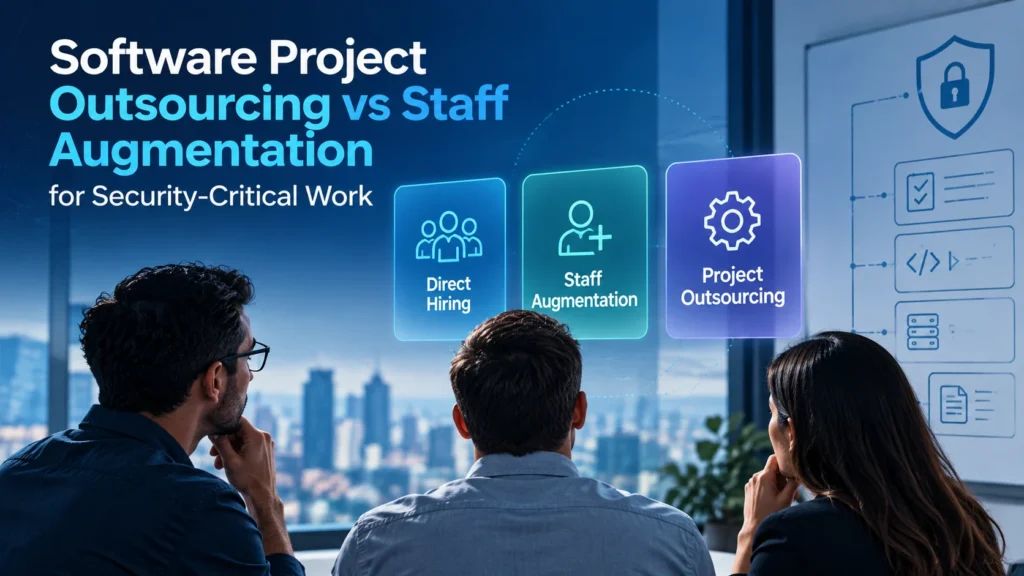
Staff augmentation vs outsourcing comparison for enterprise technology teams
When Dedicated Development Teams Make Sense
Many organizations land somewhere between the two extremes.
Rather than choosing pure augmentation or full project outsourcing, they build dedicated development teams that operate as long-term extensions of their business.
This hybrid model has become increasingly common because it balances flexibility with accountability.
According to Deloitte, organizations are increasingly adopting multidimensional sourcing strategies that combine outsourcing, insourcing, and other workforce models to optimize outcomes rather than relying on a single approach. (Deloitte)
Dedicated teams often work best when:
- Product roadmaps extend beyond twelve months
- Domain knowledge is strategically important
- Talent shortages make direct hiring difficult
- Delivery requires ongoing collaboration with internal teams
For many organizations evaluating managed teams vs staff augmentation, the dedicated team model offers a practical middle ground.
The Financial Tradeoffs CFOs Often Miss
The discussion around Staff augmentation vs outsourcing frequently focuses on labor rates.
That is rarely where the real economics are determined.
Consider the following factors:
| Cost Category | Staff Augmentation | Project Outsourcing |
|---|---|---|
| Labor Cost | Predictable | Predictable |
| Internal Management Time | Higher | Lower |
| Scope Flexibility | High | Moderate |
| Governance Complexity | Moderate | Lower |
| Delivery Control | High | Lower |
| Vendor Dependency | Lower | Higher |
| Knowledge Retention | High | Moderate |
Many outsourcing business cases underestimate the cost of internal oversight.
At the same time, organizations sometimes underestimate the long-term value of retaining institutional knowledge when using staff augmentation.
Neither model is inherently superior.
The economics depend entirely on the nature of the work.
Organizations considering hiring developers vs outsourcing should evaluate total delivery cost rather than simply comparing hourly rates.
Choosing the Right Model for Different Workloads
Not all work should be sourced the same way.
A practical framework looks like this:
Staff Augmentation Works Best For
- Product engineering
- Agile development teams
- Long-term platform ownership
- Strategic technology initiatives
- Internal capability building
Project Outsourcing Works Best For
- Fixed-scope projects
- Legacy modernization efforts
- One-time implementations
- Short-term initiatives
- Specialized delivery requirements
This is where Staff augmentation vs outsourcing becomes a portfolio decision rather than an ideological one.
The strongest organizations use both models.
The Operational Framework
Before selecting a sourcing model, leadership teams should answer the following questions.
Governance
- Do we have internal project leadership?
- Do we have product ownership capacity?
- Can we effectively manage external contributors?
Talent
- Are required skills available internally?
- Is direct hiring realistic within our timeline?
- Will knowledge retention matter long-term?
Delivery
- Is scope clearly defined?
- How much flexibility will be required?
- How often will priorities change?
Financial
- Have we calculated management overhead?
- Have we estimated transition costs?
- Have we included knowledge-transfer requirements?
Organizations that answer these questions objectively usually reach the correct sourcing decision.
Building a Flexible Delivery Model
The most effective sourcing strategies rarely rely on a single model.
Deloitte’s research shows organizations increasingly combine outsourcing, insourcing, and extended workforce strategies to balance cost, control, and agility. (Deloitte)
For CFOs, the objective is not choosing sides in the Staff augmentation vs outsourcing debate. The objective is identifying which model produces the strongest business outcome for a specific workload. Strategic initiatives often benefit from augmented teams that preserve institutional knowledge, while defined projects may benefit from outsourced delivery structures that reduce management burden.
Organizations looking to implement this type of flexible sourcing strategy often benefit from working with a partner capable of supporting multiple engagement models. TechAID helps companies build scalable delivery organizations through staff augmentation, direct recruiting, and project-based services, allowing leadership teams to align talent strategy with business objectives rather than forcing every initiative into a single delivery model. If you’d like to evaluate which model best fits your current roadmap, schedule a strategic consultation.