
The demand for LATAM software developers continues to accelerate in 2026 as U.S. companies face increasing pressure to scale engineering teams quickly, reduce hiring costs, and access specialized technical talent.
From startups racing to launch products to enterprises modernizing legacy systems, organizations are discovering that hiring developers across Latin America provides a powerful combination of technical expertise, time zone alignment, and operational efficiency.
But why are companies increasingly looking south for engineering talent?
In this article, we’ll explore the factors driving the demand for LATAM developers, the latest regional hiring trends, and why Latin America has become one of the most strategic talent markets for technology organizations.
The Global Software Talent Shortage Continues
The software industry remains highly competitive for technical talent. Recent developer surveys continue to show strong demand for software engineering talent across global markets.
Organizations across North America continue to struggle with:
- Long hiring cycles
- Rising engineering salaries
- Increasing turnover
- Competition from large technology companies
- Limited availability of senior engineers
At the same time, digital transformation initiatives continue to expand.
Companies are investing heavily in:
- Artificial Intelligence
- Cloud migration
- Cybersecurity
- Data engineering
- SaaS platforms
- Product development
The result is a widening gap between talent demand and talent availability.
Many businesses can no longer rely exclusively on domestic hiring strategies.
This reality is one of the primary reasons why the demand for LATAM software developers has grown dramatically.
Why Companies Hire LATAM Developers
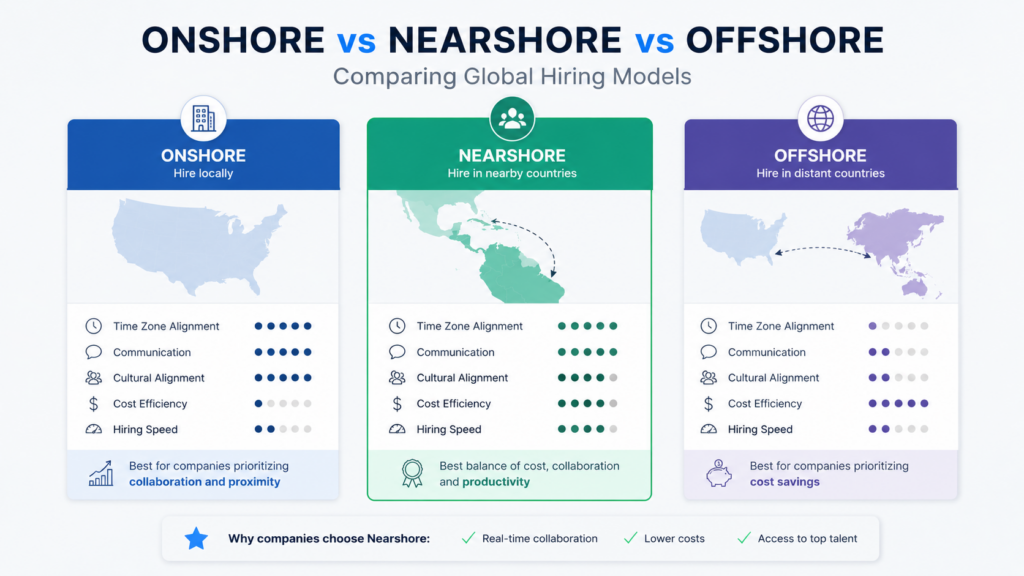
When evaluating international hiring options, companies typically compare three models:
| Model | Cost Savings | Time Zone Alignment | Communication | Collaboration |
|---|---|---|---|---|
| Onshore | Low | Excellent | Excellent | Excellent |
| Offshore | High | Poor | Moderate | Moderate |
| Nearshore (LATAM) | High | Excellent | Excellent | Excellent |
For U.S. organizations, Latin America offers a unique balance between affordability and productivity.Many organizations are adopting nearshore software development models to access qualified engineering talent without the delays of traditional hiring.
Instead of sacrificing collaboration for lower costs, businesses gain access to highly qualified engineers who can work during overlapping business hours.
This significantly improves:
- Agile development
- Sprint planning
- Standups
- Product collaboration
- Cross-functional communication
- Engineering velocity
7 Reasons LATAM Software Developers Are in High Demand
1. Strong Technical Talent Across the Region
Latin America has developed a mature technology ecosystem.
GitHub’s annual developer report highlights the continued growth of software development communities worldwide.
Countries such as:
- Argentina
- Brazil
- Mexico
- Colombia
- Chile
- Uruguay
produce thousands of engineering graduates annually.
Many software developers in Latin America have experience working with international companies and modern technology stacks including:
- React
- Angular
- Node.js
- Python
- Java
- .NET
- AWS
- Azure
- Kubernetes
The technical capabilities available throughout the region continue to attract global employers.
2. Time Zone Alignment with the United States
One of the biggest advantages of hiring remote developers LATAM companies offer is real-time collaboration.
Unlike many offshore regions that require significant schedule adjustments, Latin American engineers often work within one to three hours of U.S. business time.
Benefits include:
- Faster decision-making
- More productive meetings
- Better sprint execution
- Reduced project delays
- Stronger team integration
This advantage is especially important for agile development teams.
3. Significant Cost Efficiency
Engineering salaries in the United States continue to rise.
For many organizations, scaling a development team domestically has become increasingly expensive.
Hiring software developers in Latin America allows companies to:
- Reduce recruiting costs
- Lower payroll expenses
- Expand engineering capacity
- Improve budget predictability
Importantly, businesses often achieve these savings without compromising quality.
The goal is no longer finding the cheapest developers.
It is finding the best value.
4. English Proficiency Continues to Improve
A decade ago, language barriers were frequently cited as a concern.
Today, many LATAM developers work daily with U.S.-based clients and distributed teams.
English proficiency has improved significantly due to:
- Global outsourcing growth
- Remote work adoption
- International education programs
- Multinational technology companies operating in the region
This has reduced communication friction and increased productivity.
5. Remote Work Accelerated Global Exposure
The pandemic fundamentally changed how organizations think about talent.
Companies learned that exceptional engineers do not need to sit in the same office—or even the same country.
As remote work became mainstream, Latin American engineers gained greater visibility and access to global opportunities.
This accelerated:
- International hiring
- Remote-first organizations
- Distributed engineering teams
- Cross-border collaboration
As a result, the demand for LATAM developers increased dramatically.
6. Growing Startup and Technology Ecosystems
Latin America’s technology sector has expanded rapidly.
Major cities now host thriving startup ecosystems, including:
- Buenos Aires
- São Paulo
- Mexico City
- Medellín
- Bogotá
- Santiago
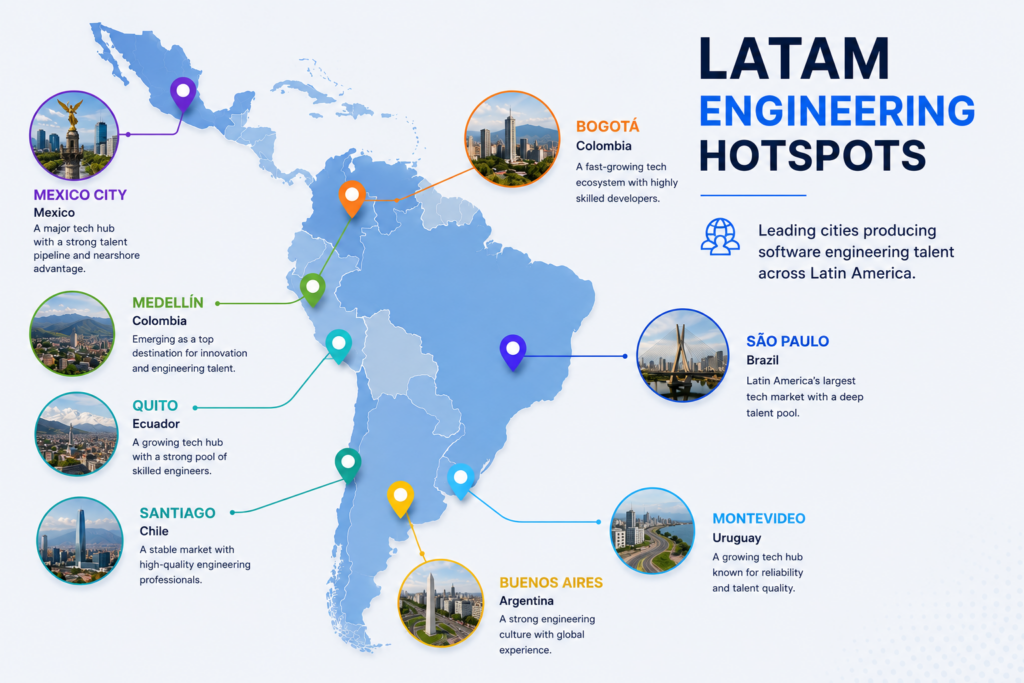
These innovation hubs have produced engineers with experience in:
- Venture-backed startups
- Fintech
- E-commerce
- Healthcare technology
- AI applications
- Enterprise software
The region’s talent pool is becoming increasingly sophisticated.
7. Nearshore Hiring Reduces Scaling Risk
Many organizations face a difficult challenge:
How do you scale engineering capacity quickly without increasing operational risk?
Nearshore hiring provides flexibility. Organizations that need to expand quickly often use dedicated development teams to accelerate delivery while maintaining engineering quality.
Companies can:
- Add specialized talent rapidly
- Scale teams up or down
- Accelerate product delivery
- Reduce recruitment bottlenecks
This flexibility is a major reason why companies hire LATAM developers instead of relying solely on traditional hiring.
LATAM Tech Talent Trends in 2026
Several important trends are shaping the future of hiring in the region.
AI and Machine Learning Skills Are Growing
Demand for engineers experienced in:
- Generative AI
- LLM integrations
- Machine learning
- Data engineering
continues to increase.
Organizations seeking AI expertise are increasingly evaluating Latin American talent pools.
DevOps and Cloud Expertise Is Expanding
Companies are actively recruiting:
- Cloud architects
- Site reliability engineers
- DevOps specialists
- Platform engineers
as cloud adoption continues to accelerate.
Senior Engineers Are Becoming More Accessible
Historically, international hiring often focused on junior or mid-level talent.
Today, many senior Latin American engineers possess extensive experience leading distributed teams and enterprise-scale projects.
This has made nearshore hiring increasingly attractive for leadership-level technical roles.
Which LATAM Countries Are Leading the Market?
While talent exists across the region, several countries consistently attract international employers.
| Country | Key Strengths |
| Argentina | Strong engineering education, English proficiency |
| Brazil | Largest talent pool in LATAM |
| Mexico | Geographic proximity to U.S. |
| Colombia | Rapidly growing technology sector |
| Chile | Stable business environment |
| Uruguay | High-quality software engineering talent |
Each market offers unique advantages depending on hiring goals and technical requirements.
Common Roles Companies Hire in Latin America
Organizations increasingly recruit LATAM developers across a wide range of disciplines.
Popular roles include:
Software Engineering
- Frontend Developers
- Backend Developers
- Full Stack Developers
Cloud & Infrastructure
- DevOps Engineers
- Platform Engineers
- Cloud Architects
Data & AI
- Data Engineers
- Machine Learning Engineers
- AI Specialists
Quality Assurance
- QA Engineers
- Automation Test Engineers
- SDET Professionals
Product & Design
- Product Managers
- UX/UI Designers
- Product Designers
Challenges of Hiring LATAM Talent
Despite the advantages, organizations should be aware of several challenges.
Competition Is Increasing
As more companies discover the value of Latin American talent, competition for top engineers continues to grow.
Regional Variability
Each country has unique:
- Labor regulations
- Compensation expectations
- Talent availability
Recruitment Complexity
Identifying qualified candidates requires:
- Technical screening
- Cultural assessment
- English evaluation
- Remote readiness verification
Working with experienced hiring partners can significantly reduce these challenges.
TechAID Perspective: Building High-Performance Nearshore Teams
At TechAID, we’ve observed a significant shift in how companies approach engineering growth.
Five years ago, many organizations viewed nearshore hiring primarily as a cost-reduction strategy.
Today, the conversation has evolved.
The most successful companies use LATAM talent to:
- Accelerate product delivery
- Access specialized skills
- Improve engineering capacity
- Build resilient distributed teams
- Scale without sacrificing quality
The strongest outcomes occur when nearshore engineers are fully integrated into product, engineering, and business processes rather than treated as external resources.
How to Successfully Hire LATAM Developers
Organizations looking to capitalize on current LATAM tech talent trends should follow a structured approach.
1. Define Business Outcomes
Focus on goals rather than headcount.
Examples include:
- Faster releases
- Improved product velocity
- Reduced backlog
- Better platform reliability
2. Prioritize Technical Evaluation
Assess:
- Coding ability
- Architecture knowledge
- Communication skills
- Problem-solving capability
3. Evaluate Time Zone Compatibility
Ensure sufficient overlap for collaboration and agile workflows.

4. Integrate Developers Into Core Teams
Treat nearshore engineers as part of the organization rather than external contributors.
5. Partner With Experienced Providers
Working with specialized nearshore talent partners can reduce hiring risk and accelerate onboarding.
Final Thoughts
The demand for LATAM software developers is not a temporary trend.
It is the result of long-term changes in global hiring, remote work adoption, and the growing need for specialized engineering talent.
Companies that successfully leverage Latin American talent gain access to:
- Highly skilled engineers
- Strong time zone alignment
- Cost-efficient scaling
- Greater organizational flexibility
As competition for technical talent continues to intensify, nearshore hiring is becoming one of the most effective strategies for building high-performing engineering teams.
For organizations exploring how to scale development capacity, LATAM offers one of the strongest talent opportunities available in 2026.
The competition for top engineering talent is only increasing. If you’re ready to scale your development team with highly skilled LATAM professionals, TechAID can help. Contact our team today to learn how we connect companies with exceptional nearshore developers who deliver results.