The Decision Is Not Simply Whether to Hire an SRE
When releases feel risky, incidents consume senior engineering time, or dashboards multiply without resolving uncertainty, deciding to hire a nearshore SRE can seem like the obvious next step. But hiring an SRE is not yet a complete reliability strategy.
The more important question is what capability your organization is missing, who needs to own that capability long term, and whether the work requires a permanent engineer, additional embedded capacity, or a clearly defined reliability project.
Site Reliability Engineering is also broader than reactive incident response. Google’s SRE guidance emphasizes structured incident management, clear roles, preparation, and learning from failures. For companies evaluating how to strengthen reliability, this distinction matters. Adding an SRE title alone does not create an effective reliability practice.
Before you hire a nearshore SRE or select another engagement model, define the operational problem you expect that investment to solve.
Before You Hire a Nearshore SRE, Define the Reliability Constraint
Start with a one sentence problem statement that can be tested against actual results.
For example:
- “We cannot identify whether a release degraded checkout within 15 minutes.”
- “Senior developers spend too much time manually triaging recurring alerts.”
- “We need a tested deployment and rollback process before a migration.”
- “We lack an owner for service level objectives across a growing portfolio.”
Once the problem is clear, identify the missing capability behind it. Your organization may need a permanent owner, temporary engineering capacity, a cross functional delivery team, stronger operating practices, or a specific technical foundation.
A permanent hiring decision cannot reliably solve an undefined operating problem. At the same time, a temporary project cannot replace ongoing service ownership when the business needs someone accountable for reliability every day.
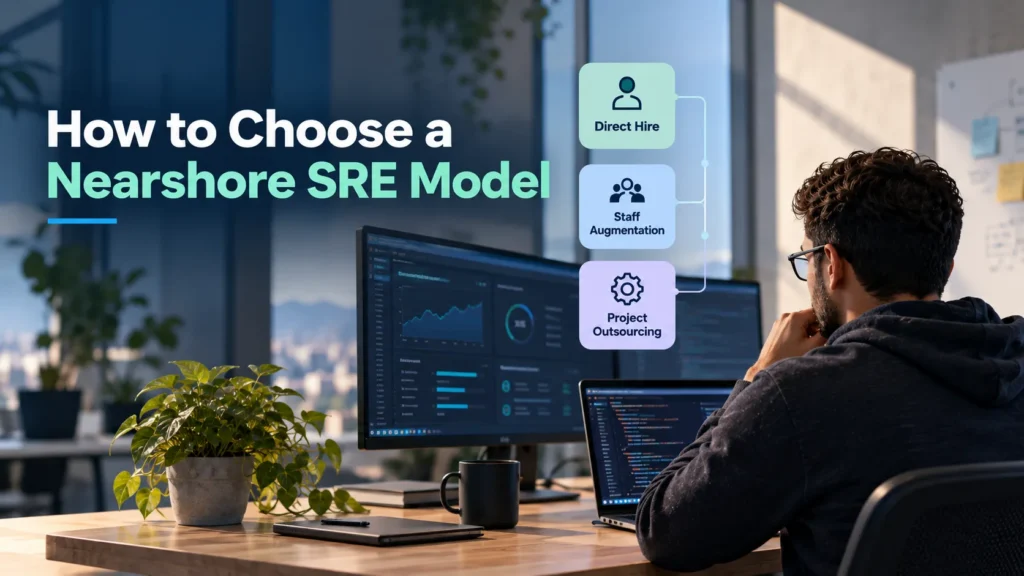
The engagement model should follow the problem:
- Choose direct hiring when continuous ownership, service knowledge, and long term development of reliability practices are the primary needs.
- Choose nearshore staff augmentation when engineering leadership and operating practices already exist, but the team needs additional capacity or specialized expertise.
- Choose project outsourcing when the desired outcome, acceptance criteria, governance, and handoff can be clearly defined, such as an observability foundation, CI/CD improvement, test automation framework, or recovery plan.
A 90 Day Framework for Choosing Your Nearshore SRE Model
Choosing how to add SRE capacity should not begin with hourly rates or recruiting speed. It should begin with what successful reliability work needs to accomplish.
A practical way to make that decision is to evaluate four areas in sequence: business consequence, ownership horizon, delivery definition, and operating readiness.
1. Define the Business Consequence
Start by identifying why the reliability problem matters to the business.
The consequence might be delayed releases, customer impacting incidents, security exposure, lost engineering capacity, or risk to an important launch.
You do not need to manufacture a precise financial estimate if reliable baseline data does not exist. You do need a clear reason to act and an accountable sponsor who understands why the problem deserves engineering resources.
This also helps prevent an SRE engagement from becoming a collection of loosely related infrastructure tasks without a measurable business objective.
2. Determine the Ownership Horizon
Ask who should own the work after the first 90 days.
If the organization needs a named long term owner who will develop service knowledge, establish standards, and coach other engineers, direct hiring may be the strongest option.
If an existing engineering manager or platform leader already owns reliability but needs more execution capacity, SRE staff augmentation may be more appropriate.
If ownership will remain internal but the team lacks a specific technical foundation, a defined reliability project may be the better fit.
The objective is not to choose one model universally. It is to match the model to the duration and type of ownership the organization actually needs.
3. Define the Delivery Scope
Next, determine whether the work can be clearly scoped.
Can your team describe the dependencies, acceptance criteria, required access, security constraints, decision rights, and expected handoff?
If the answer is yes, project outsourcing becomes a stronger option because success can be tied to a defined outcome.
If the answer is no, that does not mean the initiative should stop. It means the organization may need a discovery phase or embedded engineering capacity before committing to a fixed project outcome.
This distinction is particularly important in reliability engineering, where priorities can change quickly as teams uncover infrastructure dependencies, observability gaps, or recurring incident patterns.
4. Confirm Operating Readiness
Before you hire a nearshore SRE, augment your existing team, or begin a reliability project, determine how that person or team will operate inside the organization.
Confirm who runs incidents, approves changes, owns the backlog, reviews service levels, and receives knowledge transfer.
Nearshore collaboration can make real time communication easier, particularly when engineers share overlapping working hours with US teams. However, proximity does not replace clear governance.
For a managed project, the client and delivery partner should also establish who manages execution and who retains strategic direction, technical approval, and final decision making.
Direct Hire vs. Staff Augmentation vs. Project Outsourcing
Once the reliability problem and ownership requirements are clear, the differences between the three engagement models become easier to evaluate.
Direct Hiring for Long Term SRE Ownership
Direct hiring is strongest when reliability is a core product capability that requires continuous internal ownership.
A permanent SRE can build deep knowledge of the company’s services, architecture, incident history, engineering standards, and business priorities. This model also makes sense when the engineer will help develop reliability practices across multiple teams over several years.
Companies looking to hire a nearshore SRE through a direct hiring model should be prepared to provide stable management, a clear career path, and meaningful ownership of services and standards.
The main consideration is that recruiting, onboarding, management, and employment administration remain part of the company’s long term operating model.
For organizations building permanent engineering capabilities, TechAID’s Direct Hiring model can provide access to vetted LATAM technology professionals who become part of the client’s long term team.
Nearshore SRE Staff Augmentation
Nearshore staff augmentation is a stronger fit when your product and engineering operating model already exists but the team lacks sufficient capacity or a particular technical skill.
An SRE, DevOps engineer, QA automation specialist, or small engineering pod can work within the company’s existing tools, ceremonies, backlog, and priorities while the client retains day to day technical direction.
This approach can be particularly useful when an engineering organization needs to increase capacity without transferring ownership of its platform or reliability strategy.
The main risk is treating staff augmentation simply as extra engineering hands.
Before an embedded SRE starts, the organization should establish a clear backlog, responsible manager, access requirements, and measurable definition of success.
When those foundations are in place, SRE staff augmentation can extend an existing engineering organization while keeping technical ownership and priorities inside the client team.
Project Outsourcing for Defined Reliability Outcomes
Project outsourcing is strongest when the desired reliability outcome is clear but internal leadership or execution bandwidth is limited.
Potential projects include a reliability assessment, CI/CD improvement, observability foundation, test automation strategy, application support transition, or recovery of a stalled technical workstream.
The critical difference is that the engagement is organized around a defined outcome rather than simply adding another engineer to the existing team.
Project outsourcing becomes a weaker fit when priorities change daily or no internal stakeholder can make timely scope and technical decisions.
In those situations, an embedded capacity model may provide the flexibility the organization needs. Another option is to begin with a short discovery phase before defining the larger reliability project.
What an SRE Capacity Brief Should Contain
Whether you decide to hire a nearshore SRE, add an embedded specialist, or engage a team for a managed reliability project, create a short capacity brief before work begins.
The same document can become the foundation for a recruiting profile, a partner discovery conversation, or a statement of work. More importantly, it forces the organization to define the problem before defining the role.
Reliability work often crosses engineering, security, infrastructure, and product. Keeping the brief visible across these teams can help identify dependencies before they slow onboarding or complicate delivery.
A useful SRE capacity brief should cover:
- Services and outcomes: Identify the services, customer journeys, and reliability measures that matter most.
- Work mix: Estimate the balance between reactive work, planned engineering, support coverage, and release responsibilities.
- Authority: Define the incident commander, change approver, service owner, and escalation path.
- Access and security: Document environment access, data restrictions, logging requirements, and relevant IP or compliance expectations.
- Success after 90 days: Select three to five observable outcomes, such as documented SLOs, tested rollback procedures, improved alerting, greater runbook coverage, or a completed knowledge handoff.
This brief also gives candidates and delivery partners a clearer understanding of what they are expected to accomplish. Instead of simply asking for SRE experience, the company can evaluate whether the available skills match the reliability outcomes it actually needs.
How to Measure a Nearshore SRE Engagement
A nearshore SRE engagement should be measurable without creating artificial certainty.
During the first month, focus on leading indicators that show whether the engineer or delivery team has the foundation required to make progress.
These can include:
- Required access has been provisioned.
- Priority services have been mapped.
- Incident roles and escalation paths have been agreed upon.
- Telemetry and observability gaps have been documented.
- The initial reliability backlog has been reviewed and accepted.
- Existing runbooks and operational documentation have been assessed.
As the engagement progresses, shift toward outcome indicators.
Depending on the original reliability constraint, these might include the percentage of priority services with agreed service measures, improvements in deployment and rollback readiness, reductions in repeated alerts, completion of postmortem actions, or engineering hours reclaimed from recurring manual work.
Google’s Site Reliability Engineering guidance also emphasizes learning from incidents through structured postmortems. A useful reliability program should not only respond to failures but turn those failures into improvements that reduce the likelihood or impact of similar incidents in the future.
Avoid making blanket uptime guarantees or cost savings claims before baseline data exists. Without an established starting point, those numbers can create expectations that are difficult to validate.
The better approach is to define success using evidence from the company’s own systems and compare results against the original 90 day objectives.
Security and Risk Considerations Before You Hire a Nearshore SRE
When you hire a nearshore SRE or engage external reliability engineers, those professionals may need access to production systems, infrastructure, source code, monitoring tools, logs, and incident information.
Security and governance should therefore be part of engagement planning from the beginning.
Before access is granted, review areas such as:
- Production and infrastructure access.
- Data handling requirements.
- Intellectual property and source code ownership.
- Contractor or employment requirements.
- Access revocation and offboarding.
- On call coverage and escalation expectations.
- Security and compliance responsibilities.
- Knowledge transfer at the end of the engagement.
The specific requirements will depend on the organization, engagement model, systems involved, and applicable jurisdictions.
The objective is not to add unnecessary process. It is to identify responsibilities before an incident, security review, or transition exposes gaps in ownership.
This is particularly important when comparing direct hiring, staff augmentation, and project outsourcing because responsibility is distributed differently in each model.
With direct hiring, the SRE becomes part of the organization’s permanent operating structure. With staff augmentation, the client generally retains technical direction while the embedded professional operates within its processes. With project outsourcing, execution responsibilities and approval authority should be clearly established before delivery begins.
Which Nearshore SRE Model Should You Choose?
The right model depends primarily on three factors: ownership horizon, internal leadership capacity, and how clearly the desired outcome can be defined.
Choose Direct Hiring when:
- Reliability requires permanent internal ownership.
- Deep product and service knowledge will become increasingly important.
- The engineer will establish standards or mentor other team members.
- The organization has the management structure to support a permanent SRE role.
Choose Staff Augmentation when:
- Reliability ownership already exists internally.
- Your engineering team needs additional execution capacity.
- A specific SRE or DevOps skill is missing.
- You want the engineer to operate within your existing tools, backlog, and processes.
- Technical priorities need to remain under your team’s day to day direction.
Choose Project Outsourcing when:
- The organization needs a defined technical outcome.
- Scope and acceptance criteria can be established.
- Internal execution bandwidth is limited.
- The project has clear governance and an internal decision maker.
- Knowledge transfer and handoff can be planned in advance.
If those conditions are still unclear, avoid choosing an engagement model based solely on cost or urgency.
Start by defining the reliability constraint and the desired 90 day outcome. The appropriate sourcing model should become much easier to identify from there.
Should You Hire a Nearshore SRE?
If your organization can identify the affected services, long term owner, decision rights, and desired 90 day outcomes, you are in a much stronger position to decide whether to hire a nearshore SRE.
A permanent hire makes sense when reliability needs lasting internal ownership. Staff augmentation can provide additional capacity when the operating model and leadership already exist. Project outsourcing can address a defined reliability initiative when the organization needs a team responsible for delivering a specific outcome.
The important decision is not simply where the engineer is located. It is how that person or team will integrate into your engineering organization and who will own reliability after the initial engagement.
TechAID helps companies access vetted LATAM technology talent through Direct Hiring, Nearshore Staff Augmentation, and Project Outsourcing, allowing organizations to select an engagement model based on their actual engineering and business requirements.
If you are evaluating how to strengthen reliability, DevOps, or platform engineering capacity, talk to TechAID about your requirements and determine which model best fits your team, ownership structure, and technical goals.