How AI Is Changing QA Automation

How AI Is Changing QA Automation

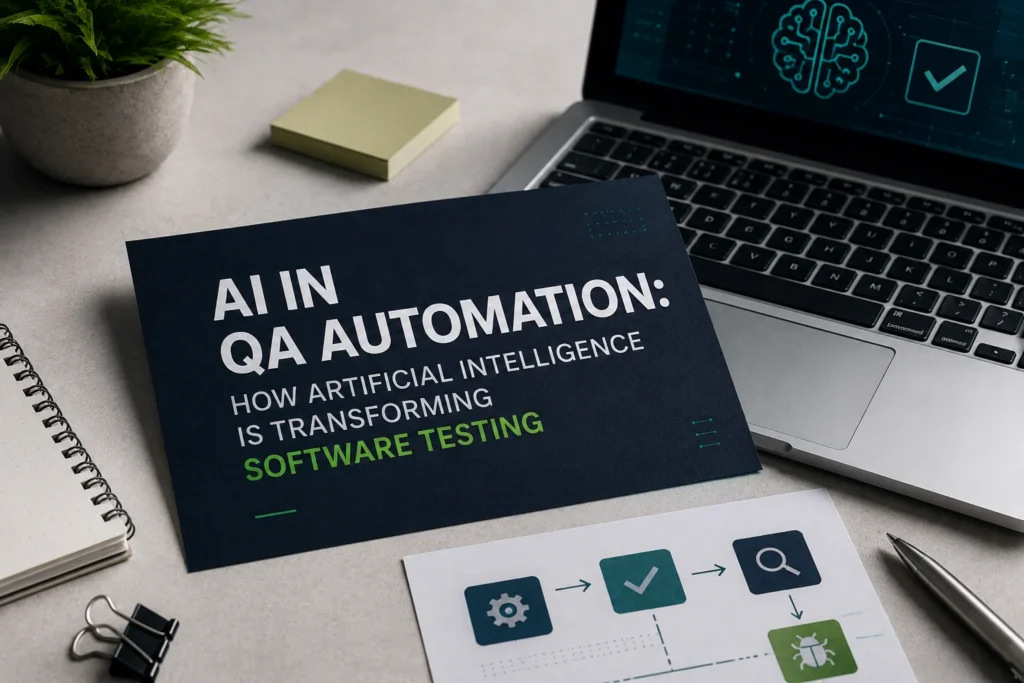
Modern workspace illustrating AI in QA automation with a laptop, testing workflow, and software quality assurance concepts.
AI is transforming QA automation by making software testing faster, smarter, and more efficient. Discover how AI-powered testing improves test generation, self-healing automation, defect detection, and continuous testing, while helping engineering teams deliver higher-quality software with greater confidence.
Share the Post:

Software testing has never been more important—or more challenging.

Modern engineering teams are expected to deliver new features faster, deploy multiple times per day, and maintain exceptional software quality across increasingly complex applications. As organizations embrace Agile development, DevOps, and Continuous Delivery, traditional test automation is struggling to keep pace with the speed of modern software development.

This is why AI in QA automation has become one of the most important trends in software engineering.

Artificial intelligence is transforming how quality assurance teams design, execute, maintain, and optimize automated tests. Instead of relying solely on static scripts and manual maintenance, AI-powered testing solutions can generate test cases, identify high-risk areas, repair broken tests automatically, and provide actionable insights that help engineering teams release software with greater confidence.

For CTOs, Engineering Managers, and QA leaders, adopting AI is no longer simply about increasing automation. It’s about building a more scalable testing strategy that improves developer productivity, accelerates release cycles, and reduces the cost of maintaining large automated test suites.

In this guide, you’ll learn how AI improves QA automation testing, explore the most effective AI tools for automated software testing, understand how AI-driven QA testing frameworks are evolving, and discover what the future of test automation with AI looks like for modern engineering organizations.

What Is AI in QA Automation?

AI in QA automation is the use of artificial intelligence and machine learning to improve how software is tested throughout the Software Development Lifecycle (SDLC). Unlike traditional automation, which depends on predefined scripts and manual updates, AI enables testing systems to learn from historical data, adapt to application changes, and make intelligent decisions during test execution.

Rather than replacing established automation frameworks such as Selenium, Cypress, or Playwright, AI enhances them by introducing capabilities that make testing more efficient, resilient, and scalable.

Some of the most valuable AI capabilities include:

  • Automatically generating test cases from user stories or application behavior.
  • Self-healing automated tests when user interface elements change.
  • Prioritizing regression tests based on code changes and business risk.
  • Detecting visual defects through computer vision.
  • Predicting areas of the application most likely to contain defects.
  • Analyzing test failures to identify probable root causes.

These capabilities allow QA teams to spend less time maintaining automation and more time improving software quality.

As AI technologies continue to mature, testing is shifting from a reactive process—where teams simply validate completed code, to a proactive discipline that helps engineering organizations identify quality risks before they impact production.

Why Traditional Test Automation Is No Longer Enough

Traditional automation frameworks have significantly improved software quality over the past two decades. However, the pace of modern software development has exposed several limitations that make it difficult for conventional automation alone to support today’s engineering teams.

Applications now evolve continuously. User interfaces change frequently, APIs are updated regularly, microservices increase system complexity, and development teams deploy new code far more often than they did just a few years ago.

This rapid evolution creates several challenges.

Test Maintenance Is Becoming More Expensive

One of the biggest obstacles to scaling automation is maintaining existing test suites.

Small interface changes—such as renamed elements, modified layouts, or updated page structures—can cause dozens of automated tests to fail even when application functionality remains unchanged.

For many organizations, maintaining automated tests consumes more engineering time than creating new ones.

Growing Test Suites Slow Down Releases

As products mature, regression suites continue expanding.

Without optimization, organizations often face:

  • Longer execution times.
  • Duplicate test coverage.
  • Higher infrastructure costs.
  • Delayed deployments.
  • Reduced confidence in test results.

Instead of accelerating software delivery, poorly maintained automation can become a bottleneck.

Static Automation Cannot Prioritize Risk

Traditional automation executes the same test suite regardless of the scope of a code change.

Modern engineering teams need more intelligent testing that can answer questions like:

  • Which tests are most important for this release?
  • Which application modules present the highest risk?
  • Which failures are genuine defects versus infrastructure issues?
  • Which tests can safely be skipped to accelerate deployments?

These are precisely the types of decisions where artificial intelligence delivers the greatest value—and the reason why AI in QA automation is rapidly becoming a strategic investment for engineering organizations.

How AI Improves QA Automation Testing

The biggest advantage of artificial intelligence isn’t that it automates testing—automation has been doing that for years. The real value lies in making automated testing smarter, more adaptive, and less dependent on manual intervention.

Traditional automation executes predefined scripts. AI, on the other hand, analyzes patterns, learns from historical data, and helps QA teams make better testing decisions throughout the Software Development Lifecycle (SDLC).

For engineering leaders, this means faster releases, lower maintenance costs, and greater confidence in production deployments.

Intelligent Test Case Generation

Creating automated test cases is one of the most time-consuming aspects of quality assurance. QA engineers must analyze requirements, identify user flows, consider edge cases, and manually write scripts that validate expected behavior.

AI significantly accelerates this process.

Modern AI models can analyze:

  • User stories
  • Product requirements
  • Acceptance criteria
  • Existing source code
  • Historical test suites
  • Previous production defects

Using this information, AI can recommend or generate new test cases that improve coverage while reducing manual effort.

Instead of starting from a blank page, QA engineers review and refine AI-generated suggestions, allowing teams to build comprehensive regression suites much faster.

This approach also helps uncover scenarios that might otherwise be overlooked during manual test design.

Self-Healing Test Automation

One of the most frustrating aspects of traditional automation is script maintenance.

A simple UI update—such as changing a button ID or moving an element within the DOM—can cause dozens of automated tests to fail, even when the application continues functioning correctly.

AI addresses this problem through self-healing automation.

Rather than relying on a single locator, AI evaluates multiple characteristics, including:

  • DOM structure
  • Visual appearance
  • Relative positioning
  • Historical element behavior
  • Neighboring components

If an element changes, the testing framework can often identify its new location automatically without requiring engineers to update the script manually.

For organizations maintaining thousands of automated tests, self-healing capabilities can dramatically reduce maintenance costs while increasing the reliability of regression testing.

Predictive Defect Analysis

AI is also changing how teams decide what to test.

Machine learning models can analyze historical development data, including:

  • Previous defects
  • Source code commits
  • Code complexity
  • Deployment history
  • Test execution results

Using these patterns, AI predicts which areas of an application are most likely to contain defects.

Instead of treating every feature equally, QA teams can prioritize high-risk components and allocate testing resources where they are most likely to generate business value.

This risk-based approach is particularly valuable for enterprise applications with extensive regression suites that cannot realistically be executed in full before every deployment.

Smarter Test Prioritization

Continuous Integration pipelines often execute hundreds—or even thousands—of automated tests after every code commit.

Running every available test consumes infrastructure resources and slows software delivery.

AI improves efficiency by determining which tests are most relevant based on:

  • Modified files
  • Dependency analysis
  • Historical failures
  • Business-critical functionality
  • Previous production incidents

As a result, engineering teams can execute the highest-value tests first, reducing build times while maintaining confidence in release quality.

This capability is becoming increasingly important for organizations practicing Continuous Delivery. Organizations looking to accelerate delivery while expanding their engineering capacity can also benefit from understanding how staff augmentation helps modern engineering teams scale efficiently.

Faster Failure Analysis

Investigating failed automated tests is often more time-consuming than running the tests themselves.

Not every failure represents a software defect.

Failures may be caused by:

  • Environment instability
  • Network interruptions
  • Test data inconsistencies
  • Infrastructure issues
  • Timing problems
  • Defective application code

AI-powered analytics can automatically classify failures, identify recurring patterns, and suggest likely root causes before an engineer even opens the logs.

This significantly reduces debugging time and allows development teams to focus on fixing genuine product issues.

AI-Driven QA Testing Frameworks Explained

Artificial intelligence is not replacing popular testing frameworks—it is enhancing them.

Today’s AI-driven QA testing frameworks combine traditional automation engines with machine learning capabilities that improve efficiency, resilience, and decision-making.

Rather than requiring organizations to abandon existing testing investments, AI layers intelligent functionality on top of familiar frameworks.

Common AI capabilities include:

AI CapabilityBusiness Benefit
Self-healing locatorsReduce script maintenance
Intelligent test generationIncrease test coverage faster
Predictive analyticsPrioritize high-risk testing
Visual AI validationDetect UI regressions automatically
Failure classificationAccelerate debugging
Test optimizationReduce CI/CD execution time

These capabilities enable organizations to scale automation without proportionally increasing maintenance effort.

As software complexity grows, intelligent frameworks become increasingly valuable for sustaining long-term automation initiatives. Industry reports such as the Thoughtworks Technology Radar continue to highlight AI-assisted engineering practices and intelligent automation as technologies worth evaluating for modern software teams.

Best AI Tools for Automated Software Testing

The market for AI tools for automated software testing has expanded rapidly over the past few years. Rather than replacing existing automation platforms, most solutions integrate directly with popular testing frameworks to improve productivity and reduce maintenance.

Below are some of the leading categories of AI-powered testing solutions.

Tool CategoryPrimary AI CapabilitiesTypical Use Cases
Intelligent Test Automation PlatformsSelf-healing tests, smart locatorsFunctional UI testing
Visual Testing ToolsComputer vision, layout comparisonCross-browser UI validation
AI Test Management PlatformsTest recommendations, analyticsEnterprise QA management
Generative AI AssistantsTest generation, documentationQA productivity
Performance Testing PlatformsPredictive bottleneck detectionLoad and scalability testing

Many engineering organizations combine these solutions with established frameworks such as Selenium, Cypress, Playwright, and Appium to create a more intelligent testing ecosystem.

The objective isn’t simply to automate more tests—it’s to automate the right tests more effectively.

AI in Continuous Testing and DevOps

As organizations adopt DevOps practices, testing has shifted from a final project phase to a continuous activity integrated throughout the development lifecycle.

This evolution has made continuous testing in DevOps one of the most important areas where AI delivers measurable value.

Instead of executing static regression suites after every deployment, AI continuously evaluates:

  • Code changes
  • Deployment history
  • Test results
  • Production incidents
  • Application dependencies

Using this information, AI helps determine:

  • Which tests should execute immediately.
  • Which areas require additional validation.
  • Which deployments carry elevated risk.
  • Which failures deserve immediate attention.

This intelligent prioritization allows engineering teams to maintain rapid release cycles without sacrificing software quality.

For organizations practicing Continuous Delivery, AI-powered continuous testing helps balance development speed with release confidence, enabling faster feedback loops and more resilient software delivery pipelines.

Cypress vs Selenium: Which Benefits More from AI?

Selenium and Cypress remain two of the most widely used frameworks for automated software testing. Both have evolved significantly in recent years, and both can benefit from artificial intelligence. However, they do so in different ways.

Understanding how AI enhances each framework can help engineering leaders choose the right testing strategy based on their application architecture, team expertise, and long-term maintenance goals.

Selenium with AI

Selenium has long been the standard for enterprise web automation because of its flexibility, language support, and large ecosystem.

Today, AI is helping address one of Selenium’s biggest challenges: maintenance.

AI-powered platforms built on top of Selenium can provide:

  • Self-healing locators that automatically recover from UI changes.
  • Intelligent object recognition using multiple element attributes.
  • Automatic failure analysis and defect categorization.
  • Risk-based regression testing.
  • AI-assisted test generation from user stories or requirements.

These capabilities allow organizations with mature Selenium suites to extend the lifespan of their existing automation investments while reducing maintenance effort.

Cypress with AI

Cypress has gained widespread adoption for modern web applications thanks to its speed, developer-friendly architecture, and excellent debugging experience.

Because Cypress already minimizes much of the complexity found in traditional automation, AI focuses primarily on improving productivity rather than solving framework limitations.

Common AI enhancements include:

  • Automated test generation.
  • AI-assisted debugging.
  • Intelligent screenshot comparison.
  • Visual regression testing.
  • Natural language test creation.

For teams building React, Angular, or Vue applications, combining Cypress with AI can significantly reduce the time required to create and maintain automated tests.

Selenium vs Cypress: AI Comparison

FeatureSeleniumCypress
Self-healing automationExcellent ecosystem supportGrowing support
AI-assisted test generationAvailable through third-party platformsIncreasingly available
Visual AI testingStrong integrationsStrong integrations
Cross-browser supportExtensiveStrong but more limited than Selenium
Enterprise adoptionVery highHigh and growing
Best suited forLarge enterprise applicationsModern JavaScript applications

The choice between Selenium and Cypress should still be based on project requirements—not AI capabilities alone. Artificial intelligence enhances both frameworks, but neither framework becomes universally better simply because AI is involved.

AI-Powered Test Automation Strategies

Implementing AI successfully requires more than purchasing a new testing platform. Organizations achieve the best results when AI is introduced as part of a broader quality engineering strategy.

Below are several test automation strategies that can help maximize the return on AI investments.

Start with High-Maintenance Test Suites

Applications with large regression suites often experience the greatest benefit from AI.

Introducing self-healing automation into these projects can dramatically reduce script maintenance while improving test stability.

Prioritize Business-Critical Workflows

Not every automated test has the same business value.

Focus AI capabilities on validating critical customer journeys such as:

  • Authentication
  • Checkout processes
  • Payment workflows
  • User onboarding
  • Account management

Protecting these workflows delivers the greatest business impact.

Combine AI with Risk-Based Testing

Rather than executing every available test after every deployment, AI can prioritize tests based on:

  • Code changes
  • Historical defects
  • Business impact
  • User traffic
  • Production incidents

This approach shortens feedback cycles without sacrificing software quality.

Measure the Right KPIs

Engineering leaders should evaluate AI adoption using objective metrics such as:

  • Test execution time
  • Test maintenance effort
  • Automation coverage
  • Escaped defects
  • Deployment frequency
  • Mean Time to Detect (MTTD)
  • Mean Time to Resolution (MTTR)

Tracking these KPIs makes it easier to demonstrate the business value of AI initiatives.

The Future of Test Automation with AI

The future of test automation with AI extends far beyond self-healing scripts or automated test generation.

Artificial intelligence is transforming software quality into a continuous, data-driven discipline that supports every stage of the Software Development Lifecycle.

Several trends are already reshaping the industry.

Autonomous Testing

Future testing platforms will increasingly generate, execute, analyze, and maintain test suites with minimal human intervention.

Rather than manually updating automation after every application change, QA engineers will supervise intelligent systems capable of adapting automatically as software evolves.

Natural Language Test Creation

Large Language Models (LLMs) are making it possible to create automated tests using plain English. Major technology vendors are already incorporating generative AI into the software development lifecycle, making AI-assisted testing more accessible to engineering teams through their development platforms.

Instead of writing complex scripts, engineers and product managers can describe a user journey, and AI can generate executable test cases based on that description.

This has the potential to improve collaboration between product, engineering, and QA teams while reducing the technical barrier to creating automated tests.

AI Across the Entire SDLC

Testing is only one part of a broader transformation.

Artificial intelligence is becoming integrated into:

  • Requirements analysis
  • Code generation
  • Code reviews
  • Security testing
  • Performance optimization
  • Release planning
  • Production monitoring

As these capabilities mature, quality assurance will become increasingly proactive rather than reactive.

How QA Automation Is Evolving with AI

The evolution of QA automation is not about replacing people with machines. It is about enabling engineering teams to deliver higher-quality software with greater speed and confidence.

Modern AI platforms reduce repetitive work, improve decision-making, and allow QA professionals to focus on activities that require human expertise, such as exploratory testing, business validation, accessibility, and user experience.

Organizations that successfully adopt AI are shifting from traditional automation toward intelligent quality engineering, where testing continuously adapts to changes in code, user behavior, and business priorities.

For technology leaders, the question is no longer whether AI will influence software testing—it already is. The real challenge is determining how to incorporate these capabilities into an existing engineering strategy while maximizing return on investment.

TechAID Perspective

At TechAID, we see AI as a force multiplier for experienced QA engineers rather than a replacement for them.

The most effective software testing strategies combine skilled professionals, robust automation frameworks, and AI-powered capabilities that reduce repetitive work without compromising quality. This balanced approach enables engineering teams to release software faster while maintaining the reliability that customers expect.

For organizations building nearshore engineering teams, AI also helps experienced QA professionals become even more productive. By automating routine tasks such as test maintenance, failure analysis, and regression optimization, teams can dedicate more time to exploratory testing, risk assessment, and continuous quality improvement—areas where human expertise continues to deliver the greatest value.

This is why many of today’s highest-performing engineering organizations are investing in both AI-enabled testing platforms and experienced QA talent. Together, they create a scalable quality assurance strategy capable of supporting modern software development.

Conclusion

Artificial intelligence is fundamentally changing the role of quality assurance in modern software development.

From intelligent test generation and self-healing automation to predictive analytics and continuous testing, AI is helping engineering teams reduce maintenance, improve productivity, and deliver software with greater confidence.

However, successful adoption is not about replacing existing testing frameworks or eliminating the role of QA engineers. Instead, it involves combining AI with proven automation practices, experienced professionals, and a well-defined quality strategy.

As AI technologies continue to evolve, organizations that begin integrating these capabilities today will be better positioned to accelerate software delivery, improve release quality, and scale engineering operations more efficiently.

If your organization is exploring how to modernize its QA processes, combining AI with experienced engineers is only part of the equation. Learn how to hire software engineers in Latin America and build high-performing teams that can scale quality, development, and innovation together.


Key Takeaways
  • AI enhances QA automation by reducing manual effort, improving test coverage, and accelerating software releases.

  • The most effective testing strategies combine AI-powered automation with experienced QA engineers—not one or the other.

  • Organizations that adopt AI-driven testing can improve software quality while scaling DevOps and Continuous Delivery more efficiently.

  • Software testing has never been more important—or more challenging.

    Modern engineering teams are expected to deliver new features faster, deploy multiple times per day, and maintain exceptional software quality across increasingly complex applications. As organizations embrace Agile development, DevOps, and Continuous Delivery, traditional test automation is struggling to keep pace with the speed of modern software development.

    This is why AI in QA automation has become one of the most important trends in software engineering.

    Artificial intelligence is transforming how quality assurance teams design, execute, maintain, and optimize automated tests. Instead of relying solely on static scripts and manual maintenance, AI-powered testing solutions can generate test cases, identify high-risk areas, repair broken tests automatically, and provide actionable insights that help engineering teams release software with greater confidence.

    For CTOs, Engineering Managers, and QA leaders, adopting AI is no longer simply about increasing automation. It’s about building a more scalable testing strategy that improves developer productivity, accelerates release cycles, and reduces the cost of maintaining large automated test suites.

    In this guide, you’ll learn how AI improves QA automation testing, explore the most effective AI tools for automated software testing, understand how AI-driven QA testing frameworks are evolving, and discover what the future of test automation with AI looks like for modern engineering organizations.

    What Is AI in QA Automation?

    AI in QA automation is the use of artificial intelligence and machine learning to improve how software is tested throughout the Software Development Lifecycle (SDLC). Unlike traditional automation, which depends on predefined scripts and manual updates, AI enables testing systems to learn from historical data, adapt to application changes, and make intelligent decisions during test execution.

    Rather than replacing established automation frameworks such as Selenium, Cypress, or Playwright, AI enhances them by introducing capabilities that make testing more efficient, resilient, and scalable.

    Some of the most valuable AI capabilities include:

    • Automatically generating test cases from user stories or application behavior.
    • Self-healing automated tests when user interface elements change.
    • Prioritizing regression tests based on code changes and business risk.
    • Detecting visual defects through computer vision.
    • Predicting areas of the application most likely to contain defects.
    • Analyzing test failures to identify probable root causes.

    These capabilities allow QA teams to spend less time maintaining automation and more time improving software quality.

    As AI technologies continue to mature, testing is shifting from a reactive process—where teams simply validate completed code, to a proactive discipline that helps engineering organizations identify quality risks before they impact production.

    Why Traditional Test Automation Is No Longer Enough

    Traditional automation frameworks have significantly improved software quality over the past two decades. However, the pace of modern software development has exposed several limitations that make it difficult for conventional automation alone to support today’s engineering teams.

    Applications now evolve continuously. User interfaces change frequently, APIs are updated regularly, microservices increase system complexity, and development teams deploy new code far more often than they did just a few years ago.

    This rapid evolution creates several challenges.

    Test Maintenance Is Becoming More Expensive

    One of the biggest obstacles to scaling automation is maintaining existing test suites.

    Small interface changes—such as renamed elements, modified layouts, or updated page structures—can cause dozens of automated tests to fail even when application functionality remains unchanged.

    For many organizations, maintaining automated tests consumes more engineering time than creating new ones.

    Growing Test Suites Slow Down Releases

    As products mature, regression suites continue expanding.

    Without optimization, organizations often face:

    • Longer execution times.
    • Duplicate test coverage.
    • Higher infrastructure costs.
    • Delayed deployments.
    • Reduced confidence in test results.

    Instead of accelerating software delivery, poorly maintained automation can become a bottleneck.

    Static Automation Cannot Prioritize Risk

    Traditional automation executes the same test suite regardless of the scope of a code change.

    Modern engineering teams need more intelligent testing that can answer questions like:

    • Which tests are most important for this release?
    • Which application modules present the highest risk?
    • Which failures are genuine defects versus infrastructure issues?
    • Which tests can safely be skipped to accelerate deployments?

    These are precisely the types of decisions where artificial intelligence delivers the greatest value—and the reason why AI in QA automation is rapidly becoming a strategic investment for engineering organizations.

    How AI Improves QA Automation Testing

    The biggest advantage of artificial intelligence isn’t that it automates testing—automation has been doing that for years. The real value lies in making automated testing smarter, more adaptive, and less dependent on manual intervention.

    Traditional automation executes predefined scripts. AI, on the other hand, analyzes patterns, learns from historical data, and helps QA teams make better testing decisions throughout the Software Development Lifecycle (SDLC).

    For engineering leaders, this means faster releases, lower maintenance costs, and greater confidence in production deployments.

    Intelligent Test Case Generation

    Creating automated test cases is one of the most time-consuming aspects of quality assurance. QA engineers must analyze requirements, identify user flows, consider edge cases, and manually write scripts that validate expected behavior.

    AI significantly accelerates this process.

    Modern AI models can analyze:

    • User stories
    • Product requirements
    • Acceptance criteria
    • Existing source code
    • Historical test suites
    • Previous production defects

    Using this information, AI can recommend or generate new test cases that improve coverage while reducing manual effort.

    Instead of starting from a blank page, QA engineers review and refine AI-generated suggestions, allowing teams to build comprehensive regression suites much faster.

    This approach also helps uncover scenarios that might otherwise be overlooked during manual test design.

    Self-Healing Test Automation

    One of the most frustrating aspects of traditional automation is script maintenance.

    A simple UI update—such as changing a button ID or moving an element within the DOM—can cause dozens of automated tests to fail, even when the application continues functioning correctly.

    AI addresses this problem through self-healing automation.

    Rather than relying on a single locator, AI evaluates multiple characteristics, including:

    • DOM structure
    • Visual appearance
    • Relative positioning
    • Historical element behavior
    • Neighboring components

    If an element changes, the testing framework can often identify its new location automatically without requiring engineers to update the script manually.

    For organizations maintaining thousands of automated tests, self-healing capabilities can dramatically reduce maintenance costs while increasing the reliability of regression testing.

    Predictive Defect Analysis

    AI is also changing how teams decide what to test.

    Machine learning models can analyze historical development data, including:

    • Previous defects
    • Source code commits
    • Code complexity
    • Deployment history
    • Test execution results

    Using these patterns, AI predicts which areas of an application are most likely to contain defects.

    Instead of treating every feature equally, QA teams can prioritize high-risk components and allocate testing resources where they are most likely to generate business value.

    This risk-based approach is particularly valuable for enterprise applications with extensive regression suites that cannot realistically be executed in full before every deployment.

    Smarter Test Prioritization

    Continuous Integration pipelines often execute hundreds—or even thousands—of automated tests after every code commit.

    Running every available test consumes infrastructure resources and slows software delivery.

    AI improves efficiency by determining which tests are most relevant based on:

    • Modified files
    • Dependency analysis
    • Historical failures
    • Business-critical functionality
    • Previous production incidents

    As a result, engineering teams can execute the highest-value tests first, reducing build times while maintaining confidence in release quality.

    This capability is becoming increasingly important for organizations practicing Continuous Delivery. Organizations looking to accelerate delivery while expanding their engineering capacity can also benefit from understanding how staff augmentation helps modern engineering teams scale efficiently.

    Faster Failure Analysis

    Investigating failed automated tests is often more time-consuming than running the tests themselves.

    Not every failure represents a software defect.

    Failures may be caused by:

    • Environment instability
    • Network interruptions
    • Test data inconsistencies
    • Infrastructure issues
    • Timing problems
    • Defective application code

    AI-powered analytics can automatically classify failures, identify recurring patterns, and suggest likely root causes before an engineer even opens the logs.

    This significantly reduces debugging time and allows development teams to focus on fixing genuine product issues.

    AI-Driven QA Testing Frameworks Explained

    Artificial intelligence is not replacing popular testing frameworks—it is enhancing them.

    Today’s AI-driven QA testing frameworks combine traditional automation engines with machine learning capabilities that improve efficiency, resilience, and decision-making.

    Rather than requiring organizations to abandon existing testing investments, AI layers intelligent functionality on top of familiar frameworks.

    Common AI capabilities include:

    AI CapabilityBusiness Benefit
    Self-healing locatorsReduce script maintenance
    Intelligent test generationIncrease test coverage faster
    Predictive analyticsPrioritize high-risk testing
    Visual AI validationDetect UI regressions automatically
    Failure classificationAccelerate debugging
    Test optimizationReduce CI/CD execution time

    These capabilities enable organizations to scale automation without proportionally increasing maintenance effort.

    As software complexity grows, intelligent frameworks become increasingly valuable for sustaining long-term automation initiatives. Industry reports such as the Thoughtworks Technology Radar continue to highlight AI-assisted engineering practices and intelligent automation as technologies worth evaluating for modern software teams.

    Best AI Tools for Automated Software Testing

    The market for AI tools for automated software testing has expanded rapidly over the past few years. Rather than replacing existing automation platforms, most solutions integrate directly with popular testing frameworks to improve productivity and reduce maintenance.

    Below are some of the leading categories of AI-powered testing solutions.

    Tool CategoryPrimary AI CapabilitiesTypical Use Cases
    Intelligent Test Automation PlatformsSelf-healing tests, smart locatorsFunctional UI testing
    Visual Testing ToolsComputer vision, layout comparisonCross-browser UI validation
    AI Test Management PlatformsTest recommendations, analyticsEnterprise QA management
    Generative AI AssistantsTest generation, documentationQA productivity
    Performance Testing PlatformsPredictive bottleneck detectionLoad and scalability testing

    Many engineering organizations combine these solutions with established frameworks such as Selenium, Cypress, Playwright, and Appium to create a more intelligent testing ecosystem.

    The objective isn’t simply to automate more tests—it’s to automate the right tests more effectively.

    AI in Continuous Testing and DevOps

    As organizations adopt DevOps practices, testing has shifted from a final project phase to a continuous activity integrated throughout the development lifecycle.

    This evolution has made continuous testing in DevOps one of the most important areas where AI delivers measurable value.

    Instead of executing static regression suites after every deployment, AI continuously evaluates:

    • Code changes
    • Deployment history
    • Test results
    • Production incidents
    • Application dependencies

    Using this information, AI helps determine:

    • Which tests should execute immediately.
    • Which areas require additional validation.
    • Which deployments carry elevated risk.
    • Which failures deserve immediate attention.

    This intelligent prioritization allows engineering teams to maintain rapid release cycles without sacrificing software quality.

    For organizations practicing Continuous Delivery, AI-powered continuous testing helps balance development speed with release confidence, enabling faster feedback loops and more resilient software delivery pipelines.

    Cypress vs Selenium: Which Benefits More from AI?

    Selenium and Cypress remain two of the most widely used frameworks for automated software testing. Both have evolved significantly in recent years, and both can benefit from artificial intelligence. However, they do so in different ways.

    Understanding how AI enhances each framework can help engineering leaders choose the right testing strategy based on their application architecture, team expertise, and long-term maintenance goals.

    Selenium with AI

    Selenium has long been the standard for enterprise web automation because of its flexibility, language support, and large ecosystem.

    Today, AI is helping address one of Selenium’s biggest challenges: maintenance.

    AI-powered platforms built on top of Selenium can provide:

    • Self-healing locators that automatically recover from UI changes.
    • Intelligent object recognition using multiple element attributes.
    • Automatic failure analysis and defect categorization.
    • Risk-based regression testing.
    • AI-assisted test generation from user stories or requirements.

    These capabilities allow organizations with mature Selenium suites to extend the lifespan of their existing automation investments while reducing maintenance effort.

    Cypress with AI

    Cypress has gained widespread adoption for modern web applications thanks to its speed, developer-friendly architecture, and excellent debugging experience.

    Because Cypress already minimizes much of the complexity found in traditional automation, AI focuses primarily on improving productivity rather than solving framework limitations.

    Common AI enhancements include:

    • Automated test generation.
    • AI-assisted debugging.
    • Intelligent screenshot comparison.
    • Visual regression testing.
    • Natural language test creation.

    For teams building React, Angular, or Vue applications, combining Cypress with AI can significantly reduce the time required to create and maintain automated tests.

    Selenium vs Cypress: AI Comparison

    FeatureSeleniumCypress
    Self-healing automationExcellent ecosystem supportGrowing support
    AI-assisted test generationAvailable through third-party platformsIncreasingly available
    Visual AI testingStrong integrationsStrong integrations
    Cross-browser supportExtensiveStrong but more limited than Selenium
    Enterprise adoptionVery highHigh and growing
    Best suited forLarge enterprise applicationsModern JavaScript applications

    The choice between Selenium and Cypress should still be based on project requirements—not AI capabilities alone. Artificial intelligence enhances both frameworks, but neither framework becomes universally better simply because AI is involved.

    AI-Powered Test Automation Strategies

    Implementing AI successfully requires more than purchasing a new testing platform. Organizations achieve the best results when AI is introduced as part of a broader quality engineering strategy.

    Below are several test automation strategies that can help maximize the return on AI investments.

    Start with High-Maintenance Test Suites

    Applications with large regression suites often experience the greatest benefit from AI.

    Introducing self-healing automation into these projects can dramatically reduce script maintenance while improving test stability.

    Prioritize Business-Critical Workflows

    Not every automated test has the same business value.

    Focus AI capabilities on validating critical customer journeys such as:

    • Authentication
    • Checkout processes
    • Payment workflows
    • User onboarding
    • Account management

    Protecting these workflows delivers the greatest business impact.

    Combine AI with Risk-Based Testing

    Rather than executing every available test after every deployment, AI can prioritize tests based on:

    • Code changes
    • Historical defects
    • Business impact
    • User traffic
    • Production incidents

    This approach shortens feedback cycles without sacrificing software quality.

    Measure the Right KPIs

    Engineering leaders should evaluate AI adoption using objective metrics such as:

    • Test execution time
    • Test maintenance effort
    • Automation coverage
    • Escaped defects
    • Deployment frequency
    • Mean Time to Detect (MTTD)
    • Mean Time to Resolution (MTTR)

    Tracking these KPIs makes it easier to demonstrate the business value of AI initiatives.

    The Future of Test Automation with AI

    The future of test automation with AI extends far beyond self-healing scripts or automated test generation.

    Artificial intelligence is transforming software quality into a continuous, data-driven discipline that supports every stage of the Software Development Lifecycle.

    Several trends are already reshaping the industry.

    Autonomous Testing

    Future testing platforms will increasingly generate, execute, analyze, and maintain test suites with minimal human intervention.

    Rather than manually updating automation after every application change, QA engineers will supervise intelligent systems capable of adapting automatically as software evolves.

    Natural Language Test Creation

    Large Language Models (LLMs) are making it possible to create automated tests using plain English. Major technology vendors are already incorporating generative AI into the software development lifecycle, making AI-assisted testing more accessible to engineering teams through their development platforms.

    Instead of writing complex scripts, engineers and product managers can describe a user journey, and AI can generate executable test cases based on that description.

    This has the potential to improve collaboration between product, engineering, and QA teams while reducing the technical barrier to creating automated tests.

    AI Across the Entire SDLC

    Testing is only one part of a broader transformation.

    Artificial intelligence is becoming integrated into:

    • Requirements analysis
    • Code generation
    • Code reviews
    • Security testing
    • Performance optimization
    • Release planning
    • Production monitoring

    As these capabilities mature, quality assurance will become increasingly proactive rather than reactive.

    How QA Automation Is Evolving with AI

    The evolution of QA automation is not about replacing people with machines. It is about enabling engineering teams to deliver higher-quality software with greater speed and confidence.

    Modern AI platforms reduce repetitive work, improve decision-making, and allow QA professionals to focus on activities that require human expertise, such as exploratory testing, business validation, accessibility, and user experience.

    Organizations that successfully adopt AI are shifting from traditional automation toward intelligent quality engineering, where testing continuously adapts to changes in code, user behavior, and business priorities.

    For technology leaders, the question is no longer whether AI will influence software testing—it already is. The real challenge is determining how to incorporate these capabilities into an existing engineering strategy while maximizing return on investment.

    TechAID Perspective

    At TechAID, we see AI as a force multiplier for experienced QA engineers rather than a replacement for them.

    The most effective software testing strategies combine skilled professionals, robust automation frameworks, and AI-powered capabilities that reduce repetitive work without compromising quality. This balanced approach enables engineering teams to release software faster while maintaining the reliability that customers expect.

    For organizations building nearshore engineering teams, AI also helps experienced QA professionals become even more productive. By automating routine tasks such as test maintenance, failure analysis, and regression optimization, teams can dedicate more time to exploratory testing, risk assessment, and continuous quality improvement—areas where human expertise continues to deliver the greatest value.

    This is why many of today’s highest-performing engineering organizations are investing in both AI-enabled testing platforms and experienced QA talent. Together, they create a scalable quality assurance strategy capable of supporting modern software development.

    Conclusion

    Artificial intelligence is fundamentally changing the role of quality assurance in modern software development.

    From intelligent test generation and self-healing automation to predictive analytics and continuous testing, AI is helping engineering teams reduce maintenance, improve productivity, and deliver software with greater confidence.

    However, successful adoption is not about replacing existing testing frameworks or eliminating the role of QA engineers. Instead, it involves combining AI with proven automation practices, experienced professionals, and a well-defined quality strategy.

    As AI technologies continue to evolve, organizations that begin integrating these capabilities today will be better positioned to accelerate software delivery, improve release quality, and scale engineering operations more efficiently.

    If your organization is exploring how to modernize its QA processes, combining AI with experienced engineers is only part of the equation. Learn how to hire software engineers in Latin America and build high-performing teams that can scale quality, development, and innovation together.

    Related Posts