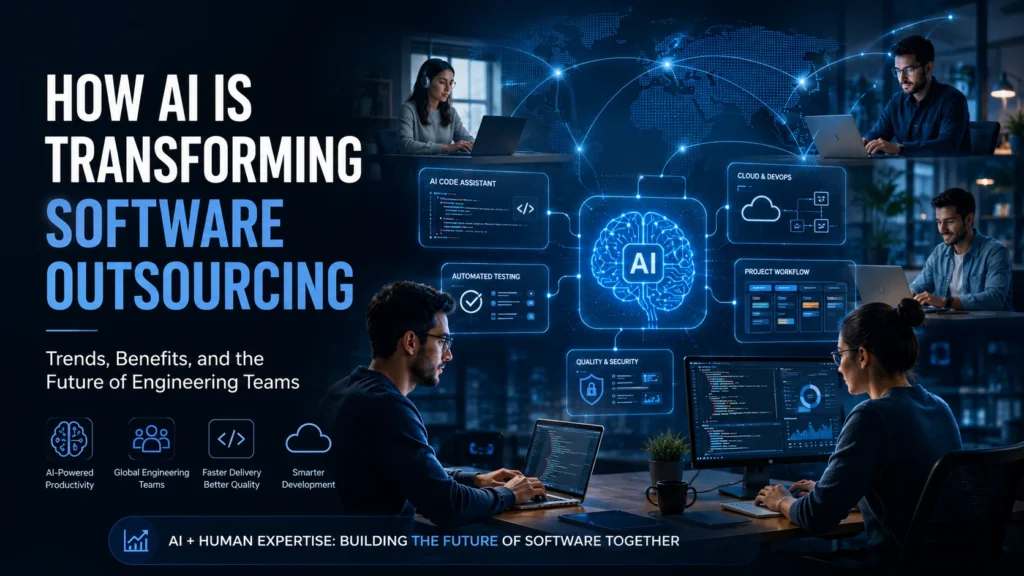
Artificial intelligence is changing how companies build, manage, and scale software teams. The rise of AI in software outsourcing is transforming traditional outsourcing models by improving development speed, increasing engineering efficiency, and creating new ways for businesses to collaborate with external technology partners.
For years, software outsourcing was mainly focused on accessing external talent, reducing development costs, and accelerating product delivery. Today, AI is adding a new layer of capabilities. Companies are no longer only looking for developers who can write code; they are looking for engineering partners who know how to combine human expertise with AI-powered workflows.
This shift is creating major changes across outsourcing companies, nearshore development providers, and distributed engineering teams. From automated testing to AI-assisted coding, the impact of AI on outsourcing companies is becoming one of the biggest technology trends shaping the future of software development.
The Rise of AI in Software Outsourcing
The software development industry has always evolved alongside new technologies. Programming languages, cloud platforms, automation tools, and development frameworks have continuously changed how engineering teams work.
AI represents the next major transformation.
According to research from Stanford AI Index Report, AI adoption continues expanding across industries, influencing how organizations approach productivity, innovation, and technology development.
Instead of replacing the entire software development process, AI is becoming a productivity layer that helps developers, architects, QA engineers, and technical leaders make better decisions faster.
Modern outsourced development teams are increasingly using AI for:
- Generating and reviewing code
- Automating repetitive engineering tasks
- Improving software testing
- Detecting bugs earlier
- Creating technical documentation
- Supporting product decisions
- Optimizing development workflows
This evolution means companies evaluating outsourcing partners must consider more than technical skills. They need teams that understand how to integrate AI into real-world engineering processes.
The biggest change is that outsourcing is moving from a simple “hire external developers” model toward a more strategic engineering partnership.
How AI Is Changing the Software Outsourcing Industry
The question many businesses are asking is not whether AI will affect outsourcing, but how deeply it will change the industry.
The answer is significant.
AI is changing software outsourcing industry operations by improving almost every stage of the development lifecycle.
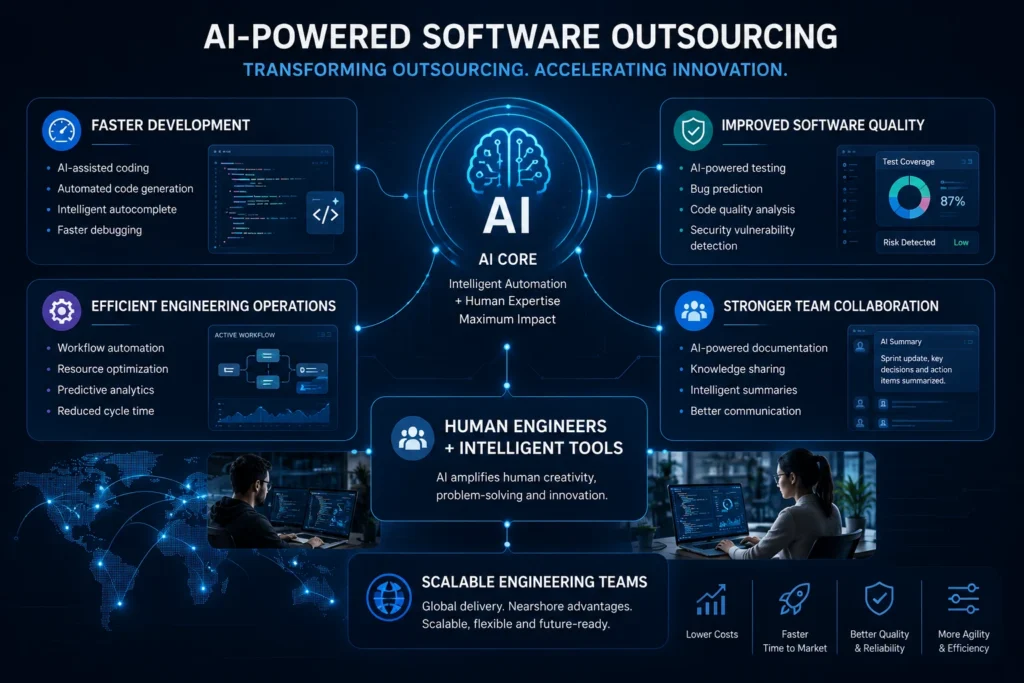
Faster Development Cycles
One of the biggest benefits of AI is increased development speed.
AI-powered coding assistants can help engineers generate code suggestions, identify errors, explain unfamiliar codebases, and automate repetitive programming tasks.
For outsourced teams, this means developers can spend less time on manual work and more time solving complex technical challenges.
For example, an engineering team building a new SaaS platform may use AI tools to:
- Generate initial code structures
- Create unit tests
- Review pull requests
- Improve documentation
- Identify potential security issues
This does not remove the need for experienced developers. Instead, it allows skilled engineers to focus on higher-value decisions.
For companies using software outsourcing services, this creates opportunities to improve delivery timelines without simply increasing team size.
Improved Software Quality
Quality assurance is another area where AI is creating major improvements.
Automation in software outsourcing is becoming more advanced as AI tools help teams identify patterns, detect anomalies, and improve testing coverage.
AI can support:
- Automated test creation
- Regression testing
- Bug prediction
- Performance analysis
- Code quality monitoring
This is especially valuable for companies working with distributed teams because maintaining consistent quality across locations requires strong processes.
AI does not replace QA expertise. Instead, it allows QA engineers to focus on strategic testing scenarios while machines handle repetitive checks.
More Efficient Engineering Operations
Engineering leaders are under constant pressure to increase productivity while controlling costs.
AI is becoming part of the solution by helping teams analyze workflows, identify bottlenecks, and improve resource allocation.
For CTOs and engineering managers, the goal is not simply adding more developers. It is creating a more effective engineering system.
This is where engineering cost reduction ai strategies are becoming increasingly relevant.
AI can help reduce costs by:
- Reducing repetitive manual tasks
- Improving developer productivity
- Shortening debugging cycles
- Increasing knowledge sharing
- Accelerating onboarding
The result is a more efficient development environment where teams can achieve more with existing resources.
AI and Nearshore Software Development Trends
Nearshore development is also being transformed by AI.
The combination of AI tools and nearshore engineering teams is creating new opportunities for companies that need scalable technical talent.
Traditionally, nearshore development provided advantages such as:
- Similar time zones
- Cultural alignment
- Access to specialized talent
- Lower costs compared to local hiring
AI adds another advantage: improved collaboration and productivity.
AI-powered collaboration tools can help distributed teams communicate better, document decisions, and maintain consistency across projects.
For example, a U.S.-based company working with a Latin American engineering team can use AI-supported workflows to improve:
- Code reviews
- Sprint planning
- Documentation
- Knowledge transfer
This makes nearshore teams even more valuable for companies trying to scale engineering capacity.
AI and nearshore software development trends show that the future of distributed engineering will not be based only on geography or cost advantages. It will depend on how effectively teams combine human expertise with intelligent tools.
The Role of AI in Staff Augmentation
Staff augmentation is another area experiencing major transformation.
Historically, companies used staff augmentation to quickly add developers when internal teams needed additional capacity.
Today, staff augmentation trends are moving toward more specialized and AI-enabled engineering support. Companies looking to scale their engineering capacity can explore how modern staff augmentation services help organizations access specialized talent while maintaining flexibility and control over development workflows.
Companies increasingly need engineers who can:
- Work effectively with AI tools
- Understand modern development workflows
- Adapt quickly to existing systems
- Collaborate with internal engineering teams
AI is changing what companies look for when hiring external developers.
The most valuable engineers are not simply those who can write code. They are professionals who understand architecture, business requirements, problem-solving, and how to use AI responsibly.
For organizations scaling quickly, AI-enhanced staff augmentation provides a way to increase engineering capacity while maintaining flexibility.
The Impact of AI on Outsourcing Companies and Development Teams
The impact of AI on outsourcing companies is becoming one of the defining factors in how technology service providers operate. AI is not simply changing development tools; it is changing expectations around productivity, communication, and delivery quality.
Companies evaluating outsourcing partners are increasingly looking for teams that can combine engineering expertise with AI-driven processes.
Traditional outsourcing success was often measured by factors such as:
- Number of developers available
- Hourly rates
- Project timelines
- Technical capabilities
While these factors still matter, AI is introducing new evaluation criteria.
Businesses now want to understand:
- How effectively teams use AI tools
- Whether engineers can validate AI-generated output
- How AI improves development workflows
- How AI affects software quality
- Whether AI adoption creates measurable business value
The future of outsourcing will depend less on simply providing developers and more on providing intelligent engineering systems.
AI-Enhanced Developer Productivity
AI-assisted development is becoming a standard part of modern engineering environments.
Developers are using AI tools to accelerate activities such as:
- Writing repetitive code
- Understanding existing systems
- Creating documentation
- Generating test cases
- Reviewing potential improvements
- Troubleshooting technical issues
However, productivity improvements depend on how these tools are implemented.
AI can generate suggestions, but experienced engineers still need to evaluate architecture decisions, security concerns, and business requirements.
For outsourced software teams, this distinction is important.
A low-quality AI implementation can create technical debt if teams blindly accept generated code. A mature engineering team uses AI as an accelerator while maintaining human oversight.
AI and the Evolution of Engineering Roles
AI is changing what it means to be a software engineer.
The role is moving from writing every line of code manually toward managing more complex problem-solving workflows.
Modern engineers need stronger skills in:
- System design
- Technical decision-making
- AI-assisted development
- Code validation
- Security awareness
- Business understanding
This creates an opportunity for companies working with nearshore development teams.
Instead of competing only on cost, engineering partners can differentiate through:
- Experienced developers
- AI adoption strategies
- Strong technical leadership
- Scalable development practices
Will AI Replace Outsourcing Developers?
One of the biggest questions companies ask is: will AI replace outsourcing developers?
The short answer is no, but it will change the type of work developers perform.
AI is powerful at handling repetitive tasks, but software development involves much more than producing code.
Successful products require:
- Understanding customer needs
- Designing scalable architectures
- Making technical trade-offs
- Managing complexity
- Ensuring security
- Collaborating with stakeholders
These areas still require human expertise.
Where AI Can Replace Manual Work
AI is already reducing the amount of time engineers spend on repetitive activities.
Examples include:
- Basic code generation
- Simple debugging assistance
- Documentation updates
- Test creation
- Code formatting
- Data analysis
This means outsourcing teams can become more efficient without increasing headcount.
For businesses, this can translate into faster delivery and better resource allocation.
Where Human Engineers Remain Essential
AI cannot replace experienced engineers who understand the bigger picture.
Human developers remain critical for:
- Architecture decisions
- Product strategy
- Complex problem-solving
- Technical leadership
- Quality control
- Communication with business teams
The future of offshore development will likely involve hybrid teams where AI handles repetitive work while engineers focus on higher-value activities.
How Companies Use AI in Outsourced Development
Understanding how companies use AI in outsourced development helps explain why AI is becoming a competitive advantage.
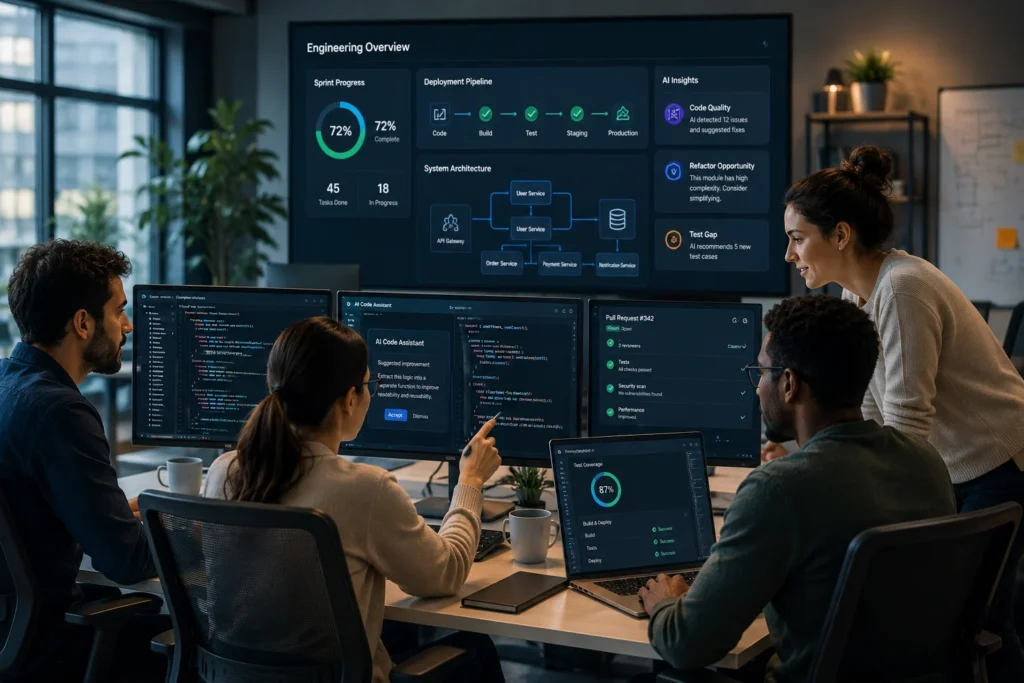
Organizations are integrating AI throughout the software development lifecycle.
AI in Planning and Requirements
Before development begins, AI can help teams analyze requirements and identify potential risks.
Teams use AI to:
- Summarize technical requirements
- Identify missing information
- Create initial project documentation
- Support product planning
For distributed teams, this improves alignment between internal stakeholders and external engineers.
AI in Development
During implementation, AI tools support developers by helping with:
- Code generation
- Refactoring suggestions
- Error detection
- Technical explanations
- Development automation
The goal is not replacing developers but increasing their effectiveness.
AI in Testing and Quality Assurance
AI is transforming QA processes by making testing more predictive and efficient.
AI-powered QA workflows can help teams:
- Identify likely failure points
- Prioritize test scenarios
- Improve regression testing
- Detect unusual behavior
This is especially valuable for companies building products where reliability directly affects customer experience.
AI in Maintenance and Support
Software does not end after launch.
Maintenance, updates, and improvements require ongoing engineering effort.
AI can support these activities by:
- Monitoring application behavior
- Detecting potential issues
- Helping engineers understand legacy systems
- Improving incident response
For companies using outsourced development teams, AI creates more visibility and control over long-term software operations.
Benefits of AI-Powered Software Outsourcing
AI-powered outsourcing models provide several advantages for companies looking to scale engineering teams.
Faster Time to Market
AI-assisted workflows can reduce delays caused by repetitive manual processes.
Development teams can:
- Build features faster
- Resolve issues sooner
- Improve release cycles
This allows companies to respond more quickly to market changes.
Better Cost Efficiency
One of the main reasons businesses use outsourcing is controlling development costs.
AI adds another layer of optimization.
Research from World Economic Forum Future of Jobs Report highlights how AI and emerging technologies are reshaping skills, workflows, and the future of work.
Through improved productivity, companies can achieve engineering cost reduction ai benefits by:
- Reducing unnecessary manual work
- Increasing developer output
- Improving project planning
- Avoiding delays
The goal is not simply hiring cheaper talent. It is creating a more efficient engineering operation.
Improved Scalability
Scaling internal engineering teams can be challenging.
Companies often face:
- Hiring delays
- Talent shortages
- High salary expectations
- Limited technical availability
AI-enabled software outsourcing allows organizations to expand capabilities faster by combining external expertise with modern tools.
Stronger Collaboration Between Teams
Distributed teams need effective communication.
AI tools can support collaboration through:
- Automated documentation
- Meeting summaries
- Knowledge management
- Technical assistance
This helps internal and external teams work as one engineering organization.
Challenges and Risks of AI in Software Outsourcing
Although AI provides significant benefits, companies must also understand the risks.
AI adoption requires strategy, governance, and technical expertise.
Security and Data Concerns
When using AI tools, organizations must consider:
- What data is shared
- How information is protected
- Which tools meet security requirements
This is especially important for companies handling sensitive customer or business data.
Quality Control
AI-generated output still requires review.
Without proper engineering oversight, companies may experience:
- Poor-quality code
- Security vulnerabilities
- Long-term maintenance issues
Strong development practices remain essential.
Overdependence on AI Tools
AI should support engineers, not replace critical thinking.
The strongest teams use AI as a productivity enhancer while maintaining human decision-making.
The Future of Offshore Development and AI
The future of offshore development is changing as AI becomes more integrated into software engineering workflows. Traditional offshore models were often focused on labor availability and cost savings, but modern outsourcing strategies are shifting toward expertise, innovation, and measurable business outcomes.
AI is accelerating this transformation by enabling distributed teams to operate with greater efficiency and flexibility.
Companies that once viewed outsourcing mainly as a way to reduce expenses are now looking for technology partners that can help them:
- Build products faster
- Improve engineering quality
- Scale development capabilities
- Adopt modern technologies
- Maintain competitive advantages
This shift is creating a new generation of outsourcing relationships where external engineering teams operate as strategic extensions of internal organizations.
The Evolution From Outsourcing Provider to Engineering Partner
The most successful software outsourcing companies are moving beyond transactional relationships.
Instead of simply providing developers, they are helping businesses solve broader engineering challenges.
Modern outsourcing partnerships focus on:
- Technical strategy
- Product development support
- Engineering process improvements
- AI adoption
- Long-term scalability
For CTOs and engineering leaders, this means choosing partners based on their ability to contribute strategically, not only their availability.
AI is reinforcing this change because companies need teams that understand both technology and business goals.
AI and Software Outsourcing Trends 2026
The software outsourcing trends 2026 landscape shows that AI will continue influencing how companies build and manage engineering teams.
Several trends are expected to shape the industry:
AI-Augmented Engineering Teams
Teams will increasingly combine human developers with AI-powered tools.
This model creates a balance where:
- AI handles repetitive tasks
- Engineers manage complex decisions
- Leaders focus on architecture and strategy
This approach improves productivity without sacrificing quality.
Increased Demand for AI-Skilled Developers
Companies will prioritize engineers who understand how to work effectively with AI.
Future-ready developers will need knowledge of:
- AI coding assistants
- Automation workflows
- Data-driven development
- AI governance
- Responsible AI usage
This will influence how companies evaluate outsourcing partners.
More Strategic Staff Augmentation Models
Staff augmentation will continue evolving.
Instead of simply adding more developers, companies will seek specialized engineers who can immediately contribute to modern development environments.
The future of staff augmentation will emphasize:
- Faster onboarding
- Specialized expertise
- AI-assisted productivity
- Flexible team scaling
Greater Focus on Engineering Outcomes
Companies are moving away from measuring outsourcing success only through hours worked.
Future outsourcing models will focus more on:
- Product delivery
- Engineering velocity
- Software quality
- Business impact
How Businesses Should Prepare for AI-Driven Outsourcing
Companies considering outsourcing should adapt their evaluation process.
Choosing the right partner requires looking beyond traditional factors.
Evaluate AI Readiness
Before selecting an outsourcing provider, businesses should ask:
- How does the team use AI tools?
- What AI workflows are already implemented?
- How do engineers validate AI-generated output?
- What security practices exist around AI usage?
A partner’s AI maturity will become an important competitive factor.
Prioritize Engineering Experience
AI tools are only as effective as the people using them.
Companies should prioritize teams with:
- Strong technical foundations
- Experience with scalable systems
- Effective communication skills
- Ability to solve complex problems
AI enhances skilled engineers; it does not replace engineering judgment.
Build a Flexible Development Strategy
The most effective organizations will combine multiple approaches:
- Internal engineering leadership
- Nearshore development teams
- AI-powered workflows
- Automation strategies
This creates a flexible system capable of adapting to changing business needs.
The Role of Nearshore Teams in the AI Era
Nearshore development is positioned strongly in the AI era because it combines human collaboration advantages with modern engineering practices.
Companies working with nearshore teams benefit from:
- Overlapping working hours
- Easier communication
- Cultural compatibility
- Access to specialized talent
When combined with AI, nearshore teams can deliver even greater value.
AI helps remove friction from distributed work by improving:
- Documentation
- Collaboration
- Knowledge transfer
- Development efficiency
For companies in the United States looking to expand engineering capacity, nearshore partnerships provide a practical approach to scaling without the challenges of traditional hiring.
Conclusion
AI in software outsourcing is transforming how companies build products, manage engineering teams, and scale technology operations.
The biggest change is not that AI is replacing developers. Instead, AI is changing how developers work and what companies expect from outsourcing partners.
The future belongs to engineering teams that combine:
- Human expertise
- AI-powered tools
- Strong technical processes
- Strategic collaboration
The impact of AI on outsourcing companies will continue growing as businesses look for faster, smarter, and more flexible ways to deliver software.
For organizations exploring nearshore development, staff augmentation, or software outsourcing services, the key question is no longer whether AI will affect their development strategy.
The question is how effectively they can integrate AI into their engineering ecosystem.
Ready to build a more efficient engineering team with AI-enabled development practices? Explore our nearshore software development services and discover how TechAID helps companies scale technical teams with experienced LATAM engineers.
Frequently Asked Questions
How is AI changing the software outsourcing industry?
AI is changing the software outsourcing industry by improving developer productivity, automating repetitive tasks, enhancing software testing, and enabling teams to deliver products faster. Outsourcing companies are increasingly combining AI tools with human engineering expertise.
Will AI replace outsourcing developers?
AI will not fully replace outsourcing developers. Instead, it will change developer responsibilities by reducing repetitive work and allowing engineers to focus on architecture, problem-solving, and higher-value technical decisions.
What is the impact of AI on outsourcing companies?
The impact of AI on outsourcing companies includes improved productivity, better quality control, faster development cycles, and new expectations around AI adoption and engineering capabilities.
How are companies using AI in outsourced development?
Companies use AI in outsourced development for code assistance, automated testing, documentation, debugging, workflow optimization, and improving collaboration between internal and external teams.
How does AI affect nearshore software development?
AI improves nearshore software development by increasing collaboration, reducing communication friction, improving productivity, and helping distributed engineering teams work more efficiently.
What are the biggest software outsourcing trends 2026?
Major software outsourcing trends 2026 include AI-enabled engineering teams, increased demand for AI-skilled developers, strategic staff augmentation, and stronger focus on measurable engineering outcomes.
Can AI reduce software development costs?
AI can help reduce software development costs by improving productivity, reducing repetitive work, accelerating delivery cycles, and helping engineering teams use resources more efficiently.