AI incident response: A Human-in-the-Loop Runbook for SRE Teams

AI incident response: A Human-in-the-Loop Runbook for SRE Teams

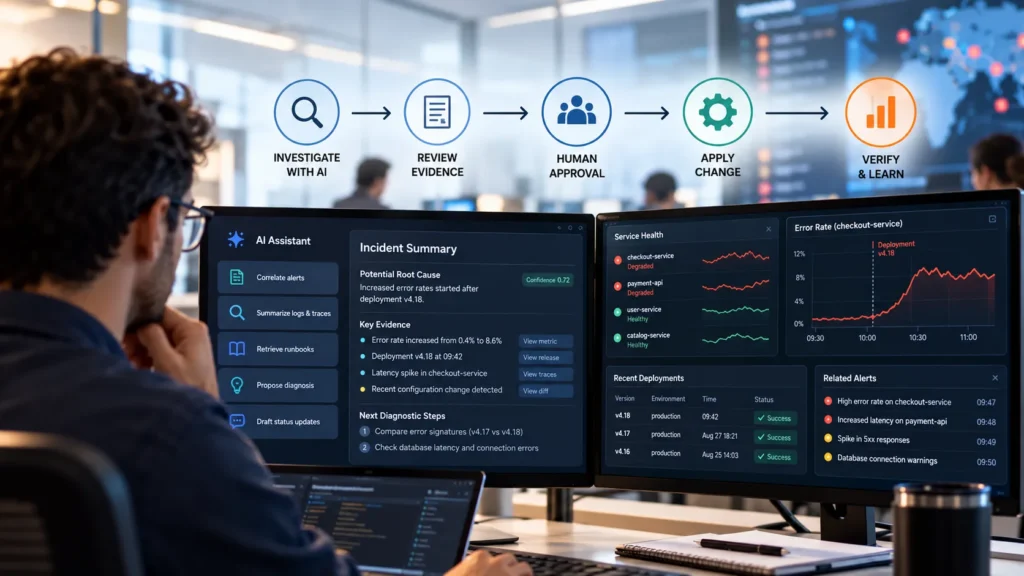
SRE engineer using AI-assisted incident response to review evidence, diagnose service issues, and keep production changes under human approval.
AI can help SRE teams investigate incidents faster, but production authority still needs clear boundaries. This human-in-the-loop runbook shows how to use AI for evidence gathering, hypothesis generation, change approval, rollback, verification, and post-incident learning.
Share the Post:

AI can help SRE teams investigate incidents faster.

It can summarize logs, correlate alerts, compare recent deployments, retrieve runbooks, and propose possible causes within seconds.

But faster investigation does not mean production authority should become autonomous.

During an incident, the most important requirement is not simply reaching an answer quickly. It is reaching a safe, explainable decision based on evidence the team can inspect.

That distinction should define how organizations approach AI incident response.

An incident commander does not need another system that confidently announces a root cause. They need a clear path from:

alert → evidence → hypothesis → decision → change → verification

AI can accelerate several parts of that path.

It should not erase accountability from it.

For SRE, DevOps, and platform teams, the goal should therefore be limited: use AI to reduce the time required to understand an incident while preserving human ownership of severity, change approval, rollback, and final production decisions.

AI Can Shorten Investigation Without Owning the Incident

Incident response already requires coordination across multiple systems and teams.

Responders may need to review:

  • Logs
  • Metrics
  • Traces
  • Deployment history
  • Feature flags
  • Infrastructure changes
  • Dependency status
  • Alerts
  • Customer reports
  • Runbooks
  • Previous incidents

AI can reduce the manual work involved in gathering and organizing that information.

The risk appears when useful assistance is confused with operational authority.

An AI system may produce a plausible explanation for an outage without understanding every dependency, missing piece of telemetry, or business consequence.

A recommendation can sound confident while still being incomplete.

For that reason, AI-generated incident information should be treated as evidence to review, not authority to act.

Google’s SRE guidance on incident management emphasizes clear roles and coordinated decision-making during incidents.

That principle becomes even more important when AI enters the process.

The assistant can help responders reach a decision faster.

The incident commander and service owners should still decide what happens next.

Start With a Bounded Job, Not an Autonomous Agent

The safest starting point for AI incident response is not autonomous remediation.

It is bounded assistance.

Give AI tasks that are:

  • Read-only
  • Reversible
  • Easy to verify
  • Based on observable evidence
  • Narrow enough to explain

The objective is to reduce investigation toil without creating an uncontrolled path into production.

Good Early Uses of AI in Incident Response

Correlate Alerts

Multiple monitoring systems may report symptoms of the same underlying failure.

AI can help group related signals by:

  • Service
  • Time window
  • Region
  • Dependency
  • Deployment
  • Error signature

This can reduce the amount of noise responders must process manually.

The correlation should still preserve links to the underlying alerts so engineers can verify the grouping.

Summarize an Incident Timeline

During a fast-moving incident, important events may be scattered across:

  • Monitoring systems
  • Deployment tools
  • Incident channels
  • Logs
  • Feature-flag systems
  • Infrastructure events

AI can assemble these into a chronological timeline.

For example:

09:42 — Version 4.18 deployed
09:47 — Checkout latency begins increasing
09:50 — Payment API error rate crosses alert threshold
09:52 — Incident declared
09:56 — Feature flag disabled

The timeline becomes valuable when each event retains a source or query reference.

A fluent summary without provenance should be treated as a lead rather than a verified fact.

Retrieve Relevant Runbooks

Responders should not need to search manually through hundreds of documents during an outage.

An assistant can retrieve:

  • Relevant service runbooks
  • Known failure procedures
  • Dependency documentation
  • Prior incident notes
  • Escalation contacts

The system should show where the information came from rather than presenting retrieved guidance as original AI knowledge.

Propose Diagnostic Queries

AI can help responders decide what evidence to gather next.

For example:

  • Query error rates for a specific endpoint
  • Compare latency before and after a deployment
  • Check whether failures are isolated to one region
  • Compare healthy and unhealthy instances
  • Review recent configuration changes

The assistant can propose the query.

A responder should still interpret the result.

Compare Recent Changes With a Baseline

Deployment history is often central to incident investigation.

AI can help compare:

  • Current release vs previous release
  • Current configuration vs known-good configuration
  • Current infrastructure state vs baseline
  • Current feature flags vs previous values

This is especially useful when the incident begins shortly after a known change.

Draft Status Updates

Incident communication is repetitive but important.

AI can draft updates containing:

  • Current impact
  • Known facts
  • Current investigation
  • Mitigation status
  • Next update time

A human should review the message before it reaches customers or executives.

Require Evidence With Every AI Assertion

The most important rule for AI-assisted investigation is simple:

Every meaningful claim should point back to evidence.

If the assistant says:

“Latency increased immediately after deployment 4.18.”

the team should be able to see:

  • Deployment timestamp
  • Relevant latency metric
  • Time window
  • Dashboard or query reference

If it says:

“The database is probably the bottleneck.”

it should identify:

  • Which metrics support that hypothesis
  • Which evidence contradicts it
  • What diagnostic step would confirm or reject it

Unsupported narrative is especially dangerous during incidents because responders are already operating under time pressure.

A confident explanation can redirect attention even when the underlying evidence is weak.

If reliable data is unavailable, the assistant should say so.

Unknown is safer than invented certainty.

What AI Should Not Do by Default

Some tasks carry significantly greater risk because they directly change production state or increase blast radius.

These should remain human-approved by default.

Examples include:

  • Changing production configuration
  • Rotating credentials
  • Modifying routing
  • Changing feature flags with broad impact
  • Scaling stateful databases
  • Deleting data
  • Running database migrations
  • Modifying load balancer behavior
  • Changing access permissions
  • Executing infrastructure changes

The question is not whether an AI system could technically perform these actions.

The question is whether the organization has enough control around the action to make it safe.

“The model is usually right” is not a change-management policy.

When Automated Remediation May Be Appropriate

Not every production action needs indefinite manual approval.

Some remediation can eventually become automated when the action is:

  • Narrowly bounded
  • Well understood
  • Pre-approved
  • Independently validated
  • Observable
  • Easy to reverse

For example, an organization may already have deterministic automation that restarts a failed stateless service under specific conditions.

Adding AI to the investigation around that action does not necessarily increase risk if the execution path itself remains bounded by existing controls.

The key distinction is between:

AI proposing what should happen

and

AI having unrestricted authority to decide and execute what happens.

Organizations should expand autonomy only after they understand the failure modes and can contain the blast radius.

The Five Gates of a Human-in-the-Loop Runbook

A practical AI incident response runbook can be structured around five gates.

Each gate prevents the response from moving forward until a specific responsibility or evidence requirement has been satisfied.

The five gates are:

  1. Classify the incident
  2. Assemble evidence
  3. Propose and challenge
  4. Authorize the change
  5. Verify and learn

The assistant can support every stage.

Human authority remains explicit where risk requires it.

Gate 1: Classify the Incident

Before investigating solutions, define what kind of incident the team is responding to.

Record:

  • Severity
  • Customer impact
  • Affected services
  • Regions or tenants affected
  • Data sensitivity
  • Regulatory implications
  • Safety implications
  • Current owner

The incident commander should retain responsibility for severity and escalation.

AI may suggest a severity based on observed symptoms, but it should not silently determine how the organization responds.

For example, the same technical failure may have very different implications depending on whether it affects:

  • An internal reporting tool
  • Customer authentication
  • Payment processing
  • Regulated data
  • A safety-sensitive system

Context matters.

The model may not have all of that context unless the organization explicitly provides it.

Define the Incident Boundary

Before broad investigation begins, identify:

  • What is known to be affected
  • What appears healthy
  • When symptoms began
  • What changed recently
  • Which dependencies are relevant

This prevents the investigation from expanding unnecessarily.

It also gives the AI assistant a more precise evidence window.

Gate 2: Assemble the Evidence

Once the incident is classified, create a time-bounded evidence packet.

AI is particularly useful at this stage because evidence may be spread across many systems.

The packet can include:

  • Logs
  • Metrics
  • Traces
  • Deployment history
  • Configuration changes
  • Feature flags
  • Dependency health
  • Known issues
  • Alerts
  • Customer symptoms
  • Previous related incidents

Every significant statement should include a source.

For example:

Observed: API error rate increased from 0.4% to 8.6% at 14:07.
Source: Payments API error-rate dashboard.

Observed: Version 6.2.1 deployed at 14:02.
Source: Production deployment record.

Observed: Database latency remained within baseline.
Source: Database latency dashboard.

This creates a shared evidence surface rather than an AI-generated story.

Separate Facts From Hypotheses

The incident packet should clearly distinguish between:

Observed fact:
Checkout failures increased after 14:07.

Hypothesis:
Deployment 6.2.1 introduced a regression in the checkout service.

The first is supported directly by evidence.

The second still needs to be tested.

AI systems should label this distinction explicitly.

That helps prevent a plausible theory from gradually becoming accepted as fact simply because it was repeated during the response.

Gate 3: Propose, Then Challenge

Once enough evidence has been collected, AI can help generate possible explanations.

Do not ask only:

“What is the root cause?”

Instead, require multiple competing hypotheses.

For each hypothesis, request:

  • Evidence supporting it
  • Evidence against it
  • Missing information
  • Confidence level
  • Lowest-risk next diagnostic step
  • Conditions that would falsify the hypothesis

For example:

Hypothesis A: New checkout deployment introduced the failure.

Supporting evidence:

  • Errors began five minutes after deployment.
  • Failure appears only in the updated service.

Evidence against:

  • Similar latency increase appeared briefly before deployment.

Next check:
Compare error signatures before and after version 6.2.1.

Hypothesis B: Payment provider degradation is causing the failures.

Supporting evidence:

  • Payment API latency increased during the same period.

Evidence against:

  • Another service using the same provider remains healthy.

Next check:
Compare provider response codes across affected and unaffected services.

This structure forces the assistant to reason in terms of evidence rather than producing a single confident narrative.

Require a Challenge Before a Production Change

Before a hypothesis becomes a remediation request, it should be challenged.

That challenge may come from:

  • A second engineer
  • The incident commander
  • The service owner
  • A deterministic query
  • A controlled test
  • A lower-en

Gate 4: Authorize the Change

A strong hypothesis is not the same as permission to modify production.

Before any change is executed, the team should explicitly define:

  • The proposed action
  • The responsible owner
  • The approver
  • The expected outcome
  • The affected service or environment
  • The potential blast radius
  • The time window for the change
  • The rollback procedure
  • The metric that will confirm whether the change worked

The designated service owner should approve the action.

That approval should be recorded in the incident channel, change-management system, or another auditable location.

It should not exist only inside an AI chat session.

Make the Proposed Action Specific

Avoid approvals such as:

“Fix the database issue.”

Instead, describe the exact action being authorized.

For example:

Change:
Revert database connection-pool configuration from version B to version A.

Expected outcome:
Reduce connection timeout errors within five minutes.

Rollback:
Restore configuration B if latency or error rate increases.

Verification:
Monitor database connection errors, API latency, and checkout success rate for ten minutes.

Specific authorization reduces ambiguity during high-pressure incidents.

Limit the Blast Radius

When possible, choose the smallest effective intervention.

Examples include:

  • Apply the change to one instance first
  • Disable a feature for a limited user segment
  • Shift a portion of traffic
  • Roll back one service instead of an entire release
  • Test the remediation in a lower environment where time permits

AI can help compare possible actions, but the team should prefer the option that creates the least irreversible impact while still addressing the incident.

Require a Rollback Path

Every significant production change should answer:

“What happens if this makes the incident worse?”

The rollback plan should be explicit before the change begins.

Document:

  • Who initiates rollback
  • What condition triggers it
  • How long rollback remains viable
  • Which command or procedure is required
  • What data implications exist
  • Which metrics confirm recovery

A remediation proposal without a credible rollback path may require additional review before execution.

Gate 5: Verify and Learn

Executing a change is not the end of the incident-response loop.

The team must confirm whether the action actually improved the system.

Verification should focus on the signal the remediation was intended to change.

Depending on the incident, that may include:

  • Error rate
  • Latency
  • Availability
  • Queue depth
  • Request success rate
  • Customer-facing symptoms
  • Resource saturation
  • SLI or SLO performance
  • Error budget impact

Do not assume that a successful command means successful remediation.

Check for Downstream Effects

A change can improve one signal while creating another problem elsewhere.

After remediation, verify:

  • Dependent services
  • Related customer journeys
  • Infrastructure health
  • Data consistency
  • Secondary alerts
  • Regional behavior

This is especially important when the response changes routing, configuration, infrastructure capacity, or shared dependencies.

Keep the Evidence Packet

The final incident record should preserve:

  • Initial symptoms
  • Evidence collected
  • Hypotheses considered
  • Evidence supporting and contradicting each hypothesis
  • Approved changes
  • Approvers
  • Verification results
  • Rollbacks, if any
  • Remaining uncertainty

This creates a traceable record of how the team moved from alert to decision.

It also provides better input for the postmortem.

Use the Postmortem to Reduce Future Toil

The goal of the postmortem is not to evaluate whether the AI assistant was impressive.

It is to identify what the system should improve before the same incident happens again.

Ask:

  • Which evidence was difficult to find?
  • Which dashboard was missing?
  • Which alert was noisy?
  • Which runbook was outdated?
  • Which dependency was poorly understood?
  • Which diagnostic step should become automated?
  • Which test could have detected the issue earlier?
  • Which ownership boundary was unclear?

The output should become engineering work.

That may mean:

  • Better telemetry
  • Improved alerting
  • Updated runbooks
  • Additional test coverage
  • Automated diagnostics
  • Clearer ownership
  • Safer deployment controls

The most valuable incident-response automation is often the automation that prevents responders from repeating the same manual investigation next time.

Build a Minimal Incident Packet

AI can generate extremely detailed summaries.

During an active incident, that is not always useful.

A responder under pressure needs a compact decision surface that separates known facts, hypotheses, actions, and unknowns.

A practical incident packet can contain five sections.

What Changed?

Capture:

  • Deployment IDs
  • Configuration changes
  • Feature-flag changes
  • Infrastructure changes
  • Dependency changes
  • Relevant timestamps

Do not assume that the latest change caused the incident.

This section simply establishes what changed near the relevant time window.

What Is Observed?

Document the evidence currently available.

Examples include:

  • SLI or SLO degradation
  • Error-rate changes
  • Customer reports
  • Affected regions
  • Affected tenants
  • Service availability
  • Confidence level

Observed symptoms should remain separate from explanations.

What Is the Leading Hypothesis?

For the current hypothesis, include:

  • Evidence supporting it
  • Evidence against it
  • Missing evidence
  • Confidence level
  • Next diagnostic step

The packet should make uncertainty visible.

If the assistant cannot determine something reliably, leave the field unknown.

What Action Is Proposed?

Document:

  • Action
  • Owner
  • Approver
  • Expected outcome
  • Blast radius
  • Rollback
  • Verification metric

This creates a bridge between investigation and controlled production change.

What Did We Learn?

Capture follow-up opportunities such as:

  • Missing telemetry
  • Missing alert
  • Outdated runbook
  • Unclear service ownership
  • Missing test
  • Repetitive manual diagnostic
  • Weak escalation path

These observations should become backlog items after the incident.

Never Let AI Fill Evidence Gaps With Plausible Detail

During incident response, incomplete information is normal.

The assistant should be designed to say:

  • Data unavailable
  • No reliable evidence found
  • Source inaccessible
  • Confidence insufficient
  • Additional validation required

It should not create a complete narrative simply because the incident template expects one.

A missing field is visible uncertainty.

Invented detail is invisible risk.

That distinction is especially important when engineers are tired, under time pressure, or managing a customer-impacting outage.

Put Guardrails in the System, Not Only in Policy

A written policy that says “review AI output before acting” is too vague for production incident response.

Important boundaries should be enforced technically wherever possible.

Start With Read-Only Access

An AI assistant used for investigation should initially receive only the telemetry access required for its task.

That may include:

  • Logs
  • Metrics
  • Traces
  • Deployment history
  • Runbooks
  • Alert history
  • Service documentation

Avoid granting broad write access simply because the system technically supports it.

The permission model should reflect the actual job.

Route Write Actions Through Existing Change Controls

When the assistant proposes a production change, execution should pass through the organization’s normal approval mechanism.

That may mean:

  • Change-management workflow
  • Incident command approval
  • Deployment system
  • Infrastructure automation
  • Privileged access workflow

The AI recommendation becomes an input to the system rather than a bypass around it.

Log Important Actions and Approvals

For systems where retention is appropriate, maintain enough history to understand:

  • What information the assistant accessed
  • What it proposed
  • Which source evidence it referenced
  • Which tools were invoked
  • Who approved the action
  • What was executed
  • What happened afterward

Auditability makes it easier to improve both incident procedures and AI guardrails.

Limit Actions by Time and Environment

Automated capabilities should have explicit boundaries.

For example:

  • Production actions require approval
  • Lower-environment diagnostics may run automatically
  • Temporary access expires after the incident
  • A specific remediation is authorized only during a defined window
  • Actions are limited to a specific service

These controls reduce the risk that temporary incident permissions become permanent capabilities.

Use a Staged Path for Higher-Risk Services

For high-impact systems, teams can introduce an additional validation path before production changes.

Where feasible:

  1. AI proposes a diagnostic or remediation.
  2. Engineers reproduce the behavior in a lower environment.
  3. The team validates the expected outcome.
  4. A specific action is approved.
  5. The action is executed in production.
  6. Defined metrics verify the result.

Not every outage allows this sequence.

Some incidents require immediate intervention.

But when the staged path cannot be used, that should be an explicit exception rather than a reason to normalize unrestricted autonomy.

Measure Whether AI Incident Response Is Actually Helping

Do not measure success by counting:

  • AI-generated summaries
  • AI queries
  • Recommendations
  • Automated conversations

Those numbers say little about incident quality.

Measure operational outcomes instead.

Time to a Verified Hypothesis

How long does it take the team to move from alert to an evidence-supported explanation worth testing?

This is more useful than measuring how quickly AI generates its first theory.

Time to Safe Mitigation

Measure the time between incident declaration and a mitigation that has been approved and verified.

The word safe matters.

A fast but poorly controlled change is not automatically an improvement.

Assertions With Source Evidence

Track how often meaningful AI-generated statements include verifiable evidence.

A rising percentage suggests the workflow is becoming more auditable.

Rollback Rate

How often do AI-assisted remediation decisions require rollback?

Rollback is not automatically a failure, but patterns may indicate weak hypotheses, poor verification, or overly broad actions.

Repeat-Incident Rate

Are similar incidents recurring because the team resolves symptoms without fixing underlying operational gaps?

A useful incident process should gradually reduce repeated toil.

Alert Noise

Measure whether responders are spending less time processing redundant or low-value alerts.

AI correlation should reduce cognitive load, not simply produce longer summaries.

Follow-Up Completion

Track whether postmortem actions actually become completed engineering work.

If the same missing telemetry or runbook gap appears repeatedly, the learning loop is failing.

Segment Results by Incident Severity

An AI workflow that performs well for routine incidents may be inappropriate for high-severity events.

Evaluate results separately across severity levels.

For example:

Low-severity incidents may tolerate more automated diagnostic activity.

Critical incidents may require:

  • Stricter approval
  • More senior review
  • Smaller action boundaries
  • Stronger evidence requirements
  • Tighter access control

AI incident response does not need one universal level of autonomy.

The level of assistance should match the risk of the incident.

A 30-Day AI Incident Response Adoption Plan

Introducing AI into incident response should begin with a narrow operational problem, not a broad automation initiative.

The first month should focus on learning whether AI can improve investigation speed and evidence quality without weakening existing incident-management controls.

Week 1: Choose One Read-Only Use Case

Start by reviewing recurring incident types.

Look for investigation tasks that consume time but do not require production changes.

Possible starting points include:

  • Correlating related alerts
  • Building incident timelines
  • Retrieving relevant runbooks
  • Summarizing recent deployments
  • Comparing current metrics with a baseline
  • Drafting diagnostic queries
  • Organizing logs, metrics, and traces into an evidence packet

Choose one use case.

Keep the scope small enough that the team can evaluate the quality of every output.

Do not begin by connecting an AI agent to unrestricted production actions.

The first objective is to determine whether the assistant can reliably improve sense-making.

Week 2: Define the Incident Packet and Approval Model

Create the structure the AI assistant should follow.

Define:

  • Required evidence fields
  • Source-link requirements
  • Confidence indicators
  • Unknown or unavailable states
  • Human review responsibilities
  • Production approval roles
  • Escalation paths

The team should also agree on what the assistant is not permitted to do.

Examples may include:

  • No direct production changes
  • No credential modification
  • No database operations
  • No routing changes
  • No deletion of data
  • No autonomous severity changes

Explicit boundaries are easier to operate than vague instructions such as “use AI carefully.”

Week 3: Run Tabletop Exercises

Test the workflow before relying on it during a real outage.

Use simulated incidents with:

  • Missing telemetry
  • Conflicting signals
  • Misleading recent deployments
  • Unavailable dependencies
  • Incomplete runbooks
  • Multiple plausible root causes

The goal is not to see whether the assistant can guess correctly.

The goal is to test whether it:

  • Identifies uncertainty
  • Preserves source evidence
  • Separates observations from hypotheses
  • Requests missing information
  • Avoids unsupported claims
  • Proposes low-risk diagnostic steps

Deliberately remove important information during some exercises.

A trustworthy system should admit when the available evidence is insufficient.

Week 4: Pilot With Low-Severity Incidents

Once the team understands the workflow, introduce it into real low-risk incidents.

Review every output.

For each incident, ask:

  • Did AI reduce investigation time?
  • Were claims supported by evidence?
  • Did responders understand where the information came from?
  • Did it introduce distracting or incorrect hypotheses?
  • Were approval boundaries respected?
  • Did the workflow reduce manual toil?
  • What guardrails need adjustment?

At the end of the pilot, choose deliberately whether to:

  • Expand the use case
  • Modify the workflow
  • Tighten permissions
  • Improve telemetry
  • Continue the pilot
  • Stop using AI for that task

Successful adoption does not require expansion.

Stopping an unreliable use case is also a useful result.

Measure Human Cost, Not Only Incident Speed

Faster incident resolution is important, but it should not be the only measure.

Reliability teams can become trapped in constant reactive work.

AI can make that worse if it simply helps responders close more alerts without addressing why those incidents keep occurring.

Track whether the workflow reduces repetitive work.

Questions to ask include:

  • Are responders spending less time gathering basic evidence?
  • Are repeated diagnostic steps becoming automated?
  • Are runbooks improving after incidents?
  • Are noisy alerts being removed?
  • Are recurring failures becoming engineering backlog items?
  • Are responders interrupted less often by avoidable incidents?

If AI makes individual investigations faster but the same incidents continue happening, the reliability system has not improved enough.

The goal should be to reduce future toil, not only accelerate current toil.

Turn Repeated Diagnostics Into Better Engineering

Postmortems should reveal which manual activities deserve permanent improvement.

For example, if engineers repeatedly ask:

“Was there a deployment immediately before the failure?”

that information may belong directly in the incident dashboard.

If responders repeatedly need to compare configuration across environments, that comparison may deserve automation.

If the same missing trace slows every investigation, observability may be the real problem.

AI can help expose these patterns.

The longer-term response should often be:

  • Better telemetry
  • Better dashboards
  • Better alerts
  • Better runbooks
  • Better testing
  • Safer deployment automation
  • Clearer service ownership

A mature AI incident response workflow should gradually reduce the amount of investigation work that requires AI in the first place.

Where TechAID Fits

AI incident response often exposes gaps that are larger than the AI implementation itself.

The organization may discover that it lacks:

  • Reliable observability
  • Consistent runbooks
  • Clear incident ownership
  • CI/CD safety controls
  • Test automation
  • Release verification
  • Incident diagnostics
  • Defined escalation paths

When the desired outcome can be clearly scoped, project outsourcing can be used to establish or improve a defined reliability workstream.

That could include:

  • Observability improvements
  • Incident-process design
  • Runbook standardization
  • CI/CD implementation
  • QA and test automation
  • Release-readiness controls
  • Incident logging and assessment

TechAID’s project outsourcing model is designed for defined technical outcomes where delivery responsibilities, acceptance criteria, and handoff expectations can be established in advance.

If the organization already has strong platform or engineering leadership but lacks sustained specialist capacity, an embedded DevOps, SRE, or QA automation professional may be a better fit.

For teams evaluating that ownership decision, TechAID’s guide to nearshore SRE engagement models provides additional context on when permanent ownership, embedded capacity, or a managed reliability project makes more sense.

In either model, the client should retain production authority and final risk acceptance.

Need to strengthen observability, incident processes, CI/CD safety, or release reliability?
TechAID can help scope a defined engineering workstream around the specific reliability gap your team needs to solve. Explore Project Outsourcing.

A Practical Next Step

Do not start by asking:

“How much incident response can we automate with AI?”

Choose one recurring incident instead.

Map:

  • The initial alert
  • Evidence responders normally collect
  • Systems they consult
  • Diagnostic queries they run
  • Decisions requiring human judgment
  • Production actions that may follow
  • Approval path
  • Rollback requirements
  • Missing telemetry
  • Repetitive manual work

Then identify which steps are:

  • Read-only
  • Repetitive
  • Evidence-driven
  • Easy to validate

Those are the strongest candidates for early AI assistance.

Keep production-changing actions behind explicit controls until the organization has enough evidence to justify a different model.

Final Thoughts: Faster Investigation Should Not Mean Less Accountability

AI incident response can improve how quickly SRE and DevOps teams gather evidence, compare signals, develop hypotheses, and communicate during an outage.

That does not require giving an AI agent unrestricted production authority.

A safer operating model separates investigation from authorization.

AI can:

  • Gather evidence
  • Correlate signals
  • Build timelines
  • Retrieve runbooks
  • Generate hypotheses
  • Suggest diagnostic steps
  • Draft remediation options

Humans can remain responsible for:

  • Incident severity
  • Risk evaluation
  • Production changes
  • Exceptions
  • Rollback decisions
  • Final verification

The useful finish line is not:

“We deployed an autonomous incident-response agent.”

It is:

“Our responders can reach safer, evidence-backed decisions faster.”

A human-in-the-loop runbook makes that boundary visible and gives teams a practical way to expand AI assistance only where the evidence supports it.

If your team already has an incident process but lacks the observability, automation, or reliability capacity to improve it, start with the specific operational gap rather than a broad AI initiative.

Talk with TechAID about your DevOps, SRE, QA automation, or reliability needs.

Key Takeaways
  • Use AI incident response first for evidence gathering, correlation, diagnostics, and hypothesis generation rather than unrestricted production remediation.

  • Require source evidence, explicit approval, rollback, and verification before high-impact changes reach production.

  • Measure success through safer mitigation, faster verified hypotheses, reduced toil, and fewer repeated incidents, not the number of AI-generated summaries.

  • AI can help SRE teams investigate incidents faster.

    It can summarize logs, correlate alerts, compare recent deployments, retrieve runbooks, and propose possible causes within seconds.

    But faster investigation does not mean production authority should become autonomous.

    During an incident, the most important requirement is not simply reaching an answer quickly. It is reaching a safe, explainable decision based on evidence the team can inspect.

    That distinction should define how organizations approach AI incident response.

    An incident commander does not need another system that confidently announces a root cause. They need a clear path from:

    alert → evidence → hypothesis → decision → change → verification

    AI can accelerate several parts of that path.

    It should not erase accountability from it.

    For SRE, DevOps, and platform teams, the goal should therefore be limited: use AI to reduce the time required to understand an incident while preserving human ownership of severity, change approval, rollback, and final production decisions.

    AI Can Shorten Investigation Without Owning the Incident

    Incident response already requires coordination across multiple systems and teams.

    Responders may need to review:

    • Logs
    • Metrics
    • Traces
    • Deployment history
    • Feature flags
    • Infrastructure changes
    • Dependency status
    • Alerts
    • Customer reports
    • Runbooks
    • Previous incidents

    AI can reduce the manual work involved in gathering and organizing that information.

    The risk appears when useful assistance is confused with operational authority.

    An AI system may produce a plausible explanation for an outage without understanding every dependency, missing piece of telemetry, or business consequence.

    A recommendation can sound confident while still being incomplete.

    For that reason, AI-generated incident information should be treated as evidence to review, not authority to act.

    Google’s SRE guidance on incident management emphasizes clear roles and coordinated decision-making during incidents.

    That principle becomes even more important when AI enters the process.

    The assistant can help responders reach a decision faster.

    The incident commander and service owners should still decide what happens next.

    Start With a Bounded Job, Not an Autonomous Agent

    The safest starting point for AI incident response is not autonomous remediation.

    It is bounded assistance.

    Give AI tasks that are:

    • Read-only
    • Reversible
    • Easy to verify
    • Based on observable evidence
    • Narrow enough to explain

    The objective is to reduce investigation toil without creating an uncontrolled path into production.

    Good Early Uses of AI in Incident Response

    Correlate Alerts

    Multiple monitoring systems may report symptoms of the same underlying failure.

    AI can help group related signals by:

    • Service
    • Time window
    • Region
    • Dependency
    • Deployment
    • Error signature

    This can reduce the amount of noise responders must process manually.

    The correlation should still preserve links to the underlying alerts so engineers can verify the grouping.

    Summarize an Incident Timeline

    During a fast-moving incident, important events may be scattered across:

    • Monitoring systems
    • Deployment tools
    • Incident channels
    • Logs
    • Feature-flag systems
    • Infrastructure events

    AI can assemble these into a chronological timeline.

    For example:

    09:42 — Version 4.18 deployed
    09:47 — Checkout latency begins increasing
    09:50 — Payment API error rate crosses alert threshold
    09:52 — Incident declared
    09:56 — Feature flag disabled

    The timeline becomes valuable when each event retains a source or query reference.

    A fluent summary without provenance should be treated as a lead rather than a verified fact.

    Retrieve Relevant Runbooks

    Responders should not need to search manually through hundreds of documents during an outage.

    An assistant can retrieve:

    • Relevant service runbooks
    • Known failure procedures
    • Dependency documentation
    • Prior incident notes
    • Escalation contacts

    The system should show where the information came from rather than presenting retrieved guidance as original AI knowledge.

    Propose Diagnostic Queries

    AI can help responders decide what evidence to gather next.

    For example:

    • Query error rates for a specific endpoint
    • Compare latency before and after a deployment
    • Check whether failures are isolated to one region
    • Compare healthy and unhealthy instances
    • Review recent configuration changes

    The assistant can propose the query.

    A responder should still interpret the result.

    Compare Recent Changes With a Baseline

    Deployment history is often central to incident investigation.

    AI can help compare:

    • Current release vs previous release
    • Current configuration vs known-good configuration
    • Current infrastructure state vs baseline
    • Current feature flags vs previous values

    This is especially useful when the incident begins shortly after a known change.

    Draft Status Updates

    Incident communication is repetitive but important.

    AI can draft updates containing:

    • Current impact
    • Known facts
    • Current investigation
    • Mitigation status
    • Next update time

    A human should review the message before it reaches customers or executives.

    Require Evidence With Every AI Assertion

    The most important rule for AI-assisted investigation is simple:

    Every meaningful claim should point back to evidence.

    If the assistant says:

    “Latency increased immediately after deployment 4.18.”

    the team should be able to see:

    • Deployment timestamp
    • Relevant latency metric
    • Time window
    • Dashboard or query reference

    If it says:

    “The database is probably the bottleneck.”

    it should identify:

    • Which metrics support that hypothesis
    • Which evidence contradicts it
    • What diagnostic step would confirm or reject it

    Unsupported narrative is especially dangerous during incidents because responders are already operating under time pressure.

    A confident explanation can redirect attention even when the underlying evidence is weak.

    If reliable data is unavailable, the assistant should say so.

    Unknown is safer than invented certainty.

    What AI Should Not Do by Default

    Some tasks carry significantly greater risk because they directly change production state or increase blast radius.

    These should remain human-approved by default.

    Examples include:

    • Changing production configuration
    • Rotating credentials
    • Modifying routing
    • Changing feature flags with broad impact
    • Scaling stateful databases
    • Deleting data
    • Running database migrations
    • Modifying load balancer behavior
    • Changing access permissions
    • Executing infrastructure changes

    The question is not whether an AI system could technically perform these actions.

    The question is whether the organization has enough control around the action to make it safe.

    “The model is usually right” is not a change-management policy.

    When Automated Remediation May Be Appropriate

    Not every production action needs indefinite manual approval.

    Some remediation can eventually become automated when the action is:

    • Narrowly bounded
    • Well understood
    • Pre-approved
    • Independently validated
    • Observable
    • Easy to reverse

    For example, an organization may already have deterministic automation that restarts a failed stateless service under specific conditions.

    Adding AI to the investigation around that action does not necessarily increase risk if the execution path itself remains bounded by existing controls.

    The key distinction is between:

    AI proposing what should happen

    and

    AI having unrestricted authority to decide and execute what happens.

    Organizations should expand autonomy only after they understand the failure modes and can contain the blast radius.

    The Five Gates of a Human-in-the-Loop Runbook

    A practical AI incident response runbook can be structured around five gates.

    Each gate prevents the response from moving forward until a specific responsibility or evidence requirement has been satisfied.

    The five gates are:

    1. Classify the incident
    2. Assemble evidence
    3. Propose and challenge
    4. Authorize the change
    5. Verify and learn

    The assistant can support every stage.

    Human authority remains explicit where risk requires it.

    Gate 1: Classify the Incident

    Before investigating solutions, define what kind of incident the team is responding to.

    Record:

    • Severity
    • Customer impact
    • Affected services
    • Regions or tenants affected
    • Data sensitivity
    • Regulatory implications
    • Safety implications
    • Current owner

    The incident commander should retain responsibility for severity and escalation.

    AI may suggest a severity based on observed symptoms, but it should not silently determine how the organization responds.

    For example, the same technical failure may have very different implications depending on whether it affects:

    • An internal reporting tool
    • Customer authentication
    • Payment processing
    • Regulated data
    • A safety-sensitive system

    Context matters.

    The model may not have all of that context unless the organization explicitly provides it.

    Define the Incident Boundary

    Before broad investigation begins, identify:

    • What is known to be affected
    • What appears healthy
    • When symptoms began
    • What changed recently
    • Which dependencies are relevant

    This prevents the investigation from expanding unnecessarily.

    It also gives the AI assistant a more precise evidence window.

    Gate 2: Assemble the Evidence

    Once the incident is classified, create a time-bounded evidence packet.

    AI is particularly useful at this stage because evidence may be spread across many systems.

    The packet can include:

    • Logs
    • Metrics
    • Traces
    • Deployment history
    • Configuration changes
    • Feature flags
    • Dependency health
    • Known issues
    • Alerts
    • Customer symptoms
    • Previous related incidents

    Every significant statement should include a source.

    For example:

    Observed: API error rate increased from 0.4% to 8.6% at 14:07.
    Source: Payments API error-rate dashboard.

    Observed: Version 6.2.1 deployed at 14:02.
    Source: Production deployment record.

    Observed: Database latency remained within baseline.
    Source: Database latency dashboard.

    This creates a shared evidence surface rather than an AI-generated story.

    Separate Facts From Hypotheses

    The incident packet should clearly distinguish between:

    Observed fact:
    Checkout failures increased after 14:07.

    Hypothesis:
    Deployment 6.2.1 introduced a regression in the checkout service.

    The first is supported directly by evidence.

    The second still needs to be tested.

    AI systems should label this distinction explicitly.

    That helps prevent a plausible theory from gradually becoming accepted as fact simply because it was repeated during the response.

    Gate 3: Propose, Then Challenge

    Once enough evidence has been collected, AI can help generate possible explanations.

    Do not ask only:

    “What is the root cause?”

    Instead, require multiple competing hypotheses.

    For each hypothesis, request:

    • Evidence supporting it
    • Evidence against it
    • Missing information
    • Confidence level
    • Lowest-risk next diagnostic step
    • Conditions that would falsify the hypothesis

    For example:

    Hypothesis A: New checkout deployment introduced the failure.

    Supporting evidence:

    • Errors began five minutes after deployment.
    • Failure appears only in the updated service.

    Evidence against:

    • Similar latency increase appeared briefly before deployment.

    Next check:
    Compare error signatures before and after version 6.2.1.

    Hypothesis B: Payment provider degradation is causing the failures.

    Supporting evidence:

    • Payment API latency increased during the same period.

    Evidence against:

    • Another service using the same provider remains healthy.

    Next check:
    Compare provider response codes across affected and unaffected services.

    This structure forces the assistant to reason in terms of evidence rather than producing a single confident narrative.

    Require a Challenge Before a Production Change

    Before a hypothesis becomes a remediation request, it should be challenged.

    That challenge may come from:

    • A second engineer
    • The incident commander
    • The service owner
    • A deterministic query
    • A controlled test
    • A lower-en

    Gate 4: Authorize the Change

    A strong hypothesis is not the same as permission to modify production.

    Before any change is executed, the team should explicitly define:

    • The proposed action
    • The responsible owner
    • The approver
    • The expected outcome
    • The affected service or environment
    • The potential blast radius
    • The time window for the change
    • The rollback procedure
    • The metric that will confirm whether the change worked

    The designated service owner should approve the action.

    That approval should be recorded in the incident channel, change-management system, or another auditable location.

    It should not exist only inside an AI chat session.

    Make the Proposed Action Specific

    Avoid approvals such as:

    “Fix the database issue.”

    Instead, describe the exact action being authorized.

    For example:

    Change:
    Revert database connection-pool configuration from version B to version A.

    Expected outcome:
    Reduce connection timeout errors within five minutes.

    Rollback:
    Restore configuration B if latency or error rate increases.

    Verification:
    Monitor database connection errors, API latency, and checkout success rate for ten minutes.

    Specific authorization reduces ambiguity during high-pressure incidents.

    Limit the Blast Radius

    When possible, choose the smallest effective intervention.

    Examples include:

    • Apply the change to one instance first
    • Disable a feature for a limited user segment
    • Shift a portion of traffic
    • Roll back one service instead of an entire release
    • Test the remediation in a lower environment where time permits

    AI can help compare possible actions, but the team should prefer the option that creates the least irreversible impact while still addressing the incident.

    Require a Rollback Path

    Every significant production change should answer:

    “What happens if this makes the incident worse?”

    The rollback plan should be explicit before the change begins.

    Document:

    • Who initiates rollback
    • What condition triggers it
    • How long rollback remains viable
    • Which command or procedure is required
    • What data implications exist
    • Which metrics confirm recovery

    A remediation proposal without a credible rollback path may require additional review before execution.

    Gate 5: Verify and Learn

    Executing a change is not the end of the incident-response loop.

    The team must confirm whether the action actually improved the system.

    Verification should focus on the signal the remediation was intended to change.

    Depending on the incident, that may include:

    • Error rate
    • Latency
    • Availability
    • Queue depth
    • Request success rate
    • Customer-facing symptoms
    • Resource saturation
    • SLI or SLO performance
    • Error budget impact

    Do not assume that a successful command means successful remediation.

    Check for Downstream Effects

    A change can improve one signal while creating another problem elsewhere.

    After remediation, verify:

    • Dependent services
    • Related customer journeys
    • Infrastructure health
    • Data consistency
    • Secondary alerts
    • Regional behavior

    This is especially important when the response changes routing, configuration, infrastructure capacity, or shared dependencies.

    Keep the Evidence Packet

    The final incident record should preserve:

    • Initial symptoms
    • Evidence collected
    • Hypotheses considered
    • Evidence supporting and contradicting each hypothesis
    • Approved changes
    • Approvers
    • Verification results
    • Rollbacks, if any
    • Remaining uncertainty

    This creates a traceable record of how the team moved from alert to decision.

    It also provides better input for the postmortem.

    Use the Postmortem to Reduce Future Toil

    The goal of the postmortem is not to evaluate whether the AI assistant was impressive.

    It is to identify what the system should improve before the same incident happens again.

    Ask:

    • Which evidence was difficult to find?
    • Which dashboard was missing?
    • Which alert was noisy?
    • Which runbook was outdated?
    • Which dependency was poorly understood?
    • Which diagnostic step should become automated?
    • Which test could have detected the issue earlier?
    • Which ownership boundary was unclear?

    The output should become engineering work.

    That may mean:

    • Better telemetry
    • Improved alerting
    • Updated runbooks
    • Additional test coverage
    • Automated diagnostics
    • Clearer ownership
    • Safer deployment controls

    The most valuable incident-response automation is often the automation that prevents responders from repeating the same manual investigation next time.

    Build a Minimal Incident Packet

    AI can generate extremely detailed summaries.

    During an active incident, that is not always useful.

    A responder under pressure needs a compact decision surface that separates known facts, hypotheses, actions, and unknowns.

    A practical incident packet can contain five sections.

    What Changed?

    Capture:

    • Deployment IDs
    • Configuration changes
    • Feature-flag changes
    • Infrastructure changes
    • Dependency changes
    • Relevant timestamps

    Do not assume that the latest change caused the incident.

    This section simply establishes what changed near the relevant time window.

    What Is Observed?

    Document the evidence currently available.

    Examples include:

    • SLI or SLO degradation
    • Error-rate changes
    • Customer reports
    • Affected regions
    • Affected tenants
    • Service availability
    • Confidence level

    Observed symptoms should remain separate from explanations.

    What Is the Leading Hypothesis?

    For the current hypothesis, include:

    • Evidence supporting it
    • Evidence against it
    • Missing evidence
    • Confidence level
    • Next diagnostic step

    The packet should make uncertainty visible.

    If the assistant cannot determine something reliably, leave the field unknown.

    What Action Is Proposed?

    Document:

    • Action
    • Owner
    • Approver
    • Expected outcome
    • Blast radius
    • Rollback
    • Verification metric

    This creates a bridge between investigation and controlled production change.

    What Did We Learn?

    Capture follow-up opportunities such as:

    • Missing telemetry
    • Missing alert
    • Outdated runbook
    • Unclear service ownership
    • Missing test
    • Repetitive manual diagnostic
    • Weak escalation path

    These observations should become backlog items after the incident.

    Never Let AI Fill Evidence Gaps With Plausible Detail

    During incident response, incomplete information is normal.

    The assistant should be designed to say:

    • Data unavailable
    • No reliable evidence found
    • Source inaccessible
    • Confidence insufficient
    • Additional validation required

    It should not create a complete narrative simply because the incident template expects one.

    A missing field is visible uncertainty.

    Invented detail is invisible risk.

    That distinction is especially important when engineers are tired, under time pressure, or managing a customer-impacting outage.

    Put Guardrails in the System, Not Only in Policy

    A written policy that says “review AI output before acting” is too vague for production incident response.

    Important boundaries should be enforced technically wherever possible.

    Start With Read-Only Access

    An AI assistant used for investigation should initially receive only the telemetry access required for its task.

    That may include:

    • Logs
    • Metrics
    • Traces
    • Deployment history
    • Runbooks
    • Alert history
    • Service documentation

    Avoid granting broad write access simply because the system technically supports it.

    The permission model should reflect the actual job.

    Route Write Actions Through Existing Change Controls

    When the assistant proposes a production change, execution should pass through the organization’s normal approval mechanism.

    That may mean:

    • Change-management workflow
    • Incident command approval
    • Deployment system
    • Infrastructure automation
    • Privileged access workflow

    The AI recommendation becomes an input to the system rather than a bypass around it.

    Log Important Actions and Approvals

    For systems where retention is appropriate, maintain enough history to understand:

    • What information the assistant accessed
    • What it proposed
    • Which source evidence it referenced
    • Which tools were invoked
    • Who approved the action
    • What was executed
    • What happened afterward

    Auditability makes it easier to improve both incident procedures and AI guardrails.

    Limit Actions by Time and Environment

    Automated capabilities should have explicit boundaries.

    For example:

    • Production actions require approval
    • Lower-environment diagnostics may run automatically
    • Temporary access expires after the incident
    • A specific remediation is authorized only during a defined window
    • Actions are limited to a specific service

    These controls reduce the risk that temporary incident permissions become permanent capabilities.

    Use a Staged Path for Higher-Risk Services

    For high-impact systems, teams can introduce an additional validation path before production changes.

    Where feasible:

    1. AI proposes a diagnostic or remediation.
    2. Engineers reproduce the behavior in a lower environment.
    3. The team validates the expected outcome.
    4. A specific action is approved.
    5. The action is executed in production.
    6. Defined metrics verify the result.

    Not every outage allows this sequence.

    Some incidents require immediate intervention.

    But when the staged path cannot be used, that should be an explicit exception rather than a reason to normalize unrestricted autonomy.

    Measure Whether AI Incident Response Is Actually Helping

    Do not measure success by counting:

    • AI-generated summaries
    • AI queries
    • Recommendations
    • Automated conversations

    Those numbers say little about incident quality.

    Measure operational outcomes instead.

    Time to a Verified Hypothesis

    How long does it take the team to move from alert to an evidence-supported explanation worth testing?

    This is more useful than measuring how quickly AI generates its first theory.

    Time to Safe Mitigation

    Measure the time between incident declaration and a mitigation that has been approved and verified.

    The word safe matters.

    A fast but poorly controlled change is not automatically an improvement.

    Assertions With Source Evidence

    Track how often meaningful AI-generated statements include verifiable evidence.

    A rising percentage suggests the workflow is becoming more auditable.

    Rollback Rate

    How often do AI-assisted remediation decisions require rollback?

    Rollback is not automatically a failure, but patterns may indicate weak hypotheses, poor verification, or overly broad actions.

    Repeat-Incident Rate

    Are similar incidents recurring because the team resolves symptoms without fixing underlying operational gaps?

    A useful incident process should gradually reduce repeated toil.

    Alert Noise

    Measure whether responders are spending less time processing redundant or low-value alerts.

    AI correlation should reduce cognitive load, not simply produce longer summaries.

    Follow-Up Completion

    Track whether postmortem actions actually become completed engineering work.

    If the same missing telemetry or runbook gap appears repeatedly, the learning loop is failing.

    Segment Results by Incident Severity

    An AI workflow that performs well for routine incidents may be inappropriate for high-severity events.

    Evaluate results separately across severity levels.

    For example:

    Low-severity incidents may tolerate more automated diagnostic activity.

    Critical incidents may require:

    • Stricter approval
    • More senior review
    • Smaller action boundaries
    • Stronger evidence requirements
    • Tighter access control

    AI incident response does not need one universal level of autonomy.

    The level of assistance should match the risk of the incident.

    A 30-Day AI Incident Response Adoption Plan

    Introducing AI into incident response should begin with a narrow operational problem, not a broad automation initiative.

    The first month should focus on learning whether AI can improve investigation speed and evidence quality without weakening existing incident-management controls.

    Week 1: Choose One Read-Only Use Case

    Start by reviewing recurring incident types.

    Look for investigation tasks that consume time but do not require production changes.

    Possible starting points include:

    • Correlating related alerts
    • Building incident timelines
    • Retrieving relevant runbooks
    • Summarizing recent deployments
    • Comparing current metrics with a baseline
    • Drafting diagnostic queries
    • Organizing logs, metrics, and traces into an evidence packet

    Choose one use case.

    Keep the scope small enough that the team can evaluate the quality of every output.

    Do not begin by connecting an AI agent to unrestricted production actions.

    The first objective is to determine whether the assistant can reliably improve sense-making.

    Week 2: Define the Incident Packet and Approval Model

    Create the structure the AI assistant should follow.

    Define:

    • Required evidence fields
    • Source-link requirements
    • Confidence indicators
    • Unknown or unavailable states
    • Human review responsibilities
    • Production approval roles
    • Escalation paths

    The team should also agree on what the assistant is not permitted to do.

    Examples may include:

    • No direct production changes
    • No credential modification
    • No database operations
    • No routing changes
    • No deletion of data
    • No autonomous severity changes

    Explicit boundaries are easier to operate than vague instructions such as “use AI carefully.”

    Week 3: Run Tabletop Exercises

    Test the workflow before relying on it during a real outage.

    Use simulated incidents with:

    • Missing telemetry
    • Conflicting signals
    • Misleading recent deployments
    • Unavailable dependencies
    • Incomplete runbooks
    • Multiple plausible root causes

    The goal is not to see whether the assistant can guess correctly.

    The goal is to test whether it:

    • Identifies uncertainty
    • Preserves source evidence
    • Separates observations from hypotheses
    • Requests missing information
    • Avoids unsupported claims
    • Proposes low-risk diagnostic steps

    Deliberately remove important information during some exercises.

    A trustworthy system should admit when the available evidence is insufficient.

    Week 4: Pilot With Low-Severity Incidents

    Once the team understands the workflow, introduce it into real low-risk incidents.

    Review every output.

    For each incident, ask:

    • Did AI reduce investigation time?
    • Were claims supported by evidence?
    • Did responders understand where the information came from?
    • Did it introduce distracting or incorrect hypotheses?
    • Were approval boundaries respected?
    • Did the workflow reduce manual toil?
    • What guardrails need adjustment?

    At the end of the pilot, choose deliberately whether to:

    • Expand the use case
    • Modify the workflow
    • Tighten permissions
    • Improve telemetry
    • Continue the pilot
    • Stop using AI for that task

    Successful adoption does not require expansion.

    Stopping an unreliable use case is also a useful result.

    Measure Human Cost, Not Only Incident Speed

    Faster incident resolution is important, but it should not be the only measure.

    Reliability teams can become trapped in constant reactive work.

    AI can make that worse if it simply helps responders close more alerts without addressing why those incidents keep occurring.

    Track whether the workflow reduces repetitive work.

    Questions to ask include:

    • Are responders spending less time gathering basic evidence?
    • Are repeated diagnostic steps becoming automated?
    • Are runbooks improving after incidents?
    • Are noisy alerts being removed?
    • Are recurring failures becoming engineering backlog items?
    • Are responders interrupted less often by avoidable incidents?

    If AI makes individual investigations faster but the same incidents continue happening, the reliability system has not improved enough.

    The goal should be to reduce future toil, not only accelerate current toil.

    Turn Repeated Diagnostics Into Better Engineering

    Postmortems should reveal which manual activities deserve permanent improvement.

    For example, if engineers repeatedly ask:

    “Was there a deployment immediately before the failure?”

    that information may belong directly in the incident dashboard.

    If responders repeatedly need to compare configuration across environments, that comparison may deserve automation.

    If the same missing trace slows every investigation, observability may be the real problem.

    AI can help expose these patterns.

    The longer-term response should often be:

    • Better telemetry
    • Better dashboards
    • Better alerts
    • Better runbooks
    • Better testing
    • Safer deployment automation
    • Clearer service ownership

    A mature AI incident response workflow should gradually reduce the amount of investigation work that requires AI in the first place.

    Where TechAID Fits

    AI incident response often exposes gaps that are larger than the AI implementation itself.

    The organization may discover that it lacks:

    • Reliable observability
    • Consistent runbooks
    • Clear incident ownership
    • CI/CD safety controls
    • Test automation
    • Release verification
    • Incident diagnostics
    • Defined escalation paths

    When the desired outcome can be clearly scoped, project outsourcing can be used to establish or improve a defined reliability workstream.

    That could include:

    • Observability improvements
    • Incident-process design
    • Runbook standardization
    • CI/CD implementation
    • QA and test automation
    • Release-readiness controls
    • Incident logging and assessment

    TechAID’s project outsourcing model is designed for defined technical outcomes where delivery responsibilities, acceptance criteria, and handoff expectations can be established in advance.

    If the organization already has strong platform or engineering leadership but lacks sustained specialist capacity, an embedded DevOps, SRE, or QA automation professional may be a better fit.

    For teams evaluating that ownership decision, TechAID’s guide to nearshore SRE engagement models provides additional context on when permanent ownership, embedded capacity, or a managed reliability project makes more sense.

    In either model, the client should retain production authority and final risk acceptance.

    Need to strengthen observability, incident processes, CI/CD safety, or release reliability?
    TechAID can help scope a defined engineering workstream around the specific reliability gap your team needs to solve. Explore Project Outsourcing.

    A Practical Next Step

    Do not start by asking:

    “How much incident response can we automate with AI?”

    Choose one recurring incident instead.

    Map:

    • The initial alert
    • Evidence responders normally collect
    • Systems they consult
    • Diagnostic queries they run
    • Decisions requiring human judgment
    • Production actions that may follow
    • Approval path
    • Rollback requirements
    • Missing telemetry
    • Repetitive manual work

    Then identify which steps are:

    • Read-only
    • Repetitive
    • Evidence-driven
    • Easy to validate

    Those are the strongest candidates for early AI assistance.

    Keep production-changing actions behind explicit controls until the organization has enough evidence to justify a different model.

    Final Thoughts: Faster Investigation Should Not Mean Less Accountability

    AI incident response can improve how quickly SRE and DevOps teams gather evidence, compare signals, develop hypotheses, and communicate during an outage.

    That does not require giving an AI agent unrestricted production authority.

    A safer operating model separates investigation from authorization.

    AI can:

    • Gather evidence
    • Correlate signals
    • Build timelines
    • Retrieve runbooks
    • Generate hypotheses
    • Suggest diagnostic steps
    • Draft remediation options

    Humans can remain responsible for:

    • Incident severity
    • Risk evaluation
    • Production changes
    • Exceptions
    • Rollback decisions
    • Final verification

    The useful finish line is not:

    “We deployed an autonomous incident-response agent.”

    It is:

    “Our responders can reach safer, evidence-backed decisions faster.”

    A human-in-the-loop runbook makes that boundary visible and gives teams a practical way to expand AI assistance only where the evidence supports it.

    If your team already has an incident process but lacks the observability, automation, or reliability capacity to improve it, start with the specific operational gap rather than a broad AI initiative.

    Talk with TechAID about your DevOps, SRE, QA automation, or reliability needs.

    Related Posts