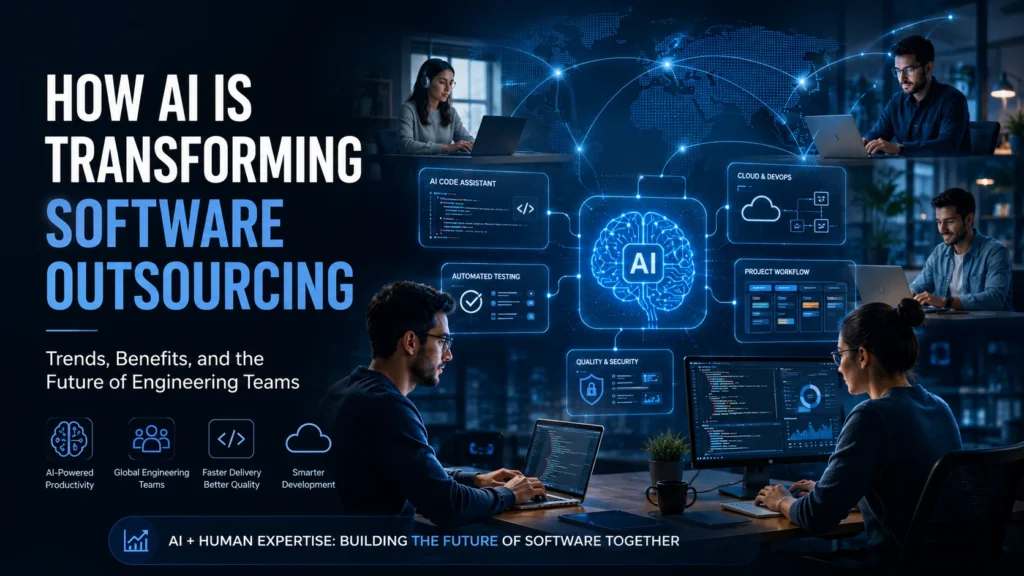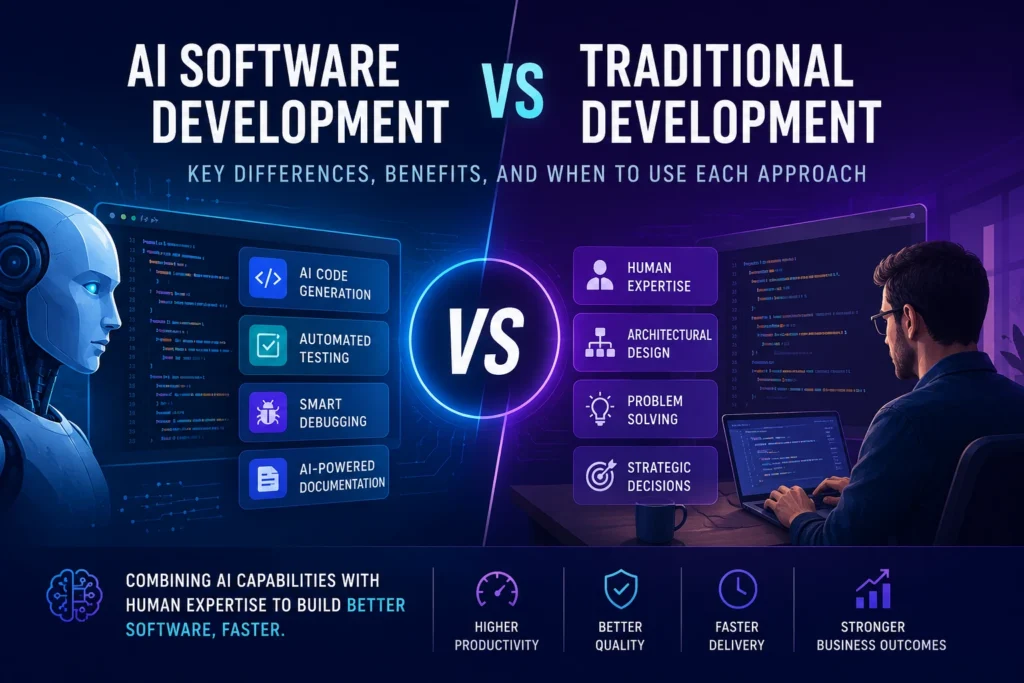
Artificial intelligence has quickly become one of the biggest forces shaping modern software engineering. Organizations are under constant pressure to deliver products faster, reduce development costs, improve software quality, and accelerate innovation. As a result, many technology leaders are asking the same question: should we embrace AI-assisted development or continue relying primarily on traditional software engineering practices?
Understanding ai software development vs traditional development is no longer just a technical discussion. It has become a strategic business decision that directly impacts engineering productivity, software quality, hiring strategies, delivery timelines, and long-term competitiveness.
While AI-powered development tools can dramatically accelerate repetitive tasks, generate code, automate testing, and assist developers throughout the software lifecycle, they are not a replacement for experienced engineering teams. Traditional development methodologies still provide the architectural thinking, business understanding, creativity, and governance required for building scalable software products.
The organizations seeing the greatest success are not choosing one approach over the other. Instead, they are building a software development strategy that combines AI capabilities with experienced software engineers who understand when automation creates value—and when human expertise remains essential.
In this guide, we’ll compare ai software development vs traditional development across every major aspect of software engineering, explain the benefits and limitations of each approach, and help technology leaders determine when to use AI in software projects as part of a successful ai development strategy for companies.
Understanding Modern Software Development
Software development has continuously evolved over the past several decades. Teams have moved from waterfall methodologies to Agile, adopted DevOps practices, embraced cloud-native architectures, and increasingly automated software delivery pipelines.
Artificial intelligence represents the next major shift.
Instead of replacing developers, AI augments engineering teams by assisting with activities that traditionally consumed valuable engineering time. Modern AI tools can generate boilerplate code, recommend improvements, detect bugs, write documentation, create unit tests, summarize pull requests, and even explain unfamiliar codebases.
This evolution is changing how engineering organizations think about software automation and engineering productivity.
However, adopting AI does not eliminate the need for experienced software architects, senior developers, QA engineers, product managers, or engineering leaders. Business requirements, system design, security, compliance, scalability, and customer experience still depend heavily on human expertise.
The question is no longer whether organizations should adopt AI. The question is how to integrate AI responsibly into an existing software development strategy.
AI Software Development vs Traditional Development: What’s the Difference?
Understanding ai software development vs traditional development begins with recognizing that these approaches solve different problems.
Traditional software development relies primarily on human expertise throughout every stage of the engineering lifecycle. Developers write code manually, architects design systems, QA teams validate functionality, and engineering managers coordinate project delivery using established development methodologies.
AI-assisted software development introduces machine learning models and generative AI tools into this workflow. Rather than replacing engineers, these systems accelerate repetitive activities while providing recommendations, code suggestions, documentation, debugging assistance, and test generation.
The difference lies less in who builds the software and more in how engineering teams accomplish their work.
| Traditional Development | AI-Assisted Development |
|---|---|
| Manual coding | AI-assisted code generation |
| Human-driven debugging | AI-assisted bug detection |
| Manual documentation | AI-generated documentation |
| Human-written test cases | AI-generated testing scenarios |
| Developer research | AI-assisted knowledge retrieval |
| Manual code reviews | AI-supported review recommendations |
For many organizations, the goal is not choosing one model exclusively. Instead, successful teams combine AI capabilities with experienced engineers to maximize productivity while maintaining software quality.
How AI Is Transforming the Software Development Lifecycle
Artificial intelligence now influences nearly every phase of the software development lifecycle.
Requirements Analysis
AI can summarize business documents, analyze stakeholder requirements, identify missing acceptance criteria, and suggest functional improvements before development begins.
Rather than replacing product managers, AI helps teams process large amounts of information more efficiently and reduce ambiguity during project planning.
Software Design
During system design, AI can recommend architectural patterns, suggest API structures, compare frameworks, and identify potential scalability concerns based on similar implementations.
Experienced architects remain responsible for validating these recommendations according to business requirements, security constraints, and long-term maintainability.
Development
Coding is where AI currently delivers the greatest measurable impact.
Developers increasingly use AI assistants to:
- Generate repetitive code
- Create API endpoints
- Write database queries
- Produce unit tests
- Refactor existing code
- Explain unfamiliar codebases
- Translate code between programming languages
These capabilities significantly improve engineering productivity, especially for experienced developers who know how to validate AI-generated outputs.
Less experienced developers, however, still require strong software engineering fundamentals to recognize incorrect or inefficient suggestions.
Testing and Quality Assurance
Quality assurance has become one of the most promising areas for AI adoption.
AI-powered tools can automatically:
- Generate test cases
- Identify edge cases
- Recommend regression tests
- Detect UI inconsistencies
- Prioritize testing efforts
- Analyze production failures
This doesn’t eliminate QA engineers. Instead, it allows them to focus on exploratory testing, usability validation, business workflows, and high-risk scenarios where human judgment remains essential.
Organizations evaluating ai assisted software development benefits often discover that testing automation delivers some of the fastest returns on investment because it reduces repetitive manual work while improving overall software quality.
The Biggest Advantages of AI-Assisted Software Development
AI adoption continues growing because it provides measurable business value beyond simply writing code faster.
Faster Development Cycles
One of the most significant ai assisted software development benefits is increased development speed.
Developers spend less time writing repetitive code and more time solving business problems.
Tasks that previously required hours can often be completed in minutes with AI assistance, allowing engineering teams to accelerate releases without proportionally increasing headcount.
Improved Engineering Productivity
Engineering productivity is not measured by lines of code but by business outcomes.
AI enables developers to spend more time on activities that create customer value instead of repetitive implementation work.
This shift helps organizations deliver more features while maintaining existing development capacity.
Recent findings from GitHub’s research on AI-assisted software development suggest that AI coding assistants can help developers complete common programming tasks more efficiently, allowing engineering teams to dedicate more time to higher-value problem solving and software design.
Better Knowledge Sharing
AI assistants help new team members understand unfamiliar codebases, explain complex functions, summarize documentation, and accelerate onboarding.
Instead of spending days searching internal documentation, engineers can retrieve relevant context almost instantly.
This becomes especially valuable for distributed engineering teams operating across multiple time zones.
Enhanced Developer Experience
Developers increasingly view AI as an intelligent collaborator rather than an automation tool.
By reducing repetitive work, AI allows engineers to focus on architecture, innovation, performance optimization, and solving complex business challenges.
Organizations investing in digital transformation often discover that improved developer experience contributes directly to employee satisfaction and retention.
Where Traditional Software Development Still Excels
Despite rapid advances in artificial intelligence, traditional software development remains the foundation of successful software engineering. AI can accelerate many activities, but experienced engineers continue to make the strategic decisions that determine whether a software product succeeds in the long term.
Organizations evaluating ai software development vs traditional development often discover that AI delivers the greatest value when combined with strong engineering fundamentals—not when it attempts to replace them.
Complex Architecture Decisions
Large-scale software systems require architectural planning that extends far beyond writing code.
Engineering teams must evaluate:
- Scalability requirements
- Security considerations
- Compliance obligations
- Infrastructure costs
- Technical debt
- Future business growth
- Integration with existing systems
While AI can suggest architectural patterns, it cannot fully understand an organization’s business priorities, regulatory environment, or long-term product vision.
Senior architects remain essential for making these high-impact decisions.
Business Context and Product Strategy
Software exists to solve business problems.
Understanding customer expectations, stakeholder priorities, competitive differentiation, and market strategy requires human collaboration.
AI cannot interview customers, negotiate product priorities, or balance conflicting business objectives during roadmap planning.
Successful digital transformation initiatives continue to depend on cross-functional collaboration between engineering, product management, design, sales, and executive leadership.
Creativity and Innovation
Generative AI is highly effective at identifying patterns from existing knowledge.
Creating entirely new products, disruptive business models, or innovative customer experiences remains a human strength.
Organizations that rely exclusively on AI-generated solutions often produce software that follows existing conventions rather than creating competitive differentiation.
Innovation still comes from people.
Security, Governance, and Compliance
AI-generated code must always be reviewed.
Engineering leaders remain responsible for ensuring software complies with:
- SOC 2
- HIPAA
- GDPR
- PCI DSS
- ISO 27001
- Industry-specific regulations
Human code reviews, security testing, architecture validation, and governance processes remain critical components of modern software development strategy.
AI Software Development vs Traditional Development: A Side-by-Side Comparison
The most effective way to evaluate ai software development vs traditional development is to compare how each approach performs across the dimensions that matter most to engineering organizations.
| Category | AI-Assisted Development | Traditional Development |
|---|---|---|
| Development speed | Excellent | Moderate |
| Code generation | Excellent | Manual |
| Business understanding | Limited | Excellent |
| Software architecture | Assists | Human-led |
| Creativity | Limited | Excellent |
| Software quality | Depends on review | Consistently controlled |
| Debugging | Accelerated | Human-driven |
| Testing | Highly automated | Manual and automated |
| Compliance | Requires human validation | Human-controlled |
| Long-term maintainability | Depends on oversight | Strong when well designed |
| Learning curve | Fast for repetitive work | Requires experience |
| Strategic decision-making | Limited | Essential |
Rather than viewing these approaches as competitors, high-performing engineering organizations treat them as complementary capabilities.
AI improves execution.
People provide direction.
When to Use AI in Software Projects
One of the most common questions technology leaders ask is when to use AI in software projects.
The answer depends on the nature of the work being performed.
AI Is Most Effective For
AI excels at repetitive, structured, and data-driven activities.
These include:
- Code generation
- Documentation
- Unit testing
- Refactoring
- API creation
- Test automation
- Log analysis
- Bug identification
- Pull request summaries
- Code explanation
- Knowledge retrieval
These activities consume a significant percentage of engineering time and represent ideal opportunities for software automation.
Traditional Development Is Better For
Certain responsibilities continue to require experienced engineers.
Examples include:
- Product architecture
- Technical leadership
- Security reviews
- Infrastructure planning
- Performance optimization
- Customer experience decisions
- Business logic validation
- Regulatory compliance
- Technology selection
- Engineering management
These responsibilities require judgment, organizational context, and collaboration that AI cannot currently replicate.
Hybrid Teams Deliver the Best Results
Increasingly, organizations are adopting a hybrid engineering model.
In this approach:
- AI handles repetitive engineering tasks.
- Developers focus on problem solving.
- Architects define technical direction.
- QA engineers validate business outcomes.
- Product managers prioritize customer value.
This model enables engineering teams to increase engineering productivity while maintaining high software quality.
For organizations expanding their engineering capacity, choosing the right delivery model is just as important as selecting the right development tools. Understanding the differences between nearshore vs offshore development can help technology leaders balance collaboration, cost, and long-term project success.
Rather than replacing software engineers, AI expands their capacity to deliver value.
Building an AI Development Strategy for Companies
Successfully adopting AI requires more than purchasing developer tools.
Organizations need a structured ai development strategy for companies that aligns technology investments with measurable business outcomes.
Step 1: Identify High-Impact Opportunities
Begin by evaluating where engineering teams spend the most time.
Common candidates include:
- Manual testing
- Documentation
- Code reviews
- Regression testing
- Technical documentation
- Internal knowledge management
These areas often deliver immediate productivity improvements with relatively low implementation risk.
Step 2: Establish Governance
AI-generated code should follow the same engineering standards as manually written software.
Organizations should define policies covering:
- Code review requirements
- Security validation
- Intellectual property considerations
- Privacy protections
- Model usage guidelines
- Documentation standards
Governance ensures AI adoption improves software quality rather than introducing unnecessary risk.
Step 3: Train Engineering Teams
AI is most valuable when developers understand both its strengths and its limitations.
Training should include:
- Prompt engineering best practices
- AI code validation
- Security awareness
- Responsible AI usage
- Productivity workflows
- Tool selection
Experienced developers often see greater productivity gains because they know how to evaluate AI-generated recommendations effectively.
Step 4: Measure Outcomes
AI initiatives should be evaluated using engineering metrics rather than assumptions.
Organizations commonly track:
- Development cycle time
- Deployment frequency
- Lead time for changes
- Defect rates
- Test coverage
- Engineering capacity
- Customer satisfaction
- Time spent on repetitive work
Measuring these indicators helps leaders determine whether AI investments are delivering meaningful business value.
Creating an AI Transformation Roadmap
Many organizations attempt to adopt AI too quickly by deploying multiple tools simultaneously without a clear implementation plan.
A phased ai transformation roadmap typically produces better long-term results.
| Phase | Primary Objective | Expected Outcome |
|---|---|---|
| Assessment | Identify repetitive engineering work | Clear AI opportunities |
| Pilot Program | Introduce AI to a small engineering team | Validate productivity gains |
| Standardization | Define governance and best practices | Consistent engineering workflows |
| Organization-Wide Adoption | Expand AI across engineering teams | Higher engineering productivity |
| Continuous Optimization | Measure, improve, and refine usage | Sustainable competitive advantage |
This gradual approach minimizes disruption while allowing teams to build confidence and establish effective workflows.
Organizations that treat AI adoption as an ongoing transformation rather than a one-time implementation are more likely to realize lasting improvements in software development strategy.
Google’s AI adoption framework also recommends a phased implementation approach that combines governance, technical readiness, and organizational change management.
Common Mistakes Companies Make When Adopting AI
Although AI offers significant potential, many organizations fail to achieve expected results because they approach implementation with unrealistic expectations.
Some of the most common mistakes include:
Expecting AI to Replace Developers
AI is an accelerator, not an autonomous engineering organization.
Companies that reduce technical oversight often experience lower software quality, increased technical debt, and security vulnerabilities.
Ignoring Human Review
AI-generated code should always be validated through established engineering practices.
Manual code reviews remain essential for maintainability, security, performance, and business logic.
Choosing Tools Before Defining Objectives
Many organizations purchase AI platforms before identifying the business problems they intend to solve.
Instead, companies should first define measurable goals such as improving engineering productivity, accelerating releases, or increasing software quality.
Technology should support strategy—not determine it.
Overlooking Change Management
Successful AI adoption requires cultural change in addition to technical implementation.
Engineering leaders should communicate expectations clearly, provide ongoing training, encourage experimentation, and establish feedback loops to continuously improve AI-assisted workflows.
Organizations that invest in both people and technology consistently achieve better outcomes than those focused solely on tooling.
Conclusion
The debate around ai software development vs traditional development isn’t about replacing engineers with artificial intelligence—it’s about enabling engineering teams to work smarter.
AI is transforming software development by accelerating coding, testing, documentation, and other repetitive tasks that traditionally consume valuable engineering time. At the same time, successful software products still rely on experienced professionals to make architectural decisions, understand business requirements, ensure security, and deliver exceptional user experiences.
For most organizations, the strongest competitive advantage comes from combining AI with experienced engineering talent. AI improves execution, while developers, architects, QA engineers, and product leaders provide the strategic thinking that technology alone cannot replicate.
As AI capabilities continue to evolve, organizations that thoughtfully integrate AI into their software development strategy will be better positioned to increase engineering productivity, shorten development cycles, improve software quality, and accelerate digital transformation without sacrificing governance or long-term maintainability.
Whether your goal is modernizing existing applications, building AI-enabled products, or scaling your engineering organization, adopting AI should be viewed as a business transformation—not simply a technology upgrade.
If your organization is evaluating how to integrate AI into software development while maintaining engineering excellence, TechAID can help you build high-performing nearshore engineering teams that combine experienced software professionals with modern AI-assisted development practices.
Ready to future-proof your software development strategy? Contact TechAID to discuss how our nearshore engineers can help you accelerate delivery, improve engineering productivity, and successfully adopt AI across your software projects.