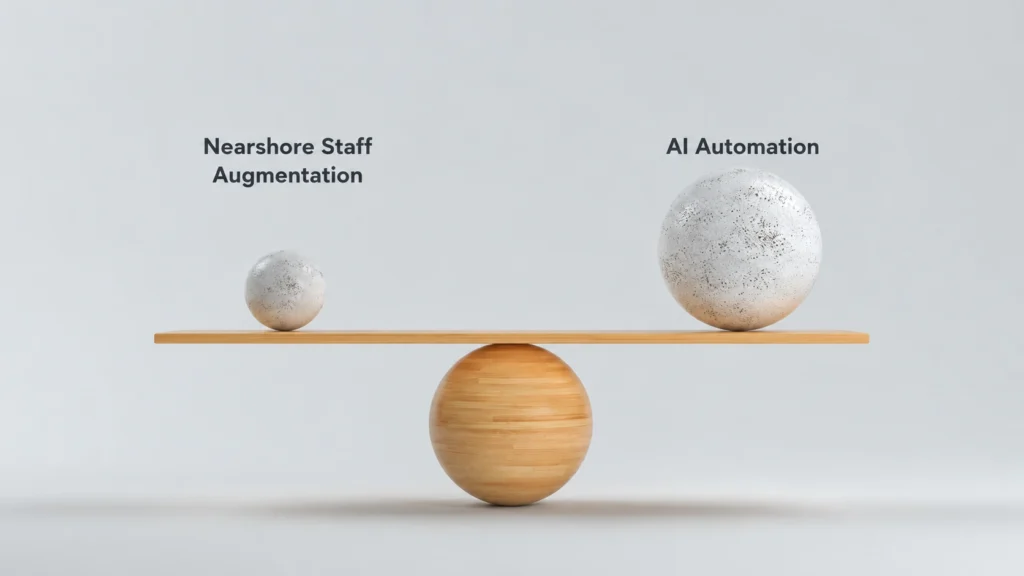
Nearshore staff augmentation and AI automation are increasingly being evaluated as competing solutions to the same business problem: how to reduce operating costs while increasing productivity and delivery capacity.
Over the last two years, executives have been told a compelling story.
Artificial intelligence will reduce headcount.
AI agents will automate workflows.
Software teams will become dramatically smaller.
Operational costs will decline.
The narrative sounds simple.
The reality is not.
Many of the organizations investing most heavily in AI are simultaneously discovering that technology alone does not guarantee business outcomes. Uber capped AI spending after exhausting its budget. Walmart introduced token controls. Amazon removed AI usage incentives. Meta pulled back on AI consumption leaderboards. Klarna reintroduced human support after quality concerns emerged. These organizations did not reject AI; they discovered that adoption and value are not the same thing.
This creates an important executive question:
If your goal is reducing operating costs while increasing productivity, should your next investment be AI automation, additional employees, nearshore talent, process improvement, or some combination of all four?
The answer is more nuanced than many technology vendors would like you to believe.
The False Choice Between AI and Talent
The title of this article presents a common assumption:
| Option A | Option B |
|---|---|
| AI | People |
This framing dominates many boardroom discussions. It is also fundamentally flawed. Business performance is rarely created by technology alone.
Instead, sustainable performance is typically driven by three interconnected components:
| Technology | Process | Talent |
|---|---|---|
| AI Tools | Workflow Design | Execution Capability |
Technology accelerates work.
Processes create consistency.
Talent creates outcomes.
When organizations struggle to generate ROI from AI investments, the problem is often not the technology itself. Research increasingly shows that many companies are layering AI onto inefficient workflows rather than redesigning them to take advantage of AI. Atlassian’s research found that while 84% of knowledge workers use AI and many report working faster, organizational productivity gains often fail to materialize because inefficient processes remain unchanged.
AI is not a workforce strategy.
It is a productivity multiplier.
And productivity multipliers only work when there is something productive to multiply.
Where AI Delivers Real Cost Savings
The discussion around AI cost reduction often becomes polarized. Some vendors promise revolutionary savings. Others focus exclusively on the risks.
The truth sits somewhere in the middle. There are several areas where AI consistently delivers measurable value, such as the following:
Repetitive Administrative Work
Administrative work remains one of the most expensive forms of hidden labor inside modern organizations. For example, the following are great candidates of repetitive administrative work:
Meeting summaries.
Status reports.
Documentation.
Internal communications.
Knowledge management.
These activities consume thousands of hours each year. And AI excels at reducing the effort required to complete these repetitive tasks.
Organizations that use AI effectively often redirect the recovered hours toward strategic activities rather than eliminating jobs outright.
Knowledge Retrieval
Many organizations spend more time searching for information than acting on it.
Internal documentation.
Policies.
Support procedures.
Technical specifications.
AI-powered search and retrieval tools help employees locate information faster and reduce duplication of effort. This creates productivity gains without requiring major organizational changes.
Development Acceleration
Software development is one of the clearest examples of AI-driven productivity improvements.
McKinsey research found that developers can complete certain coding tasks up to twice as fast using generative AI tools.
AI can assist with:
- Code generation
- Refactoring
- Unit test creation
- Documentation
- Debugging support
The important distinction is that AI accelerates developers. It does not replace software engineering.
That distinction becomes increasingly important as organizations evaluate long-term investment decisions.
Key Takeaway
AI cost reduction is real. However, it is most effective when applied to repetitive, structured, and well-defined work.
Where Human Talent Remains Essential
The promise of AI often creates the impression that human involvement will steadily decline.
The evidence suggests otherwise.
Quality Control
Starbucks provides an important example.
The company eventually discontinued portions of an AI-powered inventory management system after employees reported inventory inaccuracies and operational challenges in real-world environments.
The lesson was not that AI cannot work.
The lesson was that production environments expose complexities that demonstrations often miss.
Customer Experience
Klarna became one of the most widely discussed examples of AI-driven customer support.
While the company initially highlighted efficiency gains, it later increased investment in human support resources after concerns emerged regarding customer experience and service quality.
Cost reduction alone was not enough.
Customer satisfaction still mattered.
Business Prioritization
Uber’s experience illustrates another challenge.
The company struggled to clearly connect increasing AI usage with measurable customer-facing outcomes.
Usage increased.
Business value remained difficult to quantify.
That is not a technology problem.
It is a prioritization problem.
Accountability
Amazon and Meta discovered that when organizations measure AI activity rather than business results, employees often optimize for the wrong metrics.
People still determine:
- Priorities
- Accountability
- Customer outcomes
- Product strategy
- Quality standards
AI can generate output. Yet humans remain responsible for outcomes.
Nearshore Staff Augmentation
The term nearshore staff augmentation is frequently misunderstood. Some executives assume it is simply outsourcing under a different name.
It is not.
What Is Nearshore Staff Augmentation?
Nearshore staff augmentation is a hiring model that allows organizations to add external professionals to their existing teams while maintaining direct management control.
Instead of outsourcing an entire project, companies augment their internal capabilities with specialized talent.
Staff Augmentation Meaning
At its core, staff augmentation means supplementing your workforce with external professionals who integrate into your workflows, tools, and management structure.
The goal is flexibility.
Organizations gain access to skills without committing to permanent hiring.
What Is Nearshore Staff Augmentation Compared to Outsourcing?
Traditional outsourcing often transfers responsibility for deliverables to an external vendor.
Nearshore staff augmentation keeps management and accountability inside the organization.
The augmented professionals simply become an extension of the existing team.
Benefits of Nearshore Staff Augmentation
The popularity of nearshore staff augmentation continues to grow because it addresses several common business challenges.
Benefits include:
- Lower labor costs
- Time-zone alignment
- Faster hiring cycles
- Access to specialized expertise
- Greater operational flexibility
Common Roles
Organizations frequently use nearshore staff augmentation for:
- Software Engineers
- QA Engineers
- Salesforce Professionals
- Automation Specialists
- Product Managers
- Business Analysts
Unlike AI software subscriptions, these professionals directly contribute to execution capacity.
Comparing Three Cost Models
The most useful way to evaluate investment options is through a side-by-side comparison.
| Category | AI-First Strategy | US Hiring Strategy | Nearshore Staff Augmentation |
|---|---|---|---|
| Upfront Cost | Low | High | Moderate |
| Time to Impact | Fast | Slow | Fast |
| Scalability | High | Medium | High |
| Quality Control | Variable | High | High |
| Operational Flexibility | High | Low | High |
| Long-Term Cost | Variable | High | Moderate |
Model 1: AI First
Best when:
- Work is repetitive
- Processes are mature
- Data is available
- Governance exists
Risk:
Organizations may automate inefficiencies rather than eliminate them.
Gartner predicts that more than 40% of agentic AI projects may be canceled because of unclear business value, escalating costs, or inadequate controls. (Source: gartner.com/en/newsroom/press-releases/2025-06-25-gartner-predicts-over-40-percent-of-agentic-ai-projects-will-be-canceled-by-end-of-2027)
Model 2: US Hiring
Best when:
- Strategic leadership is needed
- Institutional knowledge is critical
- Long-term ownership is required
Risk:
Higher salaries.
Longer recruiting cycles.
Greater payroll commitments.
Model 3: Nearshore Staff Augmentation
Best when:
- Delivery capacity is constrained
- Specialized talent is difficult to hire
- Speed matters
Risk:
Provider quality varies significantly.
Partner selection becomes important.
The Most Effective Hybrid Model
The highest-performing organizations are increasingly moving away from “AI-only” thinking.
Instead, they combine technology, process improvement, and talent.
| Layer | Purpose |
|---|---|
| AI | Acceleration |
| Process | Consistency |
| Talent | Execution |
This model aligns closely with what researchers continue to observe.
AI improves individual productivity.
Organizations that redesign workflows and align teams around those tools are far more likely to achieve enterprise-level gains.
Examples include:
- AI-assisted developers
- AI-assisted QA teams
- AI-assisted Salesforce administrators
- AI-assisted product managers
The outcome is not fewer people.
The outcome is more output without proportional cost growth.
Executive Decision Framework
Before making your next investment decision, identify the actual bottleneck inside your organization.
If Your Bottleneck Is Repetitive Work
Evaluate AI first.
Automation often delivers the fastest returns.
If Your Bottleneck Is Delivery Capacity
Evaluate talent first.
Technology cannot ship products, manage stakeholders, or own outcomes.
If Your Bottleneck Is Quality
Invest in stronger talent and improved processes.
Quality problems rarely disappear through automation alone.
If Your Bottleneck Is Cost
Compare AI investments, process redesign, and nearshore staff augmentation together.
Avoid treating them as mutually exclusive options.
If Your Bottleneck Is Growth
Build a blended strategy.
The strongest organizations increasingly combine automation with high-performing teams.
The Best Cost Reduction Strategy May Not Be AI or Talent
The evidence increasingly suggests that the highest-performing organizations are not choosing between automation and people.
They are combining both. AI can reduce costs, nearshore staff augmentation can reduce costs, and process improvement can reduce costs.
The organizations generating the strongest returns focus less on tools and more on outcomes.
Instead of asking:
“Should we invest in AI or people?”
A better question may be:
“What combination of technology, process, and talent will create the greatest measurable business value?”
For organizations looking to expand delivery capacity without the cost and delays associated with traditional hiring, nearshore staff augmentation provides a flexible way to strengthen execution while maintaining cost discipline.
TechAID helps companies build high-performing nearshore engineering, QA, Salesforce, automation, and product teams that work alongside modern AI tools to deliver measurable business outcomes.
Learn more at https://techaid.co/get-started.