Software Migration Outsourcing: Direct Hire, Staff Augmentation, or Project Outsourcing?

Software Migration Outsourcing: Direct Hire, Staff Augmentation, or Project Outsourcing?

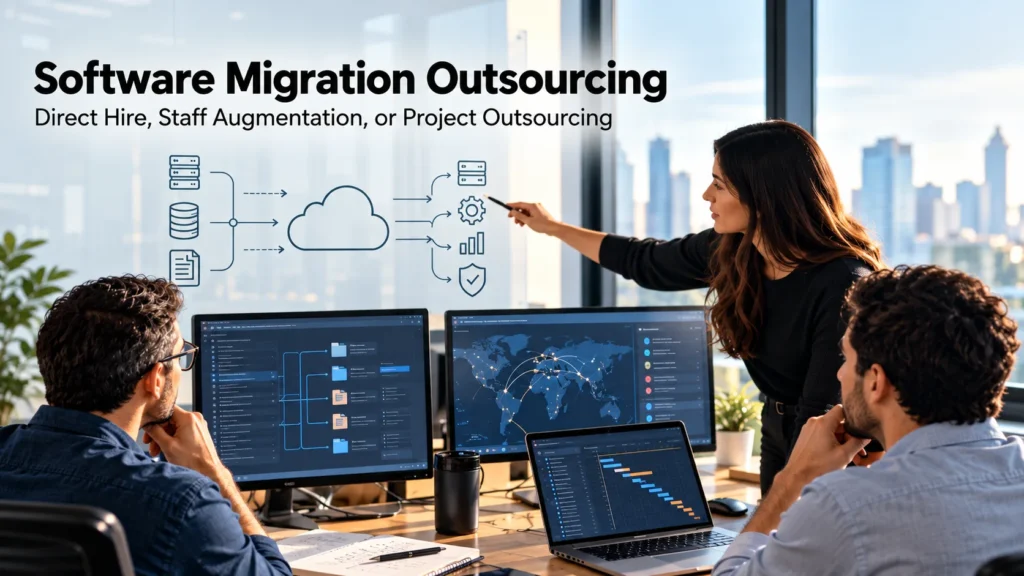
Software migration team evaluating direct hiring, staff augmentation, and project outsourcing options during a cloud migration planning session.
A successful software migration requires more than technical expertise. This framework helps technology leaders choose between direct hiring, staff augmentation, and project outsourcing based on migration scope, internal management capacity, long-term ownership, cutover risk, and handoff requirements.
Share the Post:

A software migration can look like a technical project on the surface.

Move an application to the cloud. Modernize an aging platform. Replace infrastructure approaching end of life. Rebuild deployment pipelines. Migrate databases and integrations.

But many migration problems begin before any code, infrastructure, or data is moved.

The first major decision is often organizational: who should own the migration, who should manage the work, and who should own the platform after the migration is complete?

For technology leaders evaluating software migration outsourcing, the answer should not be based only on speed, available engineers, or the nearest deadline.

A permanent hire may be the right long-term owner but still be unable to deliver a complex migration alone. Staff augmentation can add specialized capacity, but only if the client already has the management structure to direct it. Project outsourcing can transfer more delivery responsibility to a partner, but only when the migration outcome is sufficiently defined.

The right model depends on the migration’s scope, ownership horizon, internal management capacity, cutover risk, and acceptance requirements.

The Most Expensive Migration Mistake Happens Before Cutover

Migration risk is often discussed in technical terms:

  • Data loss
  • Downtime
  • Failed integrations
  • Security issues
  • Performance degradation
  • Rollback failures

Those risks matter.

But another risk appears earlier: choosing a delivery model before defining the operating problem.

Hiring a permanent engineer cannot, by itself, fix an unplanned migration.

Adding more engineers through staff augmentation does not solve unclear priorities, missing decision rights, or the absence of an application owner.

And outsourcing an entire migration does not eliminate the need for the client to make product, architecture, security, and risk decisions.

A migration needs a delivery system, not simply additional technical capacity.

That system should define:

  • What is being migrated
  • Why the migration matters
  • Who makes decisions
  • How work is prioritized
  • How dependencies are managed
  • How the migration will be tested
  • How cutover will be executed
  • How failures will be handled
  • Who owns the platform afterward

AWS migration workstreams separate migration activity across areas such as governance, portfolio planning, migration execution, testing, operations, and security.

For executives, the lesson is practical: a migration should be treated as an operating model with clear responsibilities, not simply as a change of infrastructure.

Start With Four Executive Questions

Before choosing Direct Hiring, Staff Augmentation, or Project Outsourcing, leadership should answer four questions.

1. What Business Outcome Must the Migration Produce?

Start with the business reason behind the migration.

Common objectives include:

  • Reducing infrastructure costs
  • Removing end-of-life technology
  • Improving application reliability
  • Supporting faster product releases
  • Meeting security or compliance requirements
  • Preparing for business growth
  • Reducing operational complexity
  • Supporting a new product launch

The answer matters because different outcomes create different delivery requirements.

A migration driven by an expiring data center contract has a very different risk profile from an application modernization initiative intended to improve product velocity.

The migration should therefore be defined around the outcome first, not the technology being adopted.

2. What Is Actually in Scope?

A migration can appear simple until teams begin mapping the dependencies around the applications involved.

Define:

  • Applications
  • Services
  • Databases
  • APIs
  • Infrastructure
  • User groups
  • Critical business journeys
  • External integrations
  • Authentication systems
  • Monitoring dependencies
  • Data flows

Also document what is explicitly out of scope.

Without clear boundaries, migration teams can discover late in the project that supposedly unrelated systems are required for the target environment to function correctly.

3. Who Owns the Platform After Hypercare?

The migration itself may be temporary.

The resulting platform is not.

Leadership should decide who will own:

  • Cloud architecture
  • Platform standards
  • Infrastructure
  • CI/CD pipelines
  • Monitoring
  • Security controls
  • Cost management
  • Incident response
  • Application reliability
  • Future modernization

This is one of the most important questions when choosing between permanent hiring, embedded capacity, and a managed project.

If the organization needs an internal owner for years, the engagement model should reflect that long-term responsibility.

4. Is the Migration Defined Enough to Accept?

Before treating a migration as a project, the organization should be able to describe what successful completion looks like.

That may include:

  • Migration waves
  • Target architecture assumptions
  • Performance expectations
  • Critical journeys that must work
  • Security requirements
  • Test evidence
  • Data validation
  • Cutover criteria
  • Rollback requirements
  • Post-cutover monitoring
  • Documentation
  • Knowledge transfer

If the organization cannot define these conditions, it may not yet be ready for a full migration engagement.

If the Answers Are Unclear, Start With Discovery

A migration should not be forced into a fixed scope simply because leadership wants a fixed timeline.

When important dependencies, ownership decisions, or target-state assumptions remain unclear, a discovery phase should come first.

Discovery should reduce uncertainty enough to determine how the migration should be delivered.

A useful migration discovery process should produce:

Dependency Map

Document which applications, databases, APIs, infrastructure components, identity systems, and external services depend on one another.

Migration Waves

Group workloads into logical migration sequences based on dependency, risk, business importance, and technical complexity.

Risk Register

Identify important risks such as:

  • Downtime
  • Data consistency
  • Security
  • Performance
  • Integration failure
  • Vendor dependencies
  • Resource constraints
  • Cutover timing

Each significant risk should have an owner.

Target Architecture Assumptions

Clarify what the target environment is expected to look like, including infrastructure, hosting, connectivity, identity, security, and operational responsibilities.

Acceptance Criteria

Define the evidence required before each workload or migration wave can be considered complete.

Cutover and Rollback Approach

Identify how production traffic or users will transition to the new environment and what will happen if the cutover fails.

Recommended Ownership Model

Discovery should also answer an organizational question:

Should this migration be led by permanent internal ownership, client-managed augmented capacity, or a managed project team?

This prevents the engagement model from being chosen before the migration itself is understood.

When Direct Hiring Is the Right Answer

Direct hiring is strongest when the migration creates a capability the organization needs to own permanently.

A migration may be temporary, but the new platform often creates long-term responsibilities.

These may include:

  • Cloud architecture
  • Platform engineering
  • DevOps practices
  • Cloud operations
  • Infrastructure governance
  • Application modernization
  • Site reliability
  • Security engineering

If these responsibilities will remain strategically important after the migration ends, building permanent internal ownership may be the better decision.

Direct Hiring Works Best When Knowledge Must Stay Internal

A permanent engineer can accumulate knowledge about:

  • Application architecture
  • Historical technical decisions
  • Business-critical dependencies
  • Internal security standards
  • Cloud cost structures
  • Reliability requirements
  • Product roadmap priorities

That institutional knowledge becomes more valuable over time.

Direct hiring can therefore be especially effective when the company wants someone who will influence the platform long after the migration project itself is complete.

The Organization Still Needs to Support the Role

Hiring a strong engineer is not enough.

For a permanent role to succeed, the organization should provide:

  • A stable manager
  • Clear decision authority
  • Access to technical and business stakeholders
  • A meaningful backlog
  • Defined responsibilities
  • A long-term technical roadmap
  • Career development opportunities

Without those conditions, the organization may hire a talented engineer without creating an environment where they can successfully own the platform.

Direct Hiring Does Not Automatically Solve a Near-Term Migration Deadline

The main trade-off is time and operating load.

Recruiting a permanent engineer can support long-term ownership, but a single hire may not provide enough delivery capacity for an immediate migration deadline.

A migration might require multiple disciplines at once:

  • Cloud engineering
  • Software development
  • DevOps
  • QA automation
  • Security
  • Database expertise
  • Project coordination

That means the long-term ownership decision and the immediate delivery decision do not always need to be identical.

A company may decide to hire a permanent platform owner while using another delivery model to execute the migration itself.

When Staff Augmentation Is the Right Answer

Staff augmentation works best when the organization already has a functioning delivery structure but needs additional capacity or specialized expertise to execute the migration.

In this model, the client retains control of:

  • Prioritization
  • Architecture decisions
  • Backlog management
  • Delivery cadence
  • Technical standards
  • Release approval
  • Risk acceptance

The augmented engineers contribute inside that existing system.

For a migration, this could include:

  • Cloud engineers
  • DevOps specialists
  • QA automation engineers
  • Software developers
  • Database specialists
  • Infrastructure engineers

A nearshore specialist can help accelerate delivery without forcing the company to transfer ownership of the migration itself.

Staff Augmentation Requires Strong Internal Management

The quality of the operating model matters more than the number of engineers added.

Before bringing augmented professionals into a migration, define:

  • Technical manager
  • Application or service owner
  • Migration backlog
  • Priorities
  • Access requirements
  • Development and testing environments
  • Engineering standards
  • Review process
  • Escalation paths
  • Knowledge-transfer expectations

If the internal team cannot make daily decisions, augmented engineers may spend too much time waiting for direction.

That is why companies comparing staff augmentation vs outsourcing should first determine whether they need additional capacity inside an existing delivery system or a partner to manage execution toward a defined outcome.

When Staff Augmentation Fits Best

Staff augmentation is particularly effective when:

  • The client already owns the migration plan
  • The target architecture is understood
  • Internal leaders can prioritize daily work
  • The organization wants to retain close technical control
  • Skills gaps are specific and identifiable
  • Priorities may change during execution
  • The client has enough management capacity to coordinate the work

For example, an internal platform team may already own a cloud migration but lack QA automation or DevOps capacity.

Adding those capabilities can accelerate the migration without changing who owns the overall program.

When Staff Augmentation May Be the Wrong Fit

Staff augmentation becomes less effective when:

  • There is no accountable migration owner
  • The backlog is undefined
  • Architecture decisions remain unresolved
  • Internal teams cannot prioritize work
  • Access provisioning repeatedly blocks progress
  • No one can approve releases or cutover decisions

In these situations, adding people may increase coordination without improving delivery.

The problem may be governance rather than capacity.

When Project Outsourcing Is the Right Answer

Project outsourcing becomes stronger when the migration has a defined outcome and the organization needs a partner to manage day-to-day execution.

Instead of adding individual specialists to an internal team, the client defines the expected result, boundaries, decision rights, and acceptance criteria.

The delivery partner coordinates the work required to reach that outcome.

Examples may include:

  • Migrating a defined application portfolio
  • Modernizing a specific legacy application
  • Building a cloud migration foundation
  • Migrating a group of services to a new platform
  • Establishing migration testing and automation
  • Executing a defined infrastructure transition
  • Recovering a migration that has stalled

For organizations with a clearly defined migration outcome, project outsourcing can provide a managed delivery structure while the client retains strategic direction and final approval.

Project Outsourcing Does Not Mean Giving Up Control

A managed project still requires strong client participation.

The client should retain ownership of:

  • Business priorities
  • Product decisions
  • Strategic architecture choices
  • Risk acceptance
  • Budget authority
  • Major scope changes
  • Final acceptance

The delivery partner should manage:

  • Day-to-day coordination
  • Delivery planning
  • Execution
  • Technical work
  • Testing activities
  • Progress reporting
  • Risk escalation
  • Delivery milestones

The distinction is important.

Project outsourcing transfers more execution responsibility, not all responsibility.

Do Not Outsource an Undefined Migration

A managed project requires boundaries.

If priorities change every day, critical dependencies remain unknown, or no internal stakeholder can make decisions, the migration may not yet be ready for a project outsourcing model.

Outsourcing ambiguity does not remove ambiguity.

It simply moves uncertainty into:

  • Scope discussions
  • Change requests
  • Timeline disputes
  • Budget pressure
  • Acceptance disagreements

When the target state is still unclear, begin with discovery.

When the target is understood but the organization wants to retain daily technical control, staff augmentation may fit better.

When the outcome can be defined and the organization wants a partner to manage execution, project outsourcing becomes more appropriate.

What Should a Migration Statement of Work Include?

A strong migration Statement of Work should define much more than a deadline and list of applications.

It should explain how the migration will be planned, executed, tested, accepted, and handed over.

Scope and Boundaries

Document:

  • Applications included
  • Services included
  • Databases
  • Integrations
  • Environments
  • User groups
  • Migration waves
  • Explicit exclusions

A clear boundary reduces disagreement later.

Target Environment

Define the assumptions around:

  • Cloud platform
  • Infrastructure
  • Networking
  • Identity
  • Security
  • Monitoring
  • Logging
  • Storage
  • Deployment pipelines

If important architecture decisions remain unresolved, identify who owns them and when they must be made.

Migration Approach

The SOW should describe:

  • Discovery activities
  • Dependency mapping
  • Wave planning
  • Migration sequence
  • Testing approach
  • Cutover strategy
  • Rollback or fail-forward process
  • Hypercare period

This gives both sides a common delivery model.

Acceptance Criteria

Define what evidence is required before a migration wave or application can be accepted.

Examples may include:

  • Critical journeys validated
  • Data reconciliation completed
  • Automated tests passed
  • Performance thresholds met
  • Security findings reviewed
  • Monitoring enabled
  • Deployment procedures confirmed
  • Documentation delivered
  • Knowledge transfer completed

Acceptance criteria should be measurable whenever possible.

“Migration completed successfully” is not enough.

Roles and Decision Rights

The SOW should clearly identify:

  • Client sponsor
  • Application owner
  • Technical decision-maker
  • Delivery lead
  • Security owner
  • Cutover decision authority
  • Risk acceptance authority

This becomes especially important during high-pressure migration windows.

Change Control

Migration assumptions can change.

A strong SOW should explain:

  • What constitutes a scope change
  • Who approves it
  • How timeline impact is assessed
  • How cost impact is handled
  • How new risks are documented

The objective is not to prevent change.

It is to make change visible and governed.

Treat Cutover as a Planned Decision, Not a Calendar Event

Cutover is one of the highest-risk stages of a migration.

It should not happen simply because a date has arrived.

Before cutover, teams should confirm:

  • Critical workflows have been tested
  • Required stakeholders are available
  • Monitoring is active
  • Access has been validated
  • Data migration is complete or synchronized
  • Known defects have been reviewed
  • Rollback procedures are ready
  • Support responsibilities are clear
  • Communication channels are established

AWS migration cutover guidance emphasizes preparation, defined responsibilities, testing, runbooks, and clear decision-making during migration cutover.

The practical lesson is simple:

A cutover plan should explain not only how to move forward, but also when not to move forward.

Rehearse the Runbook

A migration runbook should be tested before the real event.

Teams should know:

  • Who performs each step
  • What evidence confirms success
  • When escalation occurs
  • Who can pause the migration
  • What triggers rollback
  • How long rollback remains viable
  • How customers or internal users will be informed

A document that has never been rehearsed may contain gaps that only become visible under production pressure.

Build Acceptance Into the Migration From the Beginning

Acceptance should not begin after cutover.

It should influence migration planning from the start.

For each workload or migration wave, define:

  • What must work
  • What evidence must exist
  • What risks can remain
  • Who can accept those risks
  • What documentation must be delivered
  • What the receiving team must be able to operate independently

This keeps the migration focused on a usable outcome rather than simply moving infrastructure from one environment to another.

Need a managed team for a defined migration outcome?
TechAID supports project-based software, QA, DevOps, and modernization work where scope, acceptance criteria, delivery responsibilities, and handoff can be clearly defined. Explore Project Outsourcing.

What to Measure in the First 90 Days

Migration programs should not be judged only by whether the final cutover happened on schedule.

During the first 90 days, leaders need visibility into whether the delivery system itself is becoming ready for migration.

That means starting with leading indicators before relying on final outcome metrics.

Days 1–30: Measure Migration Readiness

During the early phase, track whether the foundations for delivery are actually being established.

Useful measures include:

  • Applications and services identified
  • Dependencies documented
  • Migration waves defined
  • Application owners assigned
  • Target architecture assumptions agreed
  • Required access provisioned
  • Risk register established
  • Acceptance criteria approved
  • Test strategy defined
  • Cutover responsibilities assigned

These measures help identify governance problems before they become migration delays.

If teams are still discovering basic dependencies or waiting for access late in the migration, adding more engineers will rarely solve the underlying problem.

Days 31–60: Measure Execution Readiness

Once scope and ownership are clearer, focus on whether the organization can execute repeatably.

Track:

  • Test environments available
  • Automated tests running
  • Migration runbook completed
  • Monitoring prepared
  • Security requirements reviewed
  • Data validation approach agreed
  • Rollback procedures documented
  • Migration waves rehearsed
  • Open risks assigned to owners

The objective is to reduce surprises before production cutover.

Days 61–90: Measure Delivery Outcomes

As migration activity reaches production, shift toward outcome measures.

These may include:

  • Critical user journeys validated
  • Cutover completed within the planned window
  • Data reconciliation results
  • Number and severity of unresolved defects
  • Post-cutover incidents
  • Recovery or rollback events
  • Outstanding remediation work
  • Hypercare issues resolved
  • Documentation completed
  • Successful knowledge transfer

The specific metrics should reflect the business outcome behind the migration.

A migration designed to reduce infrastructure risk may require different success measures from one intended to improve release velocity or support a product launch.

Avoid Migration Claims Without a Baseline

Migration initiatives often begin with promises of faster delivery, lower costs, better reliability, or improved scalability.

Those may become valid outcomes, but they should not be treated as guaranteed results before a baseline exists.

Before making claims about improvement, establish the current state.

For example:

  • Current infrastructure cost
  • Deployment frequency
  • Incident rate
  • Recovery time
  • Application performance
  • Release lead time
  • Operational effort
  • Existing cloud utilization

Without a baseline, leadership cannot reliably determine whether the migration produced the expected business value.

The same principle applies when evaluating a provider.

Compare proposals based on scope, delivery responsibility, acceptance evidence, migration governance, and handoff requirements rather than broad promises about speed or savings.

Direct Hire vs Staff Augmentation vs Project Outsourcing for Software Migration

The three models solve different migration problems.

The right choice depends on who should own the platform, who can manage execution, and how clearly the migration outcome can be defined.

Choose Direct Hiring When Long-Term Platform Ownership Is the Priority

Direct hiring is strongest when the organization needs permanent internal ownership of:

  • Cloud architecture
  • Platform engineering
  • DevOps standards
  • Cloud operations
  • Reliability
  • Security practices
  • Ongoing application modernization

The migration may end, but these responsibilities continue.

Direct hiring allows technical knowledge and decision-making capability to remain inside the company after hypercare.

Choose Staff Augmentation When the Client Owns Delivery but Needs Capacity

Staff augmentation is strongest when the organization already has:

  • A migration plan
  • Technical leadership
  • Application owners
  • Delivery rituals
  • Architecture direction
  • Backlog management
  • Release authority

but lacks enough capacity or specific expertise.

In this model, augmented engineers work inside the client’s existing delivery structure.

The client remains responsible for managing the migration.

Choose Project Outsourcing When the Migration Outcome Can Be Defined

Project outsourcing is strongest when the organization can define:

  • Migration scope
  • Target outcome
  • Responsibilities
  • Acceptance criteria
  • Delivery milestones
  • Security boundaries
  • Cutover expectations
  • Handoff requirements

and wants a partner to manage day-to-day execution.

The client retains strategic direction, key decisions, risk acceptance, and final approval.

Software Migration Outsourcing: The Core Ownership Question

The central question in software migration outsourcing is not simply whether an external team can perform the technical work.

It is:

Who should own the migration today, and who should own the resulting platform tomorrow?

Those may be different answers.

An organization might use a managed project team to execute a defined migration while simultaneously hiring a permanent platform owner.

Another organization may already have strong internal leadership and only need nearshore DevOps or QA automation capacity.

A third may discover that the migration is not defined enough for either model and should begin with discovery.

The engagement structure should follow the delivery reality.

Common Software Migration Scoping Mistakes

Several problems appear repeatedly when the delivery model is chosen too early.

Treating the Migration as Only a Technical Move

Moving infrastructure is not the same as completing a migration.

The organization must also address:

  • Business workflows
  • Testing
  • Security
  • Monitoring
  • Operations
  • Cutover
  • Documentation
  • Support
  • Ownership

Technical completion without operational readiness creates a fragile handoff.

Hiring Before Defining Ownership

A permanent engineer may eventually become the right platform owner.

That does not mean a single new hire should be expected to discover, plan, execute, test, and govern the entire migration.

Separate the long-term ownership decision from the immediate delivery requirement.

Adding Capacity Without Management Bandwidth

Staff augmentation works when there is a functioning system for managing the additional capacity.

Without clear priorities, access, decision rights, and technical leadership, more engineers can create more coordination work.

Outsourcing Before the Outcome Is Defined

Project outsourcing requires a sufficiently clear objective.

If the organization cannot explain what is in scope, what success looks like, and who can approve changes, start with discovery rather than pretending the migration is already a fixed project.

Leaving Handoff Until the End

Knowledge transfer should begin during delivery.

Waiting until the final week to explain the architecture, deployment process, monitoring, and operational responsibilities increases transition risk.

Where TechAID Fits

TechAID’s three delivery models can support different stages and ownership requirements within a migration.

Direct Hiring fits organizations that want long-term LATAM engineering talent to own platform, cloud, DevOps, or modernization capabilities internally.

Staff Augmentation fits organizations that already manage migration delivery but need additional specialists working within their existing tools, processes, and technical direction.

Project Outsourcing fits defined migration workstreams where the client wants a managed delivery team responsible for day-to-day execution against agreed scope, milestones, acceptance criteria, and handoff requirements.

These models do not need to be mutually exclusive.

A migration could begin with a managed workstream, use augmented specialists during a high-capacity phase, and transition to permanent internal ownership after stabilization.

What matters is that each responsibility is intentionally assigned.

Executive Next Step

Before selecting a migration provider or opening another engineering requisition, take one active migration initiative and answer four questions:

1. What Business Outcome Must the Migration Produce?

Define why the migration exists before deciding how it should be staffed.

2. What Is Actually in Scope?

Identify applications, dependencies, data, critical journeys, environments, and exclusions.

3. Who Owns the Platform After Hypercare?

Determine whether the organization needs permanent internal ownership or whether existing leaders already cover that responsibility.

4. Is the Migration Defined Enough to Accept?

If you cannot describe the acceptance criteria, cutover approach, major boundaries, and handoff expectations, begin with discovery.

The answers should reveal whether the immediate need is permanent ownership, embedded capacity, or a managed migration workstream.

Final Thoughts: Let the Migration Define the Delivery Model

A successful software migration requires more than finding engineers with cloud or DevOps experience.

It requires a clear relationship between scope, execution responsibility, acceptance, and long-term ownership.

Direct hiring is strongest when the organization needs a lasting internal platform owner.

Staff augmentation is strongest when an internal team already owns delivery and needs additional capacity or specialized expertise.

Project outsourcing is strongest when the migration can be defined as a measurable outcome and the organization wants a partner to manage execution.

For leaders considering software migration outsourcing, the most important step is therefore not selecting a provider first.

It is defining the migration well enough to determine what kind of delivery system the work actually needs.

Planning a software migration and deciding how to structure the team? Talk with TechAID about the right delivery model for your migration.
Key Takeaways
    • Choose the migration model based on long-term ownership, internal management capacity, and how clearly the outcome is defined.
    • Staff augmentation works best for client-led migrations that need extra capacity, while project outsourcing fits defined outcomes that need managed execution.
    • Define dependencies, acceptance criteria, cutover, rollback, and handoff before migration work accelerates.
  • A software migration can look like a technical project on the surface.

    Move an application to the cloud. Modernize an aging platform. Replace infrastructure approaching end of life. Rebuild deployment pipelines. Migrate databases and integrations.

    But many migration problems begin before any code, infrastructure, or data is moved.

    The first major decision is often organizational: who should own the migration, who should manage the work, and who should own the platform after the migration is complete?

    For technology leaders evaluating software migration outsourcing, the answer should not be based only on speed, available engineers, or the nearest deadline.

    A permanent hire may be the right long-term owner but still be unable to deliver a complex migration alone. Staff augmentation can add specialized capacity, but only if the client already has the management structure to direct it. Project outsourcing can transfer more delivery responsibility to a partner, but only when the migration outcome is sufficiently defined.

    The right model depends on the migration’s scope, ownership horizon, internal management capacity, cutover risk, and acceptance requirements.

    The Most Expensive Migration Mistake Happens Before Cutover

    Migration risk is often discussed in technical terms:

    • Data loss
    • Downtime
    • Failed integrations
    • Security issues
    • Performance degradation
    • Rollback failures

    Those risks matter.

    But another risk appears earlier: choosing a delivery model before defining the operating problem.

    Hiring a permanent engineer cannot, by itself, fix an unplanned migration.

    Adding more engineers through staff augmentation does not solve unclear priorities, missing decision rights, or the absence of an application owner.

    And outsourcing an entire migration does not eliminate the need for the client to make product, architecture, security, and risk decisions.

    A migration needs a delivery system, not simply additional technical capacity.

    That system should define:

    • What is being migrated
    • Why the migration matters
    • Who makes decisions
    • How work is prioritized
    • How dependencies are managed
    • How the migration will be tested
    • How cutover will be executed
    • How failures will be handled
    • Who owns the platform afterward

    AWS migration workstreams separate migration activity across areas such as governance, portfolio planning, migration execution, testing, operations, and security.

    For executives, the lesson is practical: a migration should be treated as an operating model with clear responsibilities, not simply as a change of infrastructure.

    Start With Four Executive Questions

    Before choosing Direct Hiring, Staff Augmentation, or Project Outsourcing, leadership should answer four questions.

    1. What Business Outcome Must the Migration Produce?

    Start with the business reason behind the migration.

    Common objectives include:

    • Reducing infrastructure costs
    • Removing end-of-life technology
    • Improving application reliability
    • Supporting faster product releases
    • Meeting security or compliance requirements
    • Preparing for business growth
    • Reducing operational complexity
    • Supporting a new product launch

    The answer matters because different outcomes create different delivery requirements.

    A migration driven by an expiring data center contract has a very different risk profile from an application modernization initiative intended to improve product velocity.

    The migration should therefore be defined around the outcome first, not the technology being adopted.

    2. What Is Actually in Scope?

    A migration can appear simple until teams begin mapping the dependencies around the applications involved.

    Define:

    • Applications
    • Services
    • Databases
    • APIs
    • Infrastructure
    • User groups
    • Critical business journeys
    • External integrations
    • Authentication systems
    • Monitoring dependencies
    • Data flows

    Also document what is explicitly out of scope.

    Without clear boundaries, migration teams can discover late in the project that supposedly unrelated systems are required for the target environment to function correctly.

    3. Who Owns the Platform After Hypercare?

    The migration itself may be temporary.

    The resulting platform is not.

    Leadership should decide who will own:

    • Cloud architecture
    • Platform standards
    • Infrastructure
    • CI/CD pipelines
    • Monitoring
    • Security controls
    • Cost management
    • Incident response
    • Application reliability
    • Future modernization

    This is one of the most important questions when choosing between permanent hiring, embedded capacity, and a managed project.

    If the organization needs an internal owner for years, the engagement model should reflect that long-term responsibility.

    4. Is the Migration Defined Enough to Accept?

    Before treating a migration as a project, the organization should be able to describe what successful completion looks like.

    That may include:

    • Migration waves
    • Target architecture assumptions
    • Performance expectations
    • Critical journeys that must work
    • Security requirements
    • Test evidence
    • Data validation
    • Cutover criteria
    • Rollback requirements
    • Post-cutover monitoring
    • Documentation
    • Knowledge transfer

    If the organization cannot define these conditions, it may not yet be ready for a full migration engagement.

    If the Answers Are Unclear, Start With Discovery

    A migration should not be forced into a fixed scope simply because leadership wants a fixed timeline.

    When important dependencies, ownership decisions, or target-state assumptions remain unclear, a discovery phase should come first.

    Discovery should reduce uncertainty enough to determine how the migration should be delivered.

    A useful migration discovery process should produce:

    Dependency Map

    Document which applications, databases, APIs, infrastructure components, identity systems, and external services depend on one another.

    Migration Waves

    Group workloads into logical migration sequences based on dependency, risk, business importance, and technical complexity.

    Risk Register

    Identify important risks such as:

    • Downtime
    • Data consistency
    • Security
    • Performance
    • Integration failure
    • Vendor dependencies
    • Resource constraints
    • Cutover timing

    Each significant risk should have an owner.

    Target Architecture Assumptions

    Clarify what the target environment is expected to look like, including infrastructure, hosting, connectivity, identity, security, and operational responsibilities.

    Acceptance Criteria

    Define the evidence required before each workload or migration wave can be considered complete.

    Cutover and Rollback Approach

    Identify how production traffic or users will transition to the new environment and what will happen if the cutover fails.

    Recommended Ownership Model

    Discovery should also answer an organizational question:

    Should this migration be led by permanent internal ownership, client-managed augmented capacity, or a managed project team?

    This prevents the engagement model from being chosen before the migration itself is understood.

    When Direct Hiring Is the Right Answer

    Direct hiring is strongest when the migration creates a capability the organization needs to own permanently.

    A migration may be temporary, but the new platform often creates long-term responsibilities.

    These may include:

    • Cloud architecture
    • Platform engineering
    • DevOps practices
    • Cloud operations
    • Infrastructure governance
    • Application modernization
    • Site reliability
    • Security engineering

    If these responsibilities will remain strategically important after the migration ends, building permanent internal ownership may be the better decision.

    Direct Hiring Works Best When Knowledge Must Stay Internal

    A permanent engineer can accumulate knowledge about:

    • Application architecture
    • Historical technical decisions
    • Business-critical dependencies
    • Internal security standards
    • Cloud cost structures
    • Reliability requirements
    • Product roadmap priorities

    That institutional knowledge becomes more valuable over time.

    Direct hiring can therefore be especially effective when the company wants someone who will influence the platform long after the migration project itself is complete.

    The Organization Still Needs to Support the Role

    Hiring a strong engineer is not enough.

    For a permanent role to succeed, the organization should provide:

    • A stable manager
    • Clear decision authority
    • Access to technical and business stakeholders
    • A meaningful backlog
    • Defined responsibilities
    • A long-term technical roadmap
    • Career development opportunities

    Without those conditions, the organization may hire a talented engineer without creating an environment where they can successfully own the platform.

    Direct Hiring Does Not Automatically Solve a Near-Term Migration Deadline

    The main trade-off is time and operating load.

    Recruiting a permanent engineer can support long-term ownership, but a single hire may not provide enough delivery capacity for an immediate migration deadline.

    A migration might require multiple disciplines at once:

    • Cloud engineering
    • Software development
    • DevOps
    • QA automation
    • Security
    • Database expertise
    • Project coordination

    That means the long-term ownership decision and the immediate delivery decision do not always need to be identical.

    A company may decide to hire a permanent platform owner while using another delivery model to execute the migration itself.

    When Staff Augmentation Is the Right Answer

    Staff augmentation works best when the organization already has a functioning delivery structure but needs additional capacity or specialized expertise to execute the migration.

    In this model, the client retains control of:

    • Prioritization
    • Architecture decisions
    • Backlog management
    • Delivery cadence
    • Technical standards
    • Release approval
    • Risk acceptance

    The augmented engineers contribute inside that existing system.

    For a migration, this could include:

    • Cloud engineers
    • DevOps specialists
    • QA automation engineers
    • Software developers
    • Database specialists
    • Infrastructure engineers

    A nearshore specialist can help accelerate delivery without forcing the company to transfer ownership of the migration itself.

    Staff Augmentation Requires Strong Internal Management

    The quality of the operating model matters more than the number of engineers added.

    Before bringing augmented professionals into a migration, define:

    • Technical manager
    • Application or service owner
    • Migration backlog
    • Priorities
    • Access requirements
    • Development and testing environments
    • Engineering standards
    • Review process
    • Escalation paths
    • Knowledge-transfer expectations

    If the internal team cannot make daily decisions, augmented engineers may spend too much time waiting for direction.

    That is why companies comparing staff augmentation vs outsourcing should first determine whether they need additional capacity inside an existing delivery system or a partner to manage execution toward a defined outcome.

    When Staff Augmentation Fits Best

    Staff augmentation is particularly effective when:

    • The client already owns the migration plan
    • The target architecture is understood
    • Internal leaders can prioritize daily work
    • The organization wants to retain close technical control
    • Skills gaps are specific and identifiable
    • Priorities may change during execution
    • The client has enough management capacity to coordinate the work

    For example, an internal platform team may already own a cloud migration but lack QA automation or DevOps capacity.

    Adding those capabilities can accelerate the migration without changing who owns the overall program.

    When Staff Augmentation May Be the Wrong Fit

    Staff augmentation becomes less effective when:

    • There is no accountable migration owner
    • The backlog is undefined
    • Architecture decisions remain unresolved
    • Internal teams cannot prioritize work
    • Access provisioning repeatedly blocks progress
    • No one can approve releases or cutover decisions

    In these situations, adding people may increase coordination without improving delivery.

    The problem may be governance rather than capacity.

    When Project Outsourcing Is the Right Answer

    Project outsourcing becomes stronger when the migration has a defined outcome and the organization needs a partner to manage day-to-day execution.

    Instead of adding individual specialists to an internal team, the client defines the expected result, boundaries, decision rights, and acceptance criteria.

    The delivery partner coordinates the work required to reach that outcome.

    Examples may include:

    • Migrating a defined application portfolio
    • Modernizing a specific legacy application
    • Building a cloud migration foundation
    • Migrating a group of services to a new platform
    • Establishing migration testing and automation
    • Executing a defined infrastructure transition
    • Recovering a migration that has stalled

    For organizations with a clearly defined migration outcome, project outsourcing can provide a managed delivery structure while the client retains strategic direction and final approval.

    Project Outsourcing Does Not Mean Giving Up Control

    A managed project still requires strong client participation.

    The client should retain ownership of:

    • Business priorities
    • Product decisions
    • Strategic architecture choices
    • Risk acceptance
    • Budget authority
    • Major scope changes
    • Final acceptance

    The delivery partner should manage:

    • Day-to-day coordination
    • Delivery planning
    • Execution
    • Technical work
    • Testing activities
    • Progress reporting
    • Risk escalation
    • Delivery milestones

    The distinction is important.

    Project outsourcing transfers more execution responsibility, not all responsibility.

    Do Not Outsource an Undefined Migration

    A managed project requires boundaries.

    If priorities change every day, critical dependencies remain unknown, or no internal stakeholder can make decisions, the migration may not yet be ready for a project outsourcing model.

    Outsourcing ambiguity does not remove ambiguity.

    It simply moves uncertainty into:

    • Scope discussions
    • Change requests
    • Timeline disputes
    • Budget pressure
    • Acceptance disagreements

    When the target state is still unclear, begin with discovery.

    When the target is understood but the organization wants to retain daily technical control, staff augmentation may fit better.

    When the outcome can be defined and the organization wants a partner to manage execution, project outsourcing becomes more appropriate.

    What Should a Migration Statement of Work Include?

    A strong migration Statement of Work should define much more than a deadline and list of applications.

    It should explain how the migration will be planned, executed, tested, accepted, and handed over.

    Scope and Boundaries

    Document:

    • Applications included
    • Services included
    • Databases
    • Integrations
    • Environments
    • User groups
    • Migration waves
    • Explicit exclusions

    A clear boundary reduces disagreement later.

    Target Environment

    Define the assumptions around:

    • Cloud platform
    • Infrastructure
    • Networking
    • Identity
    • Security
    • Monitoring
    • Logging
    • Storage
    • Deployment pipelines

    If important architecture decisions remain unresolved, identify who owns them and when they must be made.

    Migration Approach

    The SOW should describe:

    • Discovery activities
    • Dependency mapping
    • Wave planning
    • Migration sequence
    • Testing approach
    • Cutover strategy
    • Rollback or fail-forward process
    • Hypercare period

    This gives both sides a common delivery model.

    Acceptance Criteria

    Define what evidence is required before a migration wave or application can be accepted.

    Examples may include:

    • Critical journeys validated
    • Data reconciliation completed
    • Automated tests passed
    • Performance thresholds met
    • Security findings reviewed
    • Monitoring enabled
    • Deployment procedures confirmed
    • Documentation delivered
    • Knowledge transfer completed

    Acceptance criteria should be measurable whenever possible.

    “Migration completed successfully” is not enough.

    Roles and Decision Rights

    The SOW should clearly identify:

    • Client sponsor
    • Application owner
    • Technical decision-maker
    • Delivery lead
    • Security owner
    • Cutover decision authority
    • Risk acceptance authority

    This becomes especially important during high-pressure migration windows.

    Change Control

    Migration assumptions can change.

    A strong SOW should explain:

    • What constitutes a scope change
    • Who approves it
    • How timeline impact is assessed
    • How cost impact is handled
    • How new risks are documented

    The objective is not to prevent change.

    It is to make change visible and governed.

    Treat Cutover as a Planned Decision, Not a Calendar Event

    Cutover is one of the highest-risk stages of a migration.

    It should not happen simply because a date has arrived.

    Before cutover, teams should confirm:

    • Critical workflows have been tested
    • Required stakeholders are available
    • Monitoring is active
    • Access has been validated
    • Data migration is complete or synchronized
    • Known defects have been reviewed
    • Rollback procedures are ready
    • Support responsibilities are clear
    • Communication channels are established

    AWS migration cutover guidance emphasizes preparation, defined responsibilities, testing, runbooks, and clear decision-making during migration cutover.

    The practical lesson is simple:

    A cutover plan should explain not only how to move forward, but also when not to move forward.

    Rehearse the Runbook

    A migration runbook should be tested before the real event.

    Teams should know:

    • Who performs each step
    • What evidence confirms success
    • When escalation occurs
    • Who can pause the migration
    • What triggers rollback
    • How long rollback remains viable
    • How customers or internal users will be informed

    A document that has never been rehearsed may contain gaps that only become visible under production pressure.

    Build Acceptance Into the Migration From the Beginning

    Acceptance should not begin after cutover.

    It should influence migration planning from the start.

    For each workload or migration wave, define:

    • What must work
    • What evidence must exist
    • What risks can remain
    • Who can accept those risks
    • What documentation must be delivered
    • What the receiving team must be able to operate independently

    This keeps the migration focused on a usable outcome rather than simply moving infrastructure from one environment to another.

    Need a managed team for a defined migration outcome?
    TechAID supports project-based software, QA, DevOps, and modernization work where scope, acceptance criteria, delivery responsibilities, and handoff can be clearly defined. Explore Project Outsourcing.

    What to Measure in the First 90 Days

    Migration programs should not be judged only by whether the final cutover happened on schedule.

    During the first 90 days, leaders need visibility into whether the delivery system itself is becoming ready for migration.

    That means starting with leading indicators before relying on final outcome metrics.

    Days 1–30: Measure Migration Readiness

    During the early phase, track whether the foundations for delivery are actually being established.

    Useful measures include:

    • Applications and services identified
    • Dependencies documented
    • Migration waves defined
    • Application owners assigned
    • Target architecture assumptions agreed
    • Required access provisioned
    • Risk register established
    • Acceptance criteria approved
    • Test strategy defined
    • Cutover responsibilities assigned

    These measures help identify governance problems before they become migration delays.

    If teams are still discovering basic dependencies or waiting for access late in the migration, adding more engineers will rarely solve the underlying problem.

    Days 31–60: Measure Execution Readiness

    Once scope and ownership are clearer, focus on whether the organization can execute repeatably.

    Track:

    • Test environments available
    • Automated tests running
    • Migration runbook completed
    • Monitoring prepared
    • Security requirements reviewed
    • Data validation approach agreed
    • Rollback procedures documented
    • Migration waves rehearsed
    • Open risks assigned to owners

    The objective is to reduce surprises before production cutover.

    Days 61–90: Measure Delivery Outcomes

    As migration activity reaches production, shift toward outcome measures.

    These may include:

    • Critical user journeys validated
    • Cutover completed within the planned window
    • Data reconciliation results
    • Number and severity of unresolved defects
    • Post-cutover incidents
    • Recovery or rollback events
    • Outstanding remediation work
    • Hypercare issues resolved
    • Documentation completed
    • Successful knowledge transfer

    The specific metrics should reflect the business outcome behind the migration.

    A migration designed to reduce infrastructure risk may require different success measures from one intended to improve release velocity or support a product launch.

    Avoid Migration Claims Without a Baseline

    Migration initiatives often begin with promises of faster delivery, lower costs, better reliability, or improved scalability.

    Those may become valid outcomes, but they should not be treated as guaranteed results before a baseline exists.

    Before making claims about improvement, establish the current state.

    For example:

    • Current infrastructure cost
    • Deployment frequency
    • Incident rate
    • Recovery time
    • Application performance
    • Release lead time
    • Operational effort
    • Existing cloud utilization

    Without a baseline, leadership cannot reliably determine whether the migration produced the expected business value.

    The same principle applies when evaluating a provider.

    Compare proposals based on scope, delivery responsibility, acceptance evidence, migration governance, and handoff requirements rather than broad promises about speed or savings.

    Direct Hire vs Staff Augmentation vs Project Outsourcing for Software Migration

    The three models solve different migration problems.

    The right choice depends on who should own the platform, who can manage execution, and how clearly the migration outcome can be defined.

    Choose Direct Hiring When Long-Term Platform Ownership Is the Priority

    Direct hiring is strongest when the organization needs permanent internal ownership of:

    • Cloud architecture
    • Platform engineering
    • DevOps standards
    • Cloud operations
    • Reliability
    • Security practices
    • Ongoing application modernization

    The migration may end, but these responsibilities continue.

    Direct hiring allows technical knowledge and decision-making capability to remain inside the company after hypercare.

    Choose Staff Augmentation When the Client Owns Delivery but Needs Capacity

    Staff augmentation is strongest when the organization already has:

    • A migration plan
    • Technical leadership
    • Application owners
    • Delivery rituals
    • Architecture direction
    • Backlog management
    • Release authority

    but lacks enough capacity or specific expertise.

    In this model, augmented engineers work inside the client’s existing delivery structure.

    The client remains responsible for managing the migration.

    Choose Project Outsourcing When the Migration Outcome Can Be Defined

    Project outsourcing is strongest when the organization can define:

    • Migration scope
    • Target outcome
    • Responsibilities
    • Acceptance criteria
    • Delivery milestones
    • Security boundaries
    • Cutover expectations
    • Handoff requirements

    and wants a partner to manage day-to-day execution.

    The client retains strategic direction, key decisions, risk acceptance, and final approval.

    Software Migration Outsourcing: The Core Ownership Question

    The central question in software migration outsourcing is not simply whether an external team can perform the technical work.

    It is:

    Who should own the migration today, and who should own the resulting platform tomorrow?

    Those may be different answers.

    An organization might use a managed project team to execute a defined migration while simultaneously hiring a permanent platform owner.

    Another organization may already have strong internal leadership and only need nearshore DevOps or QA automation capacity.

    A third may discover that the migration is not defined enough for either model and should begin with discovery.

    The engagement structure should follow the delivery reality.

    Common Software Migration Scoping Mistakes

    Several problems appear repeatedly when the delivery model is chosen too early.

    Treating the Migration as Only a Technical Move

    Moving infrastructure is not the same as completing a migration.

    The organization must also address:

    • Business workflows
    • Testing
    • Security
    • Monitoring
    • Operations
    • Cutover
    • Documentation
    • Support
    • Ownership

    Technical completion without operational readiness creates a fragile handoff.

    Hiring Before Defining Ownership

    A permanent engineer may eventually become the right platform owner.

    That does not mean a single new hire should be expected to discover, plan, execute, test, and govern the entire migration.

    Separate the long-term ownership decision from the immediate delivery requirement.

    Adding Capacity Without Management Bandwidth

    Staff augmentation works when there is a functioning system for managing the additional capacity.

    Without clear priorities, access, decision rights, and technical leadership, more engineers can create more coordination work.

    Outsourcing Before the Outcome Is Defined

    Project outsourcing requires a sufficiently clear objective.

    If the organization cannot explain what is in scope, what success looks like, and who can approve changes, start with discovery rather than pretending the migration is already a fixed project.

    Leaving Handoff Until the End

    Knowledge transfer should begin during delivery.

    Waiting until the final week to explain the architecture, deployment process, monitoring, and operational responsibilities increases transition risk.

    Where TechAID Fits

    TechAID’s three delivery models can support different stages and ownership requirements within a migration.

    Direct Hiring fits organizations that want long-term LATAM engineering talent to own platform, cloud, DevOps, or modernization capabilities internally.

    Staff Augmentation fits organizations that already manage migration delivery but need additional specialists working within their existing tools, processes, and technical direction.

    Project Outsourcing fits defined migration workstreams where the client wants a managed delivery team responsible for day-to-day execution against agreed scope, milestones, acceptance criteria, and handoff requirements.

    These models do not need to be mutually exclusive.

    A migration could begin with a managed workstream, use augmented specialists during a high-capacity phase, and transition to permanent internal ownership after stabilization.

    What matters is that each responsibility is intentionally assigned.

    Executive Next Step

    Before selecting a migration provider or opening another engineering requisition, take one active migration initiative and answer four questions:

    1. What Business Outcome Must the Migration Produce?

    Define why the migration exists before deciding how it should be staffed.

    2. What Is Actually in Scope?

    Identify applications, dependencies, data, critical journeys, environments, and exclusions.

    3. Who Owns the Platform After Hypercare?

    Determine whether the organization needs permanent internal ownership or whether existing leaders already cover that responsibility.

    4. Is the Migration Defined Enough to Accept?

    If you cannot describe the acceptance criteria, cutover approach, major boundaries, and handoff expectations, begin with discovery.

    The answers should reveal whether the immediate need is permanent ownership, embedded capacity, or a managed migration workstream.

    Final Thoughts: Let the Migration Define the Delivery Model

    A successful software migration requires more than finding engineers with cloud or DevOps experience.

    It requires a clear relationship between scope, execution responsibility, acceptance, and long-term ownership.

    Direct hiring is strongest when the organization needs a lasting internal platform owner.

    Staff augmentation is strongest when an internal team already owns delivery and needs additional capacity or specialized expertise.

    Project outsourcing is strongest when the migration can be defined as a measurable outcome and the organization wants a partner to manage execution.

    For leaders considering software migration outsourcing, the most important step is therefore not selecting a provider first.

    It is defining the migration well enough to determine what kind of delivery system the work actually needs.

    Planning a software migration and deciding how to structure the team? Talk with TechAID about the right delivery model for your migration.
    Related Posts