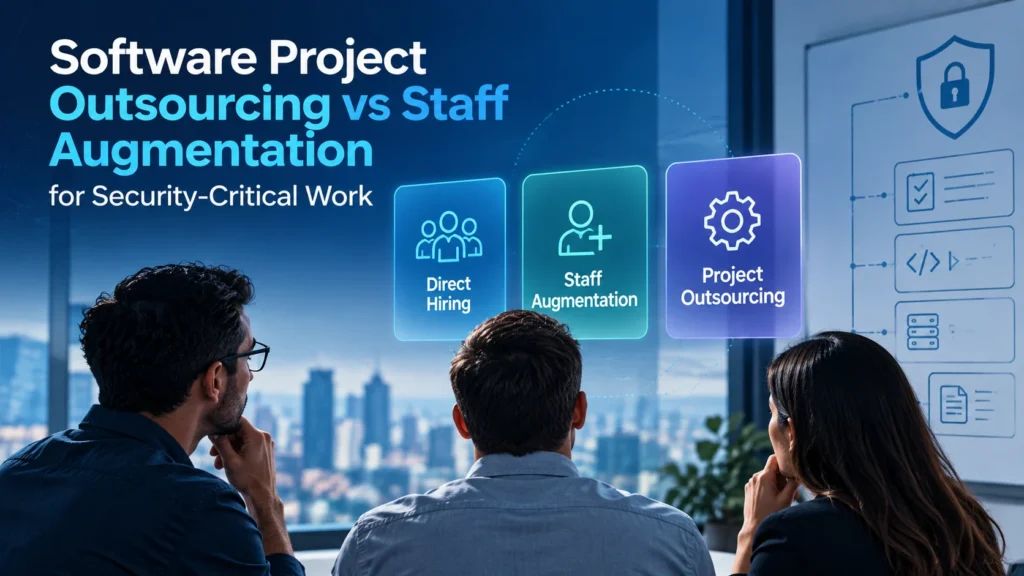
Software Project Outsourcing vs Staff Augmentation for Security-Critical Work

Software Project Outsourcing vs Staff Augmentation for Security-Critical Work

Technology leaders comparing direct hiring, staff augmentation, and project outsourcing for security-critical software work.
Choosing the right software delivery model requires more than comparing cost and speed. This guide helps technology leaders evaluate direct hiring, staff augmentation, and project outsourcing based on ownership, management capacity, security requirements, acceptance criteria, and long-term handoff.
Share the Post:

When a security-sensitive software initiative falls behind, the instinct is often to add capacity as quickly as possible.

Hire a permanent engineer. Add contractors. Bring in an augmented team. Outsource the project to a delivery partner.

Any of these approaches can work. The problem is choosing a delivery model based only on urgency.

For technology leaders comparing software project outsourcing vs staff augmentation, the better question is not simply which model can provide engineers faster. It is which model creates the right balance of ownership, management responsibility, security evidence, and long-term accountability for the work being delivered.

A permanent hire cannot replace a defined delivery plan. Additional staff augmentation cannot compensate for missing decision rights or an unmanaged backlog. And a project outsourcing partner cannot effectively own delivery if product strategy changes daily and no internal stakeholder has authority to make decisions.

Security-critical work adds another layer. Acceptance must address not only whether the application functions, but also how it was tested, what security evidence exists, how it will be deployed and supported, and who will own the system after handoff.

NIST’s software supply chain security guidance reinforces the importance of defining expectations and obtaining appropriate evidence when organizations acquire and use third-party software and services.

Before selecting a delivery model, leaders should first define the operating model around the work.

Four Questions to Ask Before Choosing a Software Delivery Model

Cost, speed, and access to talent matter, but they should not be the only criteria.

Before choosing between direct hiring, staff augmentation, or project outsourcing, answer four questions.

1. Is the Outcome Clearly Defined?

Start by identifying what the initiative must actually deliver.

Define:

  • The product or workstream in scope
  • Critical business journeys
  • Systems and integrations involved
  • Technical and business constraints
  • Acceptance criteria
  • Explicit exclusions
  • Expected security and testing evidence

The more clearly the outcome can be defined, the easier it becomes to assign delivery responsibility to an external project team.

If the organization cannot yet describe what success looks like, selecting a large delivery model may be premature. A discovery phase may be necessary first.

2. Who Should Own the Capability After Delivery?

The delivery model should reflect the long-term ownership strategy.

Some initiatives produce capabilities that should remain inside the organization for years.

Examples include:

  • Application architecture
  • Platform engineering standards
  • QA strategy
  • Secure development practices
  • Core product knowledge
  • Long-term DevOps ownership

When the organization needs that knowledge and authority to accumulate internally, direct hiring deserves serious consideration.

By contrast, a bounded modernization project or defined testing initiative may not require permanent internal ownership of every delivery activity.

3. Can the Internal Team Manage Daily Delivery?

Staff augmentation assumes the client already has a functioning delivery system.

That normally means someone internally can provide:

  • Product or technical leadership
  • Backlog ownership
  • Prioritization
  • Engineering standards
  • Tooling and environment access
  • Code review
  • Timely decisions
  • Release approval

An augmented engineer can add expertise and capacity, but they cannot independently solve a management problem they do not control.

If no one inside the organization can prioritize the work, answer technical questions, remove blockers, or approve releases, additional capacity alone may not solve the underlying issue.

4. What Evidence Is Required to Accept the Work?

Acceptance criteria should be defined before delivery accelerates.

For security-critical software, leaders should think beyond feature completion and identify the evidence required to approve the work.

That may include:

  • Requirements traceability
  • Tests for priority business journeys
  • Automated test results
  • Security findings and remediation status
  • Known defects and accepted risks
  • Release-readiness evidence
  • Deployment procedures
  • Rollback instructions
  • Monitoring and incident responsibilities
  • Documentation and knowledge transfer

This distinction matters because delivery responsibility and acceptance responsibility are not the same thing.

A vendor or delivery team may execute the work, but the client still needs a clearly identified owner who can accept, defer, or time-box exceptions.

When Direct Hiring Is the Right Choice

Direct hiring is strongest when the work creates an enduring internal responsibility.

If a capability needs to remain strategically important after the immediate project ends, building permanent internal ownership may be the better choice.

Examples include:

  • A long-running application portfolio
  • Quality engineering architecture
  • Platform engineering
  • Secure software development practices
  • Core product engineering
  • Long-term infrastructure ownership

The goal is not simply to recruit a talented engineer.

The organization also needs to provide that person with:

  • A stable manager
  • Clear authority
  • Access to systems and decision-makers
  • A credible roadmap
  • Long-term responsibilities
  • Opportunities to influence engineering practices

The value of direct hiring comes from allowing technical knowledge and decision-making capability to compound inside the organization over time.

TechAID’s direct hiring model can support organizations that want to build this long-term ownership with experienced LATAM engineering talent.

When Direct Hiring May Not Solve the Immediate Problem

Direct hiring can be less effective when the immediate challenge is a bounded initiative that needs a defined delivery outcome.

Examples include:

  • A migration with a fixed target
  • A test automation foundation
  • A performance testing program
  • A defined application launch
  • Recovery of a stalled software initiative

A permanent hire may still be part of the long-term solution.

But waiting for a single new employee to make an entire project deliverable can create delays without solving scope, management, or acceptance problems.

When Staff Augmentation Is the Right Choice

Staff augmentation works best when the client already has an effective delivery system but needs additional technical capacity or specialized expertise.

The client retains day-to-day technical direction, while embedded engineers contribute within the company’s existing processes, tools, and engineering standards.

Typical roles may include:

  • Software developers
  • QA automation engineers
  • DevOps specialists
  • Cloud engineers
  • Security-minded engineers
  • Specialized technical pods

This model works particularly well when priorities are expected to change frequently or when the organization wants to maintain close control over architecture, product decisions, and technical trade-offs.

Staff Augmentation Requires Strong Internal Ownership

Staff augmentation is not a substitute for engineering management.

The client still needs someone who can:

  • Maintain the backlog
  • Define priorities
  • Review technical decisions
  • Approve architecture changes
  • Provide system access
  • Resolve blockers
  • Review code
  • Approve releases

Without these capabilities, augmented professionals may spend too much time waiting for decisions or attempting to compensate for responsibilities that belong inside the client organization.

For teams deciding between embedded capacity and a managed outcome, understanding the difference between staff augmentation vs outsourcing is essential because the two models assign delivery responsibility very differently.

Measure Outcomes, Not Headcount

The value of staff augmentation should not be measured by the number of additional engineers added to a project.

More meaningful measures include:

  • Priority journeys covered
  • Backlog throughput
  • Defect escape trends
  • Pipeline reliability
  • Time required to provision secure environments
  • Completion of agreed technical work
  • Reduction of specific engineering bottlenecks

“More hands” is not an outcome.

The organization should also define access boundaries, code-review expectations, escalation paths, and knowledge-transfer requirements before augmented engineers begin working within security-sensitive systems.

Staff augmentation is usually strongest when the client wants to retain control of execution but needs additional capacity to move faster.

It becomes a weaker fit when no one internally can prioritize the work, answer questions, or make timely release decisions.

When Project Outsourcing Is the Right Choice

Project outsourcing is strongest when the organization can define the outcome but does not want to manage every part of day-to-day delivery internally.

Instead of adding individual contributors to an existing team, the client engages a delivery partner to manage execution against an agreed scope, timeline, and acceptance framework.

Examples may include:

  • A test automation foundation
  • A performance testing program
  • An application modernization workstream
  • A release-readiness assessment
  • Recovery of a stalled software initiative
  • A defined software build
  • A DevOps or deployment improvement initiative

In this model, the client should still retain ownership of product strategy, business requirements, major technical decisions, and final acceptance.

The delivery partner takes greater responsibility for coordinating the work required to reach the agreed outcome.

For organizations with a clearly defined initiative, project outsourcing can provide a managed delivery structure across areas such as software development, QA, test automation, DevOps, performance testing, and related engineering work.

Do Not Outsource Ambiguity

Project outsourcing works best when the outcome is sufficiently clear.

If requirements change every day, no internal stakeholder owns the product, or important decisions cannot be made quickly, outsourcing the project does not remove that uncertainty.

It simply transfers the uncertainty into the delivery relationship.

When scope is still unclear, a discovery phase may be the better first step.

When priorities are expected to change continuously and the client wants to maintain daily technical control, staff augmentation may be the stronger model until the work becomes defined enough to manage as a project.

What Should a Software Outsourcing Statement of Work Include?

A strong Statement of Work, or SOW, should describe more than features and deadlines.

For security-critical or operationally important software, it should establish how success will be demonstrated and how responsibility will transfer after delivery.

A useful SOW should define:

  • Scope and deliverables
  • Explicit exclusions
  • Architecture assumptions
  • Data and integration assumptions
  • Critical business journeys
  • Delivery milestones
  • Measurable acceptance criteria
  • Required testing evidence
  • Security evidence appropriate to the risk
  • Change-control process
  • Client decision rights
  • Access responsibilities
  • Deployment expectations
  • Rollback or fail-forward procedures
  • Documentation requirements
  • Knowledge-transfer expectations
  • Hypercare or post-launch support
  • Final handoff responsibilities

These details are especially important because the delivery partner and the client do not own the same decisions.

The partner may manage execution, but the client still needs to approve changes that affect product strategy, risk, budget, architecture, or final acceptance.

Make Acceptance Criteria Measurable

Acceptance language should avoid vague statements such as:

  • “System works as expected”
  • “Application is secure”
  • “Testing is complete”
  • “Documentation has been provided”

Instead, criteria should point to evidence.

For example:

  • Critical user journeys complete without Severity 1 defects
  • Automated regression tests run successfully in the agreed environment
  • Open security findings are documented with severity, owner, and mitigation
  • Deployment and rollback procedures have been rehearsed
  • The receiving team can execute the release process using the delivered documentation

The objective is to reduce interpretation at the end of the project.

Security and Acceptance Are Shared Responsibilities

No delivery model automatically makes software secure or compliant.

Direct hiring, staff augmentation, and project outsourcing simply distribute responsibilities differently.

Security-critical work still requires both sides to define:

  • What controls apply
  • What evidence is required
  • Who reviews that evidence
  • Who owns remediation
  • Who can accept residual risk
  • What happens after handoff

The OWASP Software Component Verification Standard provides a useful framework for thinking about supplier and software assurance, including the need to scale assurance to the risk of the system rather than treating every software delivery the same way.

The important point is that security evidence should support a decision. It should not become a collection of reports that no one owns.

An SBOM Is Evidence, Not Final Approval

A Software Bill of Materials can improve visibility into software components and dependencies.

But an SBOM does not prove that:

  • All vulnerabilities are remediated
  • The application is configured securely
  • Every dependency is trustworthy
  • Production controls are sufficient
  • The software is ready for release

It should be evaluated alongside testing, security findings, deployment controls, configuration, and explicit risk acceptance.

This applies regardless of whether the work is completed by employees, augmented engineers, or an outsourced delivery team.

Create a Shared Acceptance Packet

Every delivery model benefits from a common acceptance packet.

The packet gives technical and business stakeholders a consistent set of evidence for deciding whether the work is ready to move forward.

It should include:

Business and Technical Requirements

  • Critical business journeys
  • Technical requirements
  • Scope and exclusions
  • Acceptance criteria

Quality Evidence

  • Priority journey test results
  • Automated test evidence
  • Known testing limitations
  • Defect register
  • Accepted quality risks

Security Evidence

Depending on the system, this may include:

  • Dependency information
  • Relevant scan results
  • Open security findings
  • Severity ratings
  • Remediation owners
  • Accepted exceptions

Operational Readiness

Document:

  • Deployment procedures
  • Rollback or fail-forward strategy
  • Monitoring responsibilities
  • Incident escalation
  • Support ownership
  • Recovery expectations

Documentation and Handoff

Include:

  • Architecture documentation
  • Repository ownership
  • Environment access
  • Operational runbooks
  • Knowledge-transfer plan
  • Post-launch support expectations

Finally, identify a named client owner who has authority to:

  • Accept the work
  • Accept with conditions
  • Defer acceptance
  • Time-box an exception

This prevents the final decision from becoming an informal agreement between people who may not actually own the risk.

Need a managed team for a clearly defined software outcome?
TechAID supports project-based delivery across software development, QA, test automation, DevOps, and related engineering work. Explore Project Outsourcing.

A 90-Day Decision Sequence

Choosing a delivery model should not be treated as a one-time procurement decision.

A simple 90-day sequence can help leadership move from uncertainty to a governed delivery structure.

Days 1–15: Define the Outcome

Clarify:

  • Business objective
  • Scope
  • Critical dependencies
  • Risk level
  • Internal owner
  • Expected acceptance evidence

If these remain unclear, produce a discovery artifact before scaling the engagement.

Days 16–30: Choose the Delivery Model

Evaluate:

  • How long the capability must remain internal
  • Whether the client can manage daily delivery
  • Whether the outcome is defined enough to outsource
  • What decisions must remain with the client

Write the acceptance criteria before the project accelerates.

Days 31–60: Establish the Delivery System

Put in place:

  • Delivery cadence
  • Access controls
  • Test strategy
  • Security evidence requirements
  • Risk register
  • Decision and escalation paths
  • Reporting expectations

This is where the model becomes operational rather than contractual.

Days 61–90: Rehearse Release and Handoff

Before considering the initiative complete:

  • Validate priority business journeys
  • Review open risks and exceptions
  • Rehearse deployment
  • Confirm rollback or recovery procedures
  • Test the documentation
  • Complete knowledge transfer
  • Confirm who owns the capability after handoff

By the end of this period, leadership should have a clear view of whether the chosen model is producing the right combination of delivery speed, evidence, and long-term ownership.

How to Choose Between Direct Hiring, Staff Augmentation, and Project Outsourcing

The three delivery models solve different problems.

The right choice depends less on which model appears fastest or least expensive and more on where the organization wants ownership, management responsibility, and delivery accountability to sit.

Choose Direct Hiring When Long-Term Ownership Matters Most

Direct hiring is usually the strongest option when the organization needs to build a capability that will remain strategically important over time.

Consider direct hiring when:

  • The responsibility will exist long after the current initiative ends
  • Institutional knowledge should remain inside the company
  • The role needs authority over architecture, quality, platform, or engineering standards
  • The organization can provide management, career development, and a long-term roadmap
  • The capability is part of the company’s core technology strategy

The organization accepts more recruiting and management responsibility in exchange for lasting internal ownership.

Choose Staff Augmentation When You Have the Management System but Need Capacity

Staff augmentation fits organizations that already know how the work should be managed but need additional engineering capacity or specialized skills.

Consider staff augmentation when:

  • An internal product or engineering leader already owns delivery
  • Priorities are likely to change frequently
  • The client wants close control over architecture and technical decisions
  • Existing teams need additional developers, QA, DevOps, or specialized expertise
  • Engineers can integrate into established tools, processes, and delivery rhythms

The client retains daily management responsibility while augmented professionals extend the existing team’s capabilities.

Choose Project Outsourcing When the Outcome Can Be Defined

Project outsourcing becomes stronger when the organization can describe the result it needs and wants a partner to manage day-to-day execution.

Consider project outsourcing when:

  • The initiative has a defined business or technical outcome
  • Scope and exclusions can be documented
  • Acceptance criteria can be established
  • Delivery milestones can be measured
  • The client can provide timely decisions and approvals
  • Security, testing, deployment, and handoff evidence can be agreed in advance

The partner manages execution, while the client retains responsibility for strategy, major decisions, risk acceptance, and final approval.

Software Project Outsourcing vs Staff Augmentation: The Core Difference

The distinction between software project outsourcing vs staff augmentation ultimately comes down to who manages delivery.

With staff augmentation, the client is expanding an existing delivery system.

With project outsourcing, the client is engaging a partner to manage execution toward a defined outcome.

That difference affects:

  • Daily management
  • Backlog ownership
  • Technical coordination
  • Delivery accountability
  • Acceptance criteria
  • Risk management
  • Handoff expectations

Neither model removes the client’s responsibility for business decisions or risk acceptance.

The question is where day-to-day delivery ownership should sit.

For security-critical work, that distinction becomes particularly important because unclear ownership can lead to gaps in testing, remediation, release decisions, and operational handoff.

Common Delivery Model Mistakes to Avoid

Choosing the right model also means recognizing situations where the engagement structure and the underlying problem do not match.

Hiring Before Defining the Problem

A permanent engineer can become a valuable long-term owner, but hiring someone does not automatically create project scope, acceptance criteria, or delivery governance.

Define the problem before assuming a new employee is the entire solution.

Using Staff Augmentation to Fix Missing Management

Additional engineers cannot compensate for the absence of priorities, decision-makers, technical leadership, or release ownership.

If the delivery system itself is weak, adding capacity may increase coordination problems rather than solve them.

Outsourcing an Undefined Outcome

A managed delivery partner still needs boundaries.

If requirements shift continuously and nobody can make final product decisions, project outsourcing can become an expensive way to manage ambiguity.

Discovery should come before execution when the outcome is not yet sufficiently defined.

Treating Security as the Vendor’s Problem

Security responsibilities cannot simply be transferred through a contract.

Clients still need to define expectations, review evidence, assign remediation ownership, and decide which residual risks are acceptable.

The delivery model changes who executes the work. It does not eliminate governance.

Where TechAID Fits

TechAID’s three delivery models are designed for different ownership structures rather than as interchangeable ways to add engineers.

Direct Hiring supports companies that want experienced LATAM technology professionals to become long-term members of their organization and build internal knowledge over time.

Staff Augmentation supports teams that already own delivery but need additional engineering capacity or specialized expertise integrated into their existing processes.

Project Outsourcing supports defined initiatives where the client wants a partner to manage day-to-day execution against an agreed outcome, acceptance criteria, and handoff plan.

The best model depends on what the organization already has and what responsibility it wants to retain.

A company with strong engineering leadership but insufficient capacity may need staff augmentation.

A company building a permanent platform capability may need direct hiring.

A company with a clearly defined modernization, testing, DevOps, or software delivery objective may be better suited to project outsourcing.

In some cases, the answer can also change over time.

An organization might begin with project outsourcing to deliver a defined initiative, use staff augmentation during a transition period, and eventually hire permanent internal owners.

The models can complement each other when responsibilities are deliberately defined.

Executive Decision Framework

Before selecting a model, take one active software initiative and evaluate it against four questions.

1. Is the Outcome Defined?

Can the organization clearly explain what must be delivered, what is excluded, and what success looks like?

If not, begin with discovery.

2. Who Should Own the Capability Long Term?

If the capability should remain inside the organization and accumulate knowledge over years, consider direct hiring.

3. Can the Internal Organization Manage Daily Delivery?

If the answer is yes but capacity is constrained, staff augmentation may fit.

If the answer is no and the outcome is sufficiently defined, a managed project structure may be more appropriate.

4. What Evidence Is Required for Acceptance?

Define the testing, security, operational, documentation, and handoff evidence required before work begins.

These four questions provide a stronger basis for choosing a software delivery model than comparing hourly rates or headcount alone.

Final Thoughts: Choose the Ownership Model Before the Staffing Model

The decision between software project outsourcing vs staff augmentation should begin with ownership, not staffing.

Ask who should manage the work today, who should own the capability tomorrow, and what evidence the organization needs before accepting the result.

Direct hiring works best when long-term internal ownership is the objective.

Staff augmentation works best when the organization already has a strong delivery system and needs additional capacity or expertise.

Project outsourcing works best when the outcome can be defined and a delivery partner should manage execution toward measurable acceptance criteria.

For security-critical software, whichever model you choose should also establish clear expectations for testing, security evidence, deployment, risk acceptance, documentation, and handoff.

A delivery model is only effective when the responsibilities around it are equally clear.

Evaluating which delivery model fits your next software initiative? Talk with TechAID about your engineering needs.

Key Takeaways
  • Choose a delivery model based on ownership, management capacity, and acceptance evidence, not urgency alone.

  • Staff augmentation extends a client-led delivery system, while project outsourcing transfers more day-to-day execution responsibility to the partner.

  • Security-critical work still requires clear testing, risk ownership, deployment, and handoff expectations regardless of the delivery model.

  • When a security-sensitive software initiative falls behind, the instinct is often to add capacity as quickly as possible.

    Hire a permanent engineer. Add contractors. Bring in an augmented team. Outsource the project to a delivery partner.

    Any of these approaches can work. The problem is choosing a delivery model based only on urgency.

    For technology leaders comparing software project outsourcing vs staff augmentation, the better question is not simply which model can provide engineers faster. It is which model creates the right balance of ownership, management responsibility, security evidence, and long-term accountability for the work being delivered.

    A permanent hire cannot replace a defined delivery plan. Additional staff augmentation cannot compensate for missing decision rights or an unmanaged backlog. And a project outsourcing partner cannot effectively own delivery if product strategy changes daily and no internal stakeholder has authority to make decisions.

    Security-critical work adds another layer. Acceptance must address not only whether the application functions, but also how it was tested, what security evidence exists, how it will be deployed and supported, and who will own the system after handoff.

    NIST’s software supply chain security guidance reinforces the importance of defining expectations and obtaining appropriate evidence when organizations acquire and use third-party software and services.

    Before selecting a delivery model, leaders should first define the operating model around the work.

    Four Questions to Ask Before Choosing a Software Delivery Model

    Cost, speed, and access to talent matter, but they should not be the only criteria.

    Before choosing between direct hiring, staff augmentation, or project outsourcing, answer four questions.

    1. Is the Outcome Clearly Defined?

    Start by identifying what the initiative must actually deliver.

    Define:

    • The product or workstream in scope
    • Critical business journeys
    • Systems and integrations involved
    • Technical and business constraints
    • Acceptance criteria
    • Explicit exclusions
    • Expected security and testing evidence

    The more clearly the outcome can be defined, the easier it becomes to assign delivery responsibility to an external project team.

    If the organization cannot yet describe what success looks like, selecting a large delivery model may be premature. A discovery phase may be necessary first.

    2. Who Should Own the Capability After Delivery?

    The delivery model should reflect the long-term ownership strategy.

    Some initiatives produce capabilities that should remain inside the organization for years.

    Examples include:

    • Application architecture
    • Platform engineering standards
    • QA strategy
    • Secure development practices
    • Core product knowledge
    • Long-term DevOps ownership

    When the organization needs that knowledge and authority to accumulate internally, direct hiring deserves serious consideration.

    By contrast, a bounded modernization project or defined testing initiative may not require permanent internal ownership of every delivery activity.

    3. Can the Internal Team Manage Daily Delivery?

    Staff augmentation assumes the client already has a functioning delivery system.

    That normally means someone internally can provide:

    • Product or technical leadership
    • Backlog ownership
    • Prioritization
    • Engineering standards
    • Tooling and environment access
    • Code review
    • Timely decisions
    • Release approval

    An augmented engineer can add expertise and capacity, but they cannot independently solve a management problem they do not control.

    If no one inside the organization can prioritize the work, answer technical questions, remove blockers, or approve releases, additional capacity alone may not solve the underlying issue.

    4. What Evidence Is Required to Accept the Work?

    Acceptance criteria should be defined before delivery accelerates.

    For security-critical software, leaders should think beyond feature completion and identify the evidence required to approve the work.

    That may include:

    • Requirements traceability
    • Tests for priority business journeys
    • Automated test results
    • Security findings and remediation status
    • Known defects and accepted risks
    • Release-readiness evidence
    • Deployment procedures
    • Rollback instructions
    • Monitoring and incident responsibilities
    • Documentation and knowledge transfer

    This distinction matters because delivery responsibility and acceptance responsibility are not the same thing.

    A vendor or delivery team may execute the work, but the client still needs a clearly identified owner who can accept, defer, or time-box exceptions.

    When Direct Hiring Is the Right Choice

    Direct hiring is strongest when the work creates an enduring internal responsibility.

    If a capability needs to remain strategically important after the immediate project ends, building permanent internal ownership may be the better choice.

    Examples include:

    • A long-running application portfolio
    • Quality engineering architecture
    • Platform engineering
    • Secure software development practices
    • Core product engineering
    • Long-term infrastructure ownership

    The goal is not simply to recruit a talented engineer.

    The organization also needs to provide that person with:

    • A stable manager
    • Clear authority
    • Access to systems and decision-makers
    • A credible roadmap
    • Long-term responsibilities
    • Opportunities to influence engineering practices

    The value of direct hiring comes from allowing technical knowledge and decision-making capability to compound inside the organization over time.

    TechAID’s direct hiring model can support organizations that want to build this long-term ownership with experienced LATAM engineering talent.

    When Direct Hiring May Not Solve the Immediate Problem

    Direct hiring can be less effective when the immediate challenge is a bounded initiative that needs a defined delivery outcome.

    Examples include:

    • A migration with a fixed target
    • A test automation foundation
    • A performance testing program
    • A defined application launch
    • Recovery of a stalled software initiative

    A permanent hire may still be part of the long-term solution.

    But waiting for a single new employee to make an entire project deliverable can create delays without solving scope, management, or acceptance problems.

    When Staff Augmentation Is the Right Choice

    Staff augmentation works best when the client already has an effective delivery system but needs additional technical capacity or specialized expertise.

    The client retains day-to-day technical direction, while embedded engineers contribute within the company’s existing processes, tools, and engineering standards.

    Typical roles may include:

    • Software developers
    • QA automation engineers
    • DevOps specialists
    • Cloud engineers
    • Security-minded engineers
    • Specialized technical pods

    This model works particularly well when priorities are expected to change frequently or when the organization wants to maintain close control over architecture, product decisions, and technical trade-offs.

    Staff Augmentation Requires Strong Internal Ownership

    Staff augmentation is not a substitute for engineering management.

    The client still needs someone who can:

    • Maintain the backlog
    • Define priorities
    • Review technical decisions
    • Approve architecture changes
    • Provide system access
    • Resolve blockers
    • Review code
    • Approve releases

    Without these capabilities, augmented professionals may spend too much time waiting for decisions or attempting to compensate for responsibilities that belong inside the client organization.

    For teams deciding between embedded capacity and a managed outcome, understanding the difference between staff augmentation vs outsourcing is essential because the two models assign delivery responsibility very differently.

    Measure Outcomes, Not Headcount

    The value of staff augmentation should not be measured by the number of additional engineers added to a project.

    More meaningful measures include:

    • Priority journeys covered
    • Backlog throughput
    • Defect escape trends
    • Pipeline reliability
    • Time required to provision secure environments
    • Completion of agreed technical work
    • Reduction of specific engineering bottlenecks

    “More hands” is not an outcome.

    The organization should also define access boundaries, code-review expectations, escalation paths, and knowledge-transfer requirements before augmented engineers begin working within security-sensitive systems.

    Staff augmentation is usually strongest when the client wants to retain control of execution but needs additional capacity to move faster.

    It becomes a weaker fit when no one internally can prioritize the work, answer questions, or make timely release decisions.

    When Project Outsourcing Is the Right Choice

    Project outsourcing is strongest when the organization can define the outcome but does not want to manage every part of day-to-day delivery internally.

    Instead of adding individual contributors to an existing team, the client engages a delivery partner to manage execution against an agreed scope, timeline, and acceptance framework.

    Examples may include:

    • A test automation foundation
    • A performance testing program
    • An application modernization workstream
    • A release-readiness assessment
    • Recovery of a stalled software initiative
    • A defined software build
    • A DevOps or deployment improvement initiative

    In this model, the client should still retain ownership of product strategy, business requirements, major technical decisions, and final acceptance.

    The delivery partner takes greater responsibility for coordinating the work required to reach the agreed outcome.

    For organizations with a clearly defined initiative, project outsourcing can provide a managed delivery structure across areas such as software development, QA, test automation, DevOps, performance testing, and related engineering work.

    Do Not Outsource Ambiguity

    Project outsourcing works best when the outcome is sufficiently clear.

    If requirements change every day, no internal stakeholder owns the product, or important decisions cannot be made quickly, outsourcing the project does not remove that uncertainty.

    It simply transfers the uncertainty into the delivery relationship.

    When scope is still unclear, a discovery phase may be the better first step.

    When priorities are expected to change continuously and the client wants to maintain daily technical control, staff augmentation may be the stronger model until the work becomes defined enough to manage as a project.

    What Should a Software Outsourcing Statement of Work Include?

    A strong Statement of Work, or SOW, should describe more than features and deadlines.

    For security-critical or operationally important software, it should establish how success will be demonstrated and how responsibility will transfer after delivery.

    A useful SOW should define:

    • Scope and deliverables
    • Explicit exclusions
    • Architecture assumptions
    • Data and integration assumptions
    • Critical business journeys
    • Delivery milestones
    • Measurable acceptance criteria
    • Required testing evidence
    • Security evidence appropriate to the risk
    • Change-control process
    • Client decision rights
    • Access responsibilities
    • Deployment expectations
    • Rollback or fail-forward procedures
    • Documentation requirements
    • Knowledge-transfer expectations
    • Hypercare or post-launch support
    • Final handoff responsibilities

    These details are especially important because the delivery partner and the client do not own the same decisions.

    The partner may manage execution, but the client still needs to approve changes that affect product strategy, risk, budget, architecture, or final acceptance.

    Make Acceptance Criteria Measurable

    Acceptance language should avoid vague statements such as:

    • “System works as expected”
    • “Application is secure”
    • “Testing is complete”
    • “Documentation has been provided”

    Instead, criteria should point to evidence.

    For example:

    • Critical user journeys complete without Severity 1 defects
    • Automated regression tests run successfully in the agreed environment
    • Open security findings are documented with severity, owner, and mitigation
    • Deployment and rollback procedures have been rehearsed
    • The receiving team can execute the release process using the delivered documentation

    The objective is to reduce interpretation at the end of the project.

    Security and Acceptance Are Shared Responsibilities

    No delivery model automatically makes software secure or compliant.

    Direct hiring, staff augmentation, and project outsourcing simply distribute responsibilities differently.

    Security-critical work still requires both sides to define:

    • What controls apply
    • What evidence is required
    • Who reviews that evidence
    • Who owns remediation
    • Who can accept residual risk
    • What happens after handoff

    The OWASP Software Component Verification Standard provides a useful framework for thinking about supplier and software assurance, including the need to scale assurance to the risk of the system rather than treating every software delivery the same way.

    The important point is that security evidence should support a decision. It should not become a collection of reports that no one owns.

    An SBOM Is Evidence, Not Final Approval

    A Software Bill of Materials can improve visibility into software components and dependencies.

    But an SBOM does not prove that:

    • All vulnerabilities are remediated
    • The application is configured securely
    • Every dependency is trustworthy
    • Production controls are sufficient
    • The software is ready for release

    It should be evaluated alongside testing, security findings, deployment controls, configuration, and explicit risk acceptance.

    This applies regardless of whether the work is completed by employees, augmented engineers, or an outsourced delivery team.

    Create a Shared Acceptance Packet

    Every delivery model benefits from a common acceptance packet.

    The packet gives technical and business stakeholders a consistent set of evidence for deciding whether the work is ready to move forward.

    It should include:

    Business and Technical Requirements

    • Critical business journeys
    • Technical requirements
    • Scope and exclusions
    • Acceptance criteria

    Quality Evidence

    • Priority journey test results
    • Automated test evidence
    • Known testing limitations
    • Defect register
    • Accepted quality risks

    Security Evidence

    Depending on the system, this may include:

    • Dependency information
    • Relevant scan results
    • Open security findings
    • Severity ratings
    • Remediation owners
    • Accepted exceptions

    Operational Readiness

    Document:

    • Deployment procedures
    • Rollback or fail-forward strategy
    • Monitoring responsibilities
    • Incident escalation
    • Support ownership
    • Recovery expectations

    Documentation and Handoff

    Include:

    • Architecture documentation
    • Repository ownership
    • Environment access
    • Operational runbooks
    • Knowledge-transfer plan
    • Post-launch support expectations

    Finally, identify a named client owner who has authority to:

    • Accept the work
    • Accept with conditions
    • Defer acceptance
    • Time-box an exception

    This prevents the final decision from becoming an informal agreement between people who may not actually own the risk.

    Need a managed team for a clearly defined software outcome?
    TechAID supports project-based delivery across software development, QA, test automation, DevOps, and related engineering work. Explore Project Outsourcing.

    A 90-Day Decision Sequence

    Choosing a delivery model should not be treated as a one-time procurement decision.

    A simple 90-day sequence can help leadership move from uncertainty to a governed delivery structure.

    Days 1–15: Define the Outcome

    Clarify:

    • Business objective
    • Scope
    • Critical dependencies
    • Risk level
    • Internal owner
    • Expected acceptance evidence

    If these remain unclear, produce a discovery artifact before scaling the engagement.

    Days 16–30: Choose the Delivery Model

    Evaluate:

    • How long the capability must remain internal
    • Whether the client can manage daily delivery
    • Whether the outcome is defined enough to outsource
    • What decisions must remain with the client

    Write the acceptance criteria before the project accelerates.

    Days 31–60: Establish the Delivery System

    Put in place:

    • Delivery cadence
    • Access controls
    • Test strategy
    • Security evidence requirements
    • Risk register
    • Decision and escalation paths
    • Reporting expectations

    This is where the model becomes operational rather than contractual.

    Days 61–90: Rehearse Release and Handoff

    Before considering the initiative complete:

    • Validate priority business journeys
    • Review open risks and exceptions
    • Rehearse deployment
    • Confirm rollback or recovery procedures
    • Test the documentation
    • Complete knowledge transfer
    • Confirm who owns the capability after handoff

    By the end of this period, leadership should have a clear view of whether the chosen model is producing the right combination of delivery speed, evidence, and long-term ownership.

    How to Choose Between Direct Hiring, Staff Augmentation, and Project Outsourcing

    The three delivery models solve different problems.

    The right choice depends less on which model appears fastest or least expensive and more on where the organization wants ownership, management responsibility, and delivery accountability to sit.

    Choose Direct Hiring When Long-Term Ownership Matters Most

    Direct hiring is usually the strongest option when the organization needs to build a capability that will remain strategically important over time.

    Consider direct hiring when:

    • The responsibility will exist long after the current initiative ends
    • Institutional knowledge should remain inside the company
    • The role needs authority over architecture, quality, platform, or engineering standards
    • The organization can provide management, career development, and a long-term roadmap
    • The capability is part of the company’s core technology strategy

    The organization accepts more recruiting and management responsibility in exchange for lasting internal ownership.

    Choose Staff Augmentation When You Have the Management System but Need Capacity

    Staff augmentation fits organizations that already know how the work should be managed but need additional engineering capacity or specialized skills.

    Consider staff augmentation when:

    • An internal product or engineering leader already owns delivery
    • Priorities are likely to change frequently
    • The client wants close control over architecture and technical decisions
    • Existing teams need additional developers, QA, DevOps, or specialized expertise
    • Engineers can integrate into established tools, processes, and delivery rhythms

    The client retains daily management responsibility while augmented professionals extend the existing team’s capabilities.

    Choose Project Outsourcing When the Outcome Can Be Defined

    Project outsourcing becomes stronger when the organization can describe the result it needs and wants a partner to manage day-to-day execution.

    Consider project outsourcing when:

    • The initiative has a defined business or technical outcome
    • Scope and exclusions can be documented
    • Acceptance criteria can be established
    • Delivery milestones can be measured
    • The client can provide timely decisions and approvals
    • Security, testing, deployment, and handoff evidence can be agreed in advance

    The partner manages execution, while the client retains responsibility for strategy, major decisions, risk acceptance, and final approval.

    Software Project Outsourcing vs Staff Augmentation: The Core Difference

    The distinction between software project outsourcing vs staff augmentation ultimately comes down to who manages delivery.

    With staff augmentation, the client is expanding an existing delivery system.

    With project outsourcing, the client is engaging a partner to manage execution toward a defined outcome.

    That difference affects:

    • Daily management
    • Backlog ownership
    • Technical coordination
    • Delivery accountability
    • Acceptance criteria
    • Risk management
    • Handoff expectations

    Neither model removes the client’s responsibility for business decisions or risk acceptance.

    The question is where day-to-day delivery ownership should sit.

    For security-critical work, that distinction becomes particularly important because unclear ownership can lead to gaps in testing, remediation, release decisions, and operational handoff.

    Common Delivery Model Mistakes to Avoid

    Choosing the right model also means recognizing situations where the engagement structure and the underlying problem do not match.

    Hiring Before Defining the Problem

    A permanent engineer can become a valuable long-term owner, but hiring someone does not automatically create project scope, acceptance criteria, or delivery governance.

    Define the problem before assuming a new employee is the entire solution.

    Using Staff Augmentation to Fix Missing Management

    Additional engineers cannot compensate for the absence of priorities, decision-makers, technical leadership, or release ownership.

    If the delivery system itself is weak, adding capacity may increase coordination problems rather than solve them.

    Outsourcing an Undefined Outcome

    A managed delivery partner still needs boundaries.

    If requirements shift continuously and nobody can make final product decisions, project outsourcing can become an expensive way to manage ambiguity.

    Discovery should come before execution when the outcome is not yet sufficiently defined.

    Treating Security as the Vendor’s Problem

    Security responsibilities cannot simply be transferred through a contract.

    Clients still need to define expectations, review evidence, assign remediation ownership, and decide which residual risks are acceptable.

    The delivery model changes who executes the work. It does not eliminate governance.

    Where TechAID Fits

    TechAID’s three delivery models are designed for different ownership structures rather than as interchangeable ways to add engineers.

    Direct Hiring supports companies that want experienced LATAM technology professionals to become long-term members of their organization and build internal knowledge over time.

    Staff Augmentation supports teams that already own delivery but need additional engineering capacity or specialized expertise integrated into their existing processes.

    Project Outsourcing supports defined initiatives where the client wants a partner to manage day-to-day execution against an agreed outcome, acceptance criteria, and handoff plan.

    The best model depends on what the organization already has and what responsibility it wants to retain.

    A company with strong engineering leadership but insufficient capacity may need staff augmentation.

    A company building a permanent platform capability may need direct hiring.

    A company with a clearly defined modernization, testing, DevOps, or software delivery objective may be better suited to project outsourcing.

    In some cases, the answer can also change over time.

    An organization might begin with project outsourcing to deliver a defined initiative, use staff augmentation during a transition period, and eventually hire permanent internal owners.

    The models can complement each other when responsibilities are deliberately defined.

    Executive Decision Framework

    Before selecting a model, take one active software initiative and evaluate it against four questions.

    1. Is the Outcome Defined?

    Can the organization clearly explain what must be delivered, what is excluded, and what success looks like?

    If not, begin with discovery.

    2. Who Should Own the Capability Long Term?

    If the capability should remain inside the organization and accumulate knowledge over years, consider direct hiring.

    3. Can the Internal Organization Manage Daily Delivery?

    If the answer is yes but capacity is constrained, staff augmentation may fit.

    If the answer is no and the outcome is sufficiently defined, a managed project structure may be more appropriate.

    4. What Evidence Is Required for Acceptance?

    Define the testing, security, operational, documentation, and handoff evidence required before work begins.

    These four questions provide a stronger basis for choosing a software delivery model than comparing hourly rates or headcount alone.

    Final Thoughts: Choose the Ownership Model Before the Staffing Model

    The decision between software project outsourcing vs staff augmentation should begin with ownership, not staffing.

    Ask who should manage the work today, who should own the capability tomorrow, and what evidence the organization needs before accepting the result.

    Direct hiring works best when long-term internal ownership is the objective.

    Staff augmentation works best when the organization already has a strong delivery system and needs additional capacity or expertise.

    Project outsourcing works best when the outcome can be defined and a delivery partner should manage execution toward measurable acceptance criteria.

    For security-critical software, whichever model you choose should also establish clear expectations for testing, security evidence, deployment, risk acceptance, documentation, and handoff.

    A delivery model is only effective when the responsibilities around it are equally clear.

    Evaluating which delivery model fits your next software initiative? Talk with TechAID about your engineering needs.

    Related Posts